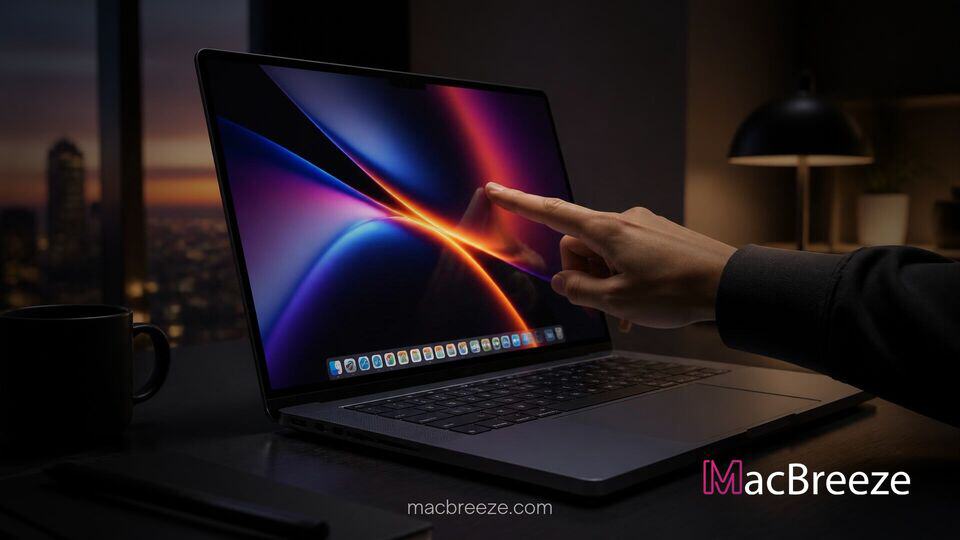
Apple is actively developing a flagship MacBook Ultra featuring a touchscreen and a tandem OLED display, with reports pointing toward an official launch in Fall 2026. The incoming hardware represents the biggest structural overhaul to the Mac portable line in years, marking the first time touch input will natively grace a macOS laptop screen.
Industry sources and supply chain leaks indicate that Apple plans to introduce this ultra-premium notebook alongside its existing professional tier rather than replacing current models outright. By expanding its catalog with a higher-tier designation, the company aims to showcase cutting-edge display technologies, revised chassis engineering, and refined user interaction paradigms without immediately displacing standard mini-LED machines.
Details of the Reported MacBook Ultra Design
The upcoming laptop, widely dubbed the MacBook Ultra, is expected to introduce a significantly thinner chassis compared to the current generation of MacBook Pro models. While Apple re-introduced vital physical ports during its 2021 industrial design overhaul, new manufacturing processes and display layers are allowing engineers to shrink overall thickness while preserving essential connectivity options.
Central to this design shift is a brand-new top housing engineered to support a touch-sensitive layer. Rather than converting the Mac into a detachable 2-in-1 hybrid, Apple is reportedly maintaining the traditional clamshell form factor. Users can expect standard keyboard and trackpad inputs to remain the primary control scheme, supplemented by touch gestures directly on the display for scrolling, tapping UI elements, and quick media controls.
Software discoveries in recent macOS developer previews reinforce these hardware leaks. Code references to liquid glass visual effects, pull-to-refresh gestures, and contextual touch targets suggest that Apple has quietly laid the operating system foundation for touch-based interactions. This subtle integration aligns with ongoing interface updates across the ecosystem, echoing developments seen when macOS UI elements hinted at upcoming OLED displays in previous beta builds.
OLED Display and First Mac Touchscreen
The defining highlight of the MacBook Ultra is its panel technology. Apple is transitioning from mini-LED backlighting to tandem OLED display assemblies in 14-inch and 16-inch sizes. Manufactured in collaboration with display partners like Samsung Display, these panels utilize two stacked light-emitting layers to deliver higher peak brightness, deeper contrast ratios, extended panel longevity, and reduced power consumption.
Integrating touch functionality into an OLED panel without adding bulk requires specialized touch-on-encapsulation techniques. By embedding the touch sensors directly onto the thin-film encapsulation layer of the OLED stack, Apple avoids extra glass layers, keeping reflections low and screen thickness to an absolute minimum. This technological step forward comes as competitors also revamp their mobile offerings, such as when LG launched the Gram Book AI to compete across light-and-thin laptop segments.
Dynamic Island Integration and Chipset Options
Along with touch capabilities, the MacBook Ultra display is set to replace the traditional camera display notch with an interactive Dynamic Island cutout. Similar to its implementation on recent flagship iPhones, this animated interface region will contextually expand to show background activities, media controls, timer countdowns, and system notifications directly within the macOS menu bar region.
Under the hood, supply chain reports suggest Apple will equip the first-generation MacBook Ultra with M5 Pro and M5 Max processor options. Because production shifts and accelerated development schedules have reportedly adjusted Apple's silicon pipeline, these proven chips will power the initial batch of Ultra hardware. Subsequent revisions are expected to adopt next-generation silicon, mirroring broad adjustments seen when Apple adjusted its broader hardware launch roadmap to prioritize high-end devices.
Positioning in the MacBook Lineup and Release Timeline
The introduction of the MacBook Ultra highlights a deliberate strategy to broaden the Mac pricing structure. According to market analysis from research firm Omdia, Apple intends to keep existing mini-LED display panels in active production through at least 2028. This means legacy professional laptops will remain on store shelves, preventing the entry-level professional price point from skyrocketing overnight.
By retaining current models, Apple can keep mini-LED models available alongside flagship OLED laptops, positioning the MacBook Ultra as a top-tier luxury choice. Industry observers project that while standard professional configurations will start around current price brackets, the flagship touchscreen MacBook Ultra could carry a substantial premium, with base configurations potentially starting near $2,999 USD.
Regarding release timing, mass production for the laptop display components is slated for mid-to-late 2026. Analysts project an official unveiling between October and November 2026, distinctly separated from Apple's annual September iPhone showcase. However, global supply dynamics and component availability, particularly surrounding specialized memory configurations and OLED yields, could influence final shipping dates.
Market Impact and What Comes Next
Adding direct touch capabilities to the Mac platform marks a major reversal of Apple's historical stance on laptop design. For over a decade, company executives publicly dismissed touchscreens on traditional notebooks, asserting that trackpads and keyboards provided superior ergonomics. The arrival of the MacBook Ultra reflects an evolving paradigm where direct touch complements traditional desktop workflows without forcing a full tablet transformation.
As fall 2026 approaches, industry partners and software developers are watching closely to see how macOS adapts to touch interaction. While power users can continue relying on existing input methods, the option to touch, swipe, and mark up content directly on a vibrant OLED screen signals a new chapter for Mac hardware. Meanwhile, users managing current hardware can still learn how to run Apple Diagnostics on MacBooks to keep their machines running smoothly as the next era of Apple silicon hardware takes shape.
In closing, the reported touchscreen MacBook Ultra represents a major shift in Apple's computing strategy. By combining high-efficiency tandem OLED panels, intuitive touch input, and premium industrial design, Apple is preparing to set a new benchmark for high-end laptops in Fall 2026.