Developer analysis of the latest macOS Golden Gate developer beta has uncovered subtle system rendering adjustments that suggest Apple is preparing its operating system for an upcoming MacBook Pro equipped with an OLED display. As testing progresses on Apple's next major operating system release, independent software engineers noticed distinct visual behavior tailored specifically for high-dynamic-range OLED panels.
These discoveries build upon months of supply chain rumors indicating that Apple intends to bring organic light-emitting diode technology to its premium laptop family. By tailoring interface elements to take advantage of self-emissive pixels and deeper black levels, the tech giant appears to be laying the software foundation well in advance of a hardware debut.
macOS Golden Gate OLED MacBook Pro Leaks and Software Signals
The newest developer beta for macOS Golden Gate contains refined interface rendering routines that behave differently when tested on display profiles matching OLED specifications. According to developer observations, the system's translucent visual layers dynamically adjust contrast and light propagation depending on panel architecture. This targeted optimization ensures that high-contrast user interface components do not suffer from unwanted blooming or clipping on ultra-high-brightness displays with true blacks.
Historically, Apple has introduced software framework tweaks in early macOS developer builds prior to revealing major display architecture shifts. Similar code-level changes appeared before the transition to Liquid Retina XDR Mini-LED panels on the M1 Pro and M1 Max MacBook Pro models. Industry analysts suggest these software accommodations indicate hardware testing is nearing maturity inside Apple's industrial design labs.
macOS Golden Gate Beta Reveals Enhanced Liquid Glass Interface
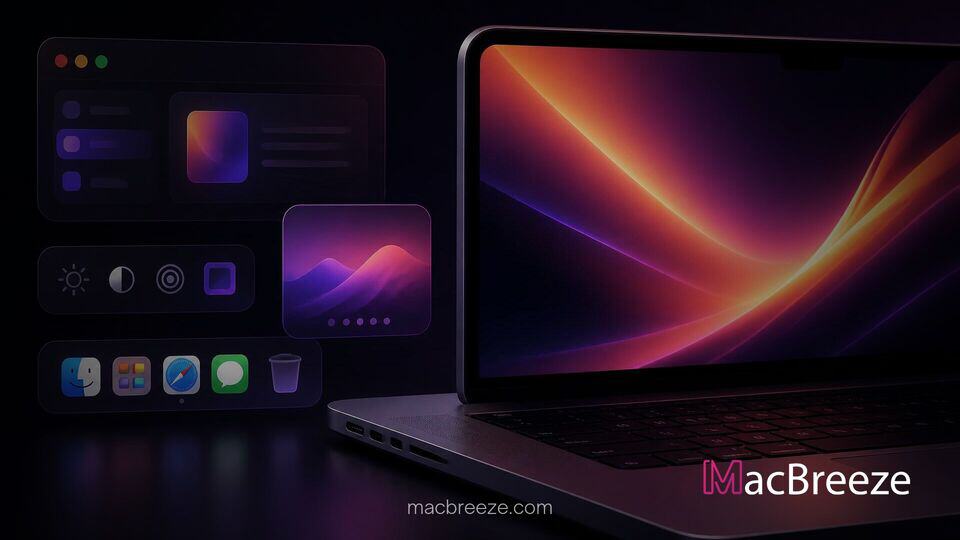
One of the focal points of the macOS Golden Gate update is its refined visual identity, featuring an evolved aesthetic known as the Liquid Glass interface. The design language uses real-time blur vectors, depth mapping, and specular highlights across finder windows, control centers, and system toolbars.
Application developers inspecting the beta noted that the underlying rendering pipeline handles dynamic specular reflections differently depending on whether the output display uses traditional backlighting or self-emissive pixel technology. When driven by OLED display parameters, these translucent elements gain a distinctly crisper appearance, preserving dark background detail without sacrificing ambient light glow.
Developer Finds Specialized Display Rendering for OLED HDR Screens
Software developer Steven Troughton-Smith pointed out that several core Liquid Glass interface assets in the macOS Golden Gate beta behave with heightened fidelity when rendered under specialized HDR profiles tailored for OLED hardware. On standard IPS and Mini-LED displays, translucent menu borders employ artificial shadow masks to maintain contrast. On OLED target profiles, however, the system relies on pixel-level contrast precision, drastically reducing backlight overhead.
This distinct rendering pipeline suggests that Apple is fine-tuning macOS to maximize energy efficiency while delivering superior color accuracy on future laptops. Because OLED displays draw significantly less power when displaying pure black, the operating system can aggressively optimize energy consumption across dark-mode user interfaces.
Expected Hardware Upgrades for the Rumored MacBook Ultra
Rumors regarding Apple's laptop strategy have pointed toward an even higher tier of performance laptop, occasionally referred to in supply chain reports as the touchscreen MacBook Ultra. While existing 14-inch and 16-inch MacBook Pro models utilize Mini-LED displays, an OLED upgrade would bring superior response times, individual pixel dimming, and significantly thinner panel assemblies.
Recent supply chain insights show that Apple has been working with panel suppliers to develop tandem OLED structures, which stack two light-emitting layers to boost peak brightness and extend panel lifespan. Industry analysts believe that the first wave of OLED laptops may debut alongside next-generation silicon, such as the base M6 MacBook Pro or higher-tier M5 Pro and M5 Max chips. The advanced display tech could also leverage an industry-first high-mobility oxide backplane to ensure high refresh rates with minimal power drain.
How macOS Golden Gate Lays Groundwork for Touchscreen OLED Macs
Beyond visual enhancements, developer discussions surrounding macOS Golden Gate focus on how the operating system handles touch input targets and adaptive gestures. While macOS has traditionally remained a pointer-driven operating system, subtle code adjustments inside the beta point to larger hit targets and touch-friendly context menus.
Inspecting system code reveals that Apple is gradually aligning window management behaviors across iPadOS and macOS. Analysts note that introducing an OLED display alongside potential touchscreen capabilities would create a clear distinction between standard consumer laptops and premium creative workstations, directly challenging competing flagship PC laptops.
Projected Release Timeline and What to Expect Next
Apple is expected to release macOS Golden Gate to the general public in the coming months, following its standard fall software update cycle. While the operating system update will immediately benefit current Apple Silicon hardware, the specialized OLED display routines will likely remain dormant or restricted to developer simulation tools until corresponding hardware is formally announced.
Supply chain timelines vary, with some reports suggesting an OLED MacBook Pro or MacBook Ultra could arrive in late 2026 or early 2027 depending on component yield rates. Additional hardware details are expected to surface as developer beta builds progress toward final candidate status, giving tech enthusiasts a clearer picture of Apple's upcoming hardware roadmap.
As software and hardware development continue to converge in Apple's ecosystem, the visual assets inside macOS Golden Gate provide a compelling preview of the display technologies driving the next generation of Mac computing.