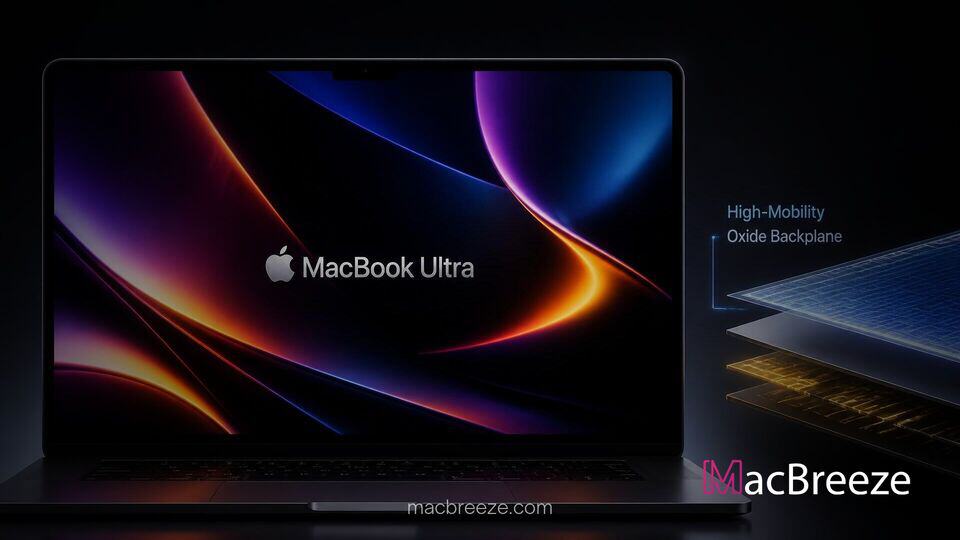
Apple is preparing to equip its long-rumored high-end laptop, dubbed the MacBook Ultra, with the display industry's first high-mobility oxide backplane OLED screen. The breakthrough panel architecture is expected to provide substantial improvements in peak brightness, energy efficiency, and dynamic refresh rates.
DSCC Report Reveals Advanced Display Tech for MacBook Ultra
According to insights shared by Display Supply Chain Consultants (DSCC) CEO Ross Young, Apple's flagship laptop will feature an advanced OLED panel equipped with a cutting-edge high-mobility oxide thin-film transistor (TFT) backplane. The backplane acts as the foundational electronics layer responsible for switching individual display pixels on and off. While standard oxide TFT panels are already known for superior power conservation over traditional LTPS displays, high-mobility oxide technology elevates electron transport speeds significantly.
By increasing electron mobility across the transistor layer, display manufacturers can shrink transistor dimensions without compromising signal strength. This design adjustment boosts the aperture ratio, allowing significantly more light to pass through each pixel while drawing less overall electrical power from the device.
Oxide Backplane and Tandem OLED Combination
The high-mobility oxide backplane is expected to be paired with a two-stack tandem OLED structure, a hybrid display configuration similar to the one Apple introduced in its latest iPad Pro lineup. By stacking two light-emitting layers in tandem, the display can distribute electrical load across multiple organic layers, drastically enhancing panel longevity and driving peak HDR brightness past 2,000 nits.
Furthermore, the high-mobility oxide architecture enables seamless variable refresh rate capabilities. Reports indicate the panel will support adaptive refresh rates spanning from a ultra-low 1Hz up to 120Hz. Lowering the screen refresh rate to 1Hz during static screen tasks reduces idle power consumption, extending battery longevity during routine desktop work.
Impact on Future MacBook Battery Life and Brightness
Integrating a high-mobility oxide backplane allows Apple to balance high visual output with power efficiency. Traditional laptop displays often struggle to maintain high peak brightness levels due to thermal build-up and heavy battery drain. The reduced energy requirement of the high-mobility oxide layer alleviates these bottlenecks.
Additionally, supply chain sources note that the display module incorporates an on-cell touch sensor, keeping the entire screen assembly under 2mm in thickness. This ultra-thin physical footprint plays a pivotal role in enabling Apple's rumored chassis redesign, allowing the MacBook Ultra to remain noticeably slim despite housing interactive touch components and multi-layered OLED hardware.
Expected Launch Timeline and Manufacturing Partner
Samsung Display is reported to be the exclusive initial panel supplier for the upcoming flagship machine. The South Korean manufacturer is utilizing its advanced 8.6-generation OLED production facility in Asan to fabricate both 14-inch and 16-inch display sizes. Initial production volumes are estimated at approximately 2.5 million units.
Industry analysts expect mass production of the MacBook Ultra to commence toward the end of late 2026, with consumer availability slated for late 2026 or early 2027. Beyond the upgraded display panel, the MacBook Ultra is anticipated to introduce a redesigned chassis, a touch-optimized user interface in macOS, a Dynamic Island cutout replacing the traditional screen notch, and next-generation Apple Silicon processors.
With high-mobility oxide backplanes set to enter mass laptop manufacturing, Apple appears positioned to define a new standard for portable display efficiency and visual performance.