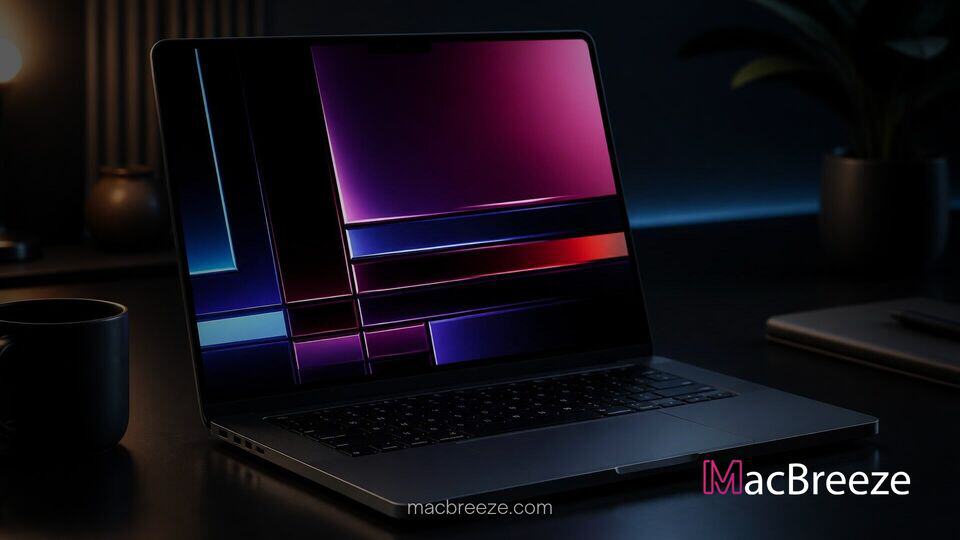
Apple has officially detailed the technical architecture behind its new PROLED XDR display, bringing high-performance tandem OLED technology to the 14-inch and 16-inch MacBook Pro models. The panel delivers up to 1,000 nits of sustained full-screen brightness and hits an extraordinary peak of 2,000 nits for both HDR and outdoor SDR content.
Breakthrough Tandem OLED Tech in the PROLED XDR Display
The introduction of the macbook pro tandem oled proled xdr display marks a major shift from mini-LED backlights toward self-emissive organic light-emitting diodes. While previous Liquid Retina XDR screens relied on thousands of localized dimming zones, the new panel controls light down to the individual pixel level. This eliminates halo effects and light bloom around bright elements on dark backgrounds, establishing a massive 10,000,000:1 contrast ratio.
By shifting to an OLED architecture, Apple has removed the heavy background diffuser layers and backlight assemblies required by older mini-LED panels. This hardware redesign allows the overall laptop chassis to be substantially lighter and thinner while preserving thermal overhead. The visual leap aligns with broader hardware shifts across Apple's lineup, echoing recent screen innovations seen when Apple unveiled the iPad mini with an OLED display.
Tandem Layer Architecture Explained
Single-layer OLED displays historically faced trade-offs between maximum brightness and long-term lifespan. Pushing organic sub-pixels to high brightness levels increases thermal stress and accelerates degradation. To overcome these thermal limits, Apple engineered a dual-layer tandem OLED panel. By stacking two electroluminescent-emitting layers on top of one another, the display combines their luminance output.
This stacked design allows each individual layer to run at lower current densities while producing double the overall screen brightness. Operating at reduced drive currents significantly reduces power consumption, extends panel lifespan, and minimizes burn-in risk. A real-time display engine built into Apple silicon monitors panel temperature, usage metrics, and ambient light levels to adjust luminance on a per-pixel basis.
Peak 2,000-Nit Brightness and Visual Specs
The PROLED XDR display pushes front-of-screen performance past previous mobile standards. It maintains 1,000 nits of continuous full-screen luminance, providing uniform brightness across demanding creative canvas environments. When rendering dynamic high-range visual elements, local highlights burst up to 2,000 nits.
Complementing the extreme brightness, the display features custom ProMotion technology supporting dynamic variable refresh rates from 10Hz up to 120Hz. The panel operates at a dense 254 pixels per inch with ultra-thin 4.6 mm borders, maximizing active workspace area. Apple has also incorporated advanced polarizers and anti-reflective coatings to minimize off-axis color shifts and internal light bounces.
SDR and HDR Outdoor Performance Upgrades
A major limitation of previous mini-LED MacBook Pro displays was their brightness restriction during standard dynamic range (SDR) usage. Older panels capped SDR content at lower brightness thresholds, reserving higher output exclusively for HDR video playback. The tandem OLED system breaks this barrier by allowing SDR content to hit up to 2,000 nits when operating under harsh outdoor conditions or direct sunlight.
This outdoor boost ensures that web browsers, text editors, code environments, and vector graphics remain clearly visible outdoors. Ambient light sensors dynamically measure surrounding glare, scaling up both SDR and HDR tone maps simultaneously to preserve shadow detail and color accuracy without washing out the picture.
Impact on Professional Creative Workflows
For creative professionals, color space support is just as critical as raw brightness. In a notable upgrade for photographers and print production teams, the PROLED XDR display natively covers both the standard P3 digital cinema color gamut and the wider Adobe RGB color space. Previous Mac displays targeted P3 exclusively. Expanded coverage into Adobe RGB brings deeper greens and cyans, ensuring accurate soft-proofing for physical print media.
Hardware executives highlighted how tight integration between display hardware and system chips makes these visual benchmarks possible. “The new MacBook Pro with PROLED XDR Display is a monumental step forward for the Mac,” said Johny Srouji, Apple's chief hardware officer. “PROLED XDR pairs state-of-the-art tandem OLED technology with advanced algorithms in our display engine to deliver the kind of visual fidelity pros have been dreaming of.”
These screen improvements arrive alongside broader platform changes, as rumors continue surrounding entry-level MacBook Pro updates with M6 silicon and software refinements like those detailed when Apple released macOS 27.2. The display upgrades also sit alongside hardware design shifts featured in redesigned MacBook Pro models featuring vapor chamber cooling.
By blending dual-layer tandem OLED hardware with granular silicon-level brightness management, Apple's latest panel solves long-standing trade-offs between battery draw, panel longevity, and extreme luminance. The PROLED XDR display sets a tough new standard for mobile workstation screens, giving portable creators desktop-grade color fidelity and clarity wherever they choose to work.