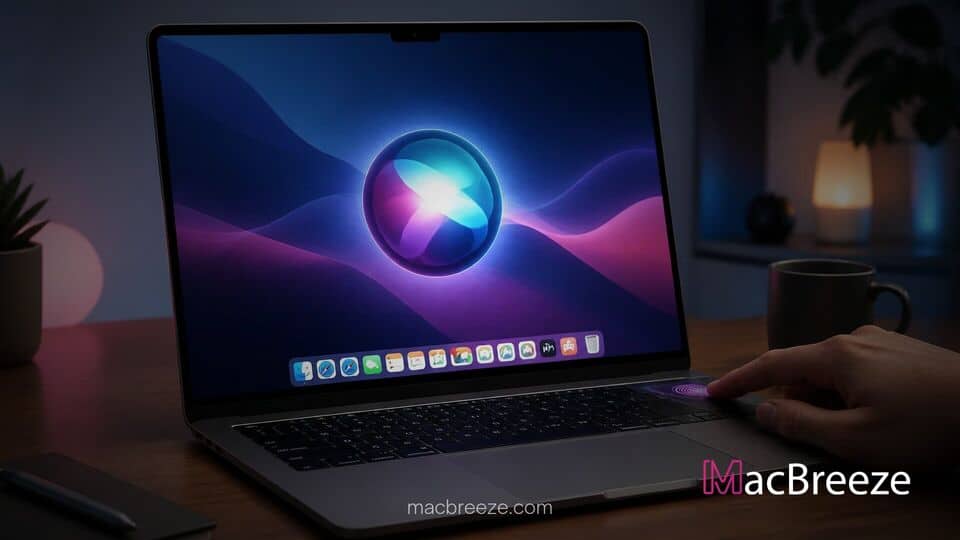
Apple has officially released macOS 27.2 to the public, bringing a significant suite of international language additions to its core intelligence platform alongside refined system privacy settings. The update, available for all compatible Apple Silicon Mac models, also introduces low-level system code that heavily hints at upcoming touchscreen hardware capabilities.
Mac users can download the software immediately through System Settings under Software Update. The release builds directly upon earlier system refinements, including macOS 27.2 preventing software upgrades from removing Rosetta installation routines for legacy executable files.
macOS 27 2 Release Siri AI Languages Expansion and Global Rollout
The headline feature of the macOS 27.2 release is the expansion of supported Siri AI languages. Apple Intelligence now natively supports five additional global dialects: Italian, Korean, Portuguese (Brazil), German (Switzerland), and English (Singapore). These languages can now take full advantage of contextual awareness, cross-app task completion, and localized natural speech processing across the Mac operating system.
By extending language coverage, Apple continues to reduce regional barriers for its advanced AI features. The expansion ensures that millions of international users can interact with Siri using natural speech prompts to manage document workflows, parse long message threads, and execute complex desktop automation scripts.
Developers who previously utilized the macOS 27 Terminal tool granting direct local access to Foundation Models will find that the local language dictionaries have been expanded across the command-line environment as well. This enables developers to test localization and context parsing directly inside the macOS command-line interface without calling remote web APIs.
Apple Officially Releases macOS 27.2 Golden Gate Update
Siri AI Expands to Five New International Languages
The broader release of macOS 27.2, internally codenamed Golden Gate during its development cycle, reflects Apple's focus on refining system performance and expanding its on-device machine learning capabilities worldwide. Beyond standard stability improvements, the update lays the foundation for unified language models across the entire Apple device family.
This release arrives alongside companion updates across the ecosystem, matching functional changes introduced in iOS 27.2 RC with new features for Messages and TV apps. Together, the operating systems establish a synchronized framework for cross-device Siri tasks, allowing users to initiate intelligent routines on a Mac and seamlessly hand them off to mobile devices.
New Siri AI Privacy Controls and System Interface Tweaks
Granular Application Access Permissions
Alongside expanded language models, macOS 27.2 upgrades system security settings by giving users finer control over how Apple Intelligence accesses personal data. A redesigned Privacy & Security dashboard allows owners to toggling on-device intelligence permissions on an application-by-application basis, ensuring that sensitive enterprise or creative tools can remain fully isolated from background processing models.
Users can now inspect real-time logs showing when local foundation models access calendar events, contacts, or system notifications. If an application requests context parsing, a lightweight visual prompt appears in the menu bar to notify the user. The update also integrates security protocols similar to recent critical system updates where Apple blocks compromised eMudhra certificate authorities across macOS to maintain complete system integrity.
Under-the-Hood Touch Frameworks Hint at Future Touchscreen Macs
Developer analysis of the macOS 27.2 source binaries has uncovered extensive new system frameworks specifically designed for direct multi-touch screen interaction. These new internal APIs include gesture-handling libraries, finger-tracking latency mitigations, and dynamic interface scaling components that go far beyond standard trackpad drivers.
The inclusion of these touch frameworks strongly aligns with industry expectations surrounding new Mac hardware. Reports regarding a redesigned touchscreen MacBook Pro retaining M5 Pro and M5 Max chips have circulated widely, suggesting Apple is preparing its desktop operating system to handle hybrid touch and pointer interfaces natively.
The newly identified touch code reveals auto-adapting UI targets that slightly enlarge window controls, context menus, and scrollbars when a direct finger tap is detected on the screen matrix. While Apple has made no formal product announcements regarding touch hardware in this release, the presence of production-ready touch code in macOS 27.2 indicates that software preparation for touch-enabled Macs is nearly complete.
System Performance and Compatibility Enhancements
In addition to intelligence and touch code updates, macOS 27.2 contains targeted bug fixes for graphics rendering, external display synchronization, and battery efficiency during intensive local AI tasks. Apple Silicon chips utilize the Neural Engine more effectively in this build, reducing power consumption during sustained local inference sessions by up to 12 percent according to internal release notes.
Audio processing pipelines have also been optimized to eliminate latency when invoking Siri in noisy environments. The desktop interface receives minor visual adjustments, including improved window snapping animations and updated system icons across native applications like Pages, Keynote, and Numbers.
Summary and Availability
The macOS 27.2 release marks an important milestone in Apple's dual strategy of expanding global AI accessibility while preparing its software ecosystem for future hardware form factors. With broader Siri AI language support, robust granular privacy controls, and underlying multi-touch infrastructure, the update delivers immediate functional value to current Mac owners while paving the way for next-generation computing experiences.