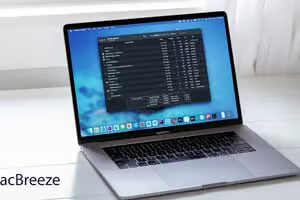
Industry reports detail a structural leap for Apple Silicon with the M6 chip, bringing gate-all-around 2nm process technology and a dual 16-core Neural Engine to the portable Mac family. The system-on-chip configuration delivers substantial efficiency improvements and hardware acceleration designed specifically for heavy artificial intelligence workloads.
M6 MacBook Pro Dual Neural Engine 2nm Efficiency Summary
The upcoming entry-level 14-inch MacBook Pro update centers on the M6 processor, Apple's first chip produced using TSMC's 2nm N2 lithography node. By transitioning away from 3nm manufacturing, Apple packs greater transistor density into a compact physical die, yielding a 20 percent decrease in power draw alongside higher peak performance. Central to the M6 architecture is a Dual 16-core Neural Engine layout that doubles peak on-device machine learning compute. This shift allows system software to split generative AI tasks, ambient contextual tracking, and real-time media processing across distinct silicon blocks simultaneously.
M6 MacBook Pro Architecture and Performance Enhancements
Apple restructured the internal layout of the M6 system-on-chip to maximize single-threaded throughput while keeping thermal output strictly contained. Moving away from traditional chip configurations, the M6 CPU features a 12-core design consisting of two dedicated super cores, four high-performance cores, and six high-efficiency cores. This configuration gives everyday background processes room to run on low-power silicon while providing immediate burst capability for intensive development tasks.
Complementing the central processor is an updated 12-core graphics processor equipped with hardware-accelerated ray tracing and Dynamic Caching. Crucially, Apple integrated a discrete Neural Accelerator into each individual GPU core. This hardware integration boosts peak GPU compute for AI operations by nearly 30 percent over prior generations, accelerating local prompt execution and complex graphics generation without overwhelming primary system memory.
Dual 16-Core Neural Engine for macOS Workflows
The primary architectural highlight of the M6 chip is its parallel machine learning pipeline. Rather than deploying a single large Neural Engine array, Apple implemented a Dual 16-core Neural Engine architecture. macOS frameworks automatically balance system demands across both units. For instance, one Neural Engine block can process local large language models and speech recognition, while the second unit simultaneously handles visual processing, computer vision, and photo indexing in the background.
To support this intense data throughput, unified memory bandwidth on the M6 rises to 170GB/s. This expanded pipe prevents memory bottlenecks when high-parameter artificial intelligence models reside directly in RAM. Professionals working with locally hosted AI agents will experience faster response times and seamless multitasking across demanding applications.
2nm Process Efficiency Gains and Battery Impact
The transition to TSMC's 2nm process technology marks a technical turning point for Apple laptop designs. The N2 process node incorporates gate-all-around nanosheet transistors, replacing the FinFET architecture used in earlier 3nm chips. This structural change reduces electrical leakage and improves power efficiency across every compute block on the chip.
In practice, the efficiency of the 2nm process means the base 14-inch MacBook Pro can sustain demanding workloads on battery power with less heat generation and fan activation. When combined with firmware optimizations for power distribution, battery life during mixed daily workflows is expected to reach record levels for the 14-inch form factor. Users can monitor system stability and thermal integrity by following guides on how to run Apple Diagnostics to test your MacBook for hardware issues.
Hardware Acceleration and System Integration
Beyond raw compute power, the M6 incorporates an upgraded media engine featuring dedicated hardware decoding and encoding for H.264, HEVC, ProRes, and AV1 video streams. Deep integration with system software allows creative professionals to edit multi-stream 8K video timelines without triggering significant battery drain.
Recent changes within Apple hardware teams have helped speed up how these hardware features are integrated with operating system features. Under engineering management changes, such as those seen during internal team adjustments detailed in reports on hardware engineering restructuring under CEO John Ternus, hardware and software development schedules have become tightly aligned. This close collaboration ensures that upcoming macOS updates take immediate advantage of the Dual Neural Engine and memory optimizations embedded in the M6 silicon.
Power management hardware on the laptop works in tandem with connected accessories. Apple continues to update external power supply controllers to optimize power delivery during fast-charging cycles, as seen when Apple releases firmware update 1.4.90 for 140W USB-C power adapter hardware used with high-end portables.
Expected Release Window and Market Position
Supply chain channels indicate that Apple is positioning the M6-powered 14-inch MacBook Pro as the centerpiece of its late-year Mac lineup. Industry sources, highlighted in reports detailing Apple Q4 M6 MacBook Pro launch schedule and chip strategy, indicate that Apple is focusing initial 2nm allocation entirely on the base M6 chip. Higher-tier M6 Pro and M6 Max variants are reportedly bypassed this cycle as Apple prepares a broader silicon evolution for future laptop generations.
This strategy allows Apple to bring cutting-edge 2nm efficiency and AI performance to entry-level professional laptops at accessible price points. Additional details on release dates appear in leaks hinting at M6 14-inch MacBook Pro launching as soon as October.
The introduction of the 2nm M6 chip underlines Apple's focus on hardware-accelerated AI and low-power performance. By combining a Dual 16-core Neural Engine with advanced nanosheet lithography, the upcoming MacBook Pro sets a high standard for power efficiency and mobile AI compute.