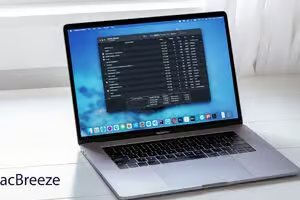
Industry leaks and internal software references suggest Apple could unveil an updated entry-level 14-inch MacBook Pro powered by the base M6 chip as soon as October. The upcoming laptop is expected to bring substantial internal processing upgrades while retaining the familiar industrial enclosure of the current generation.
While tech enthusiasts anticipate a broader overhaul for higher-end Mac laptops, reports indicate that Apple is focusing its fall updates on delivering its latest 2nm Apple Silicon architecture to standard pro notebooks. The move continues Apple's tradition of mid-autumn hardware announcements while setting up an unconventional product hierarchy for the months ahead.
Software Code and Reports Point to Fall M6 MacBook Pro Release
Recent supply chain findings and reporting from Bloomberg's Mark Gurman indicate that Apple has finalized work on an entry-level 14-inch MacBook Pro codenamed J804. Discovered backend identifiers and system framework references in recent beta releases of macOS further substantiate claims that an unreleased laptop is undergoing internal testing. Analysts note that Apple frequently schedules Mac hardware announcements in October, following its primary autumn iPhone refresh cycle.
Rather than holding a large-scale staging event, industry observers suggest Apple may opt for a direct product announcement via a press release and video presentation. This model mirrors previous autumn Mac updates where component upgrades were highlighted without requiring a complete chassis redesign. As Apple backend hardware identifiers hint at new hardware across multiple product lines, the software breadcrumbs suggest the M6 14-inch model is on track for a near-term distribution window.
m6 14 inch macbook pro october launch
Reports surrounding the m6 14 inch macbook pro october launch point to a focused internal update that bridges current hardware designs with Apple's cutting-edge 2nm manufacturing node. By refreshing the standard 14-inch model with the base M6 chip, Apple aims to deliver notable single-threaded speed improvements and higher efficiency without altering the existing chassis layout or port selection.
Retaining Mini-LED Design Ahead of Future OLED Redesign
Unlike rumors pointing to eventual touchscreen integration and thinner profiles, the entry-level M6 14-inch MacBook Pro is expected to keep its existing Liquid Retina XDR mini-LED screen. Display analysts at Omdia suggest that mini-LED panel technology will remain a staple in Apple's mainstream laptop tier for several years, ensuring consistent color accuracy and sustained brightness levels without the higher production costs currently tied to large tandem OLED panels.
This approach allows Apple to segment its line up clearly. While future premium models are rumored to eventually feature thinner chassis profiles, alternative cutouts, or touchscreen displays like those discussed for a potential touchscreen MacBook Ultra, the standard 14-inch MacBook Pro remains a reliable, traditional workhorse. Users upgrading to the M6 iteration can expect the familiar HDMI port, SDXC card slot, MagSafe charging port, and full-height function key row found on current models.
Expected Specifications and M6 Chip Performance Improvements
The transition to Apple's M6 system-on-chip marks a milestone as one of the first mass-market processors built on TSMC's 2-nanometer process node. Based on technical details revealed during early chip announcements, the standard M6 SoC expands its core configuration to a 12-core CPU and a 12-core GPU complex. Notably, the architecture introduces a tri-cluster CPU arrangement featuring dedicated super cores for single-threaded tasks, performance cores for heavy workloads, and efficiency cores for baseline system operations.
- Advanced Compute Architecture: A 12-core CPU layout featuring 2 super cores, 4 performance cores, and 6 high-efficiency cores.
- Enhanced Neural Execution: A Dual 16-core Neural Engine designed to double peak compute performance for localized artificial intelligence workflows.
- Memory Bandwidth Boost: Unified memory throughput reaching up to 170GB/s to handle intensive multitasking and large data models seamlessly.
- GPU Upgrades: A 12-core graphics block featuring integrated hardware accelerations, following recent leak trends like those seen in Apple M6 GPU benchmark reports.
The inclusion of a Dual 16-core Neural Engine aligns closely with Apple's ecosystem-wide focus on machine learning capabilities. As desktop operating systems demand more local AI processing power, hardware improvements in the M6 chip are designed to handle tasks natively without leaning heavily on cloud computing infrastructure.
Apple's Evolving Mac Product Roadmap for Late 2026
The potential release of a base M6 14-inch MacBook Pro creates a unique dynamic within Apple's laptop family. Reports suggest Apple may temporarily skip standard M6 Pro and M6 Max iterations, keeping higher-tier configurations on high-performance M5 variants or accelerating development directly toward future chip architectures. Consequently, consumers may see a standard 14-inch laptop utilizing newer 2nm base silicon alongside high-end configurations that rely on multi-die M5 Pro and M5 Max chips.
This unusual staggering mirrors recent desktop launches. For instance, after Apple confirmed new Mac mini and Mac Studio launches featuring a mix of M6 and M5-generation chips, the laptop lineup appears set to follow a similar multi-generational cadence. Industry analysts suggest this strategy allows Apple to manage chip foundry yields while ensuring baseline consumer and prosumer devices receive annual performance bumps.
What to Expect From Upcoming October Mac Announcements
If Apple maintains its typical release schedule, official details regarding the M6 14-inch MacBook Pro will arrive within weeks. Potential buyers should expect starting price points to remain relatively consistent with previous base 14-inch offerings, though ongoing component pricing shifts across the global supply chain could influence final retail figures. Users looking to verify their current system performance before deciding on an upgrade can learn how to run Apple Diagnostics on a MacBook to check existing hardware status.
In summary, an October release for the M6 14-inch MacBook Pro represents a pragmatic refresh strategy for Apple. By pairing cutting-edge 2nm silicon with a proven, durable industrial design, Apple delivers substantial speed and battery efficiency improvements to its entry-level pro laptop while reserving major physical design overhauls for future product cycles.