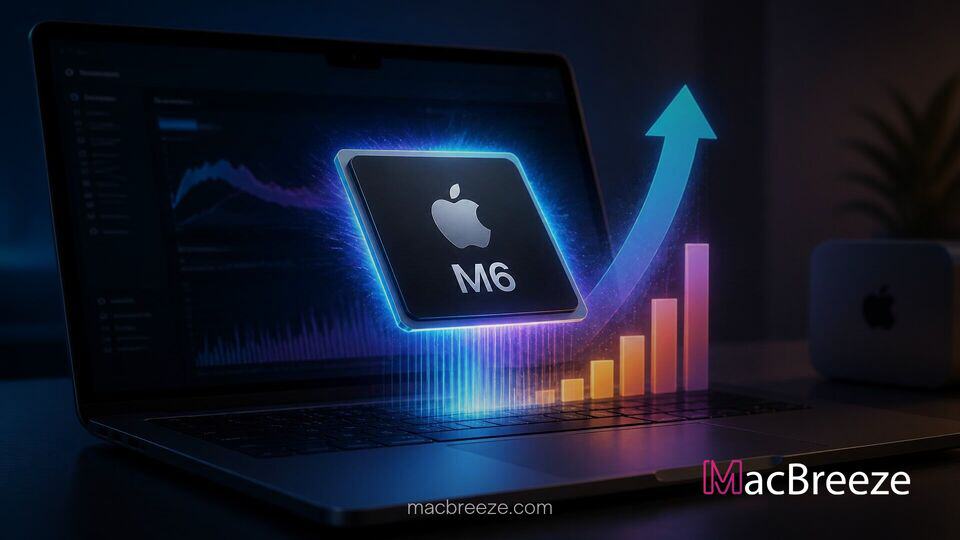
Early benchmark results for Apple's next-generation M6 processor have surfaced on the Geekbench 7 database, revealing substantial gains in graphics performance. According to the leaked entries, the base 12-core M6 integrated GPU achieves a Metal score of 93,217, representing a 34% speed jump over the previous generation M5 silicon.
The leaked performance numbers offer tech enthusiasts and professionals a clear preview of what to expect from Apple's upcoming hardware refresh. With new Mac desktop models scheduled to ship soon, these preliminary figures suggest that Apple is maintaining a rapid pace of architectural enhancement across its custom silicon lineup.
Leaked Geekbench 7 Scores Reveal Apple M6 GPU Performance
The latest benchmark entries appearing in the public Geekbench 7 repository provide concrete data regarding the graphics capability of Apple's unreleased M6 processor ahead of upcoming Mac hardware launches. The benchmark listing identifies the device under the identifier "Mac18,5," widely believed to be an entry-level desktop system testing the base configuration of the new system-on-chip.
In the Geekbench 7 Metal benchmark, which evaluates raw GPU compute and graphics rendering workloads under Apple's proprietary graphics API, the M6 integrated GPU registered an official score of 93,217 points. A separate run recorded on the same hardware configuration even reached as high as 97,137 points in optimal thermal conditions. These results confirm a major generational performance jump compared to existing Apple Silicon designs operating in the same power envelope.
Metal Benchmark Results and Comparison With M5
To put the M6 graphics performance into proper perspective, its benchmark results can be compared directly against previous generations of M-series chips:
- Apple M6 (Base 12-core iGPU): 93,217 points
- Apple M5 (Base 10-core iGPU): 69,563 points (34% generation-over-generation improvement)
- Apple M4 (Base 10-core iGPU): 51,818 points (80% multi-generational uplift)
- Apple M3 (Base 10-core iGPU): 46,033 points
- Apple M1 Pro (16-core iGPU): 63,531 points
At 93,217 points, the standard base M6 processor easily outperforms older mid-tier chips like the M1 Pro and M2 Pro (77,176 points), approaching levels of graphics compute that previously required higher-tier Pro or Max configurations. The 34% increase in Metal performance over the M5 chip represents one of the largest single-generation graphics uplifts seen in Apple Silicon since the transition from M1 to M2.
Architecture Upgrades Driving M6 Graphics Performance
The performance leap demonstrated in these benchmark leaks stems from both microarchitectural advancements and node scaling. The M6 processor is built on an advanced 2-nanometer semiconductor process, allowing Apple engineers to increase core density while keeping thermal dissipation within strict limits for compact hardware frames like the Mac mini.
Beyond process manufacturing gains, Apple has expanded the base GPU core count from 10 cores in the M5 up to 12 cores in the standard M6 configuration. Additionally, each GPU core integrates dedicated neural accelerators and enhanced ray-tracing capabilities designed to accelerate machine learning workloads and real-time graphics rendering. High-bandwidth unified memory pipelines, which reach transfer speeds up to 170 GB/s on base M6 models, ensure that the graphics cores remain fed with data without encountering memory bottlenecks.
Software optimization in current operating system builds also plays a critical role in unlocking hardware capabilities. As Apple continues refining platform features in updates such as macOS 27.2 developer beta testing, operating system graphics drivers are increasingly tuned to leverage modern unified memory architectures efficiently.
How the M6 GPU Compares to Desktop Graphics Cards
Evaluating integrated graphics against standalone desktop hardware requires looking at multiple API workloads. In native Metal tests, the M6 demonstrates high efficiency, outperforming standard integrated solutions on competing platform architectures. However, cross-platform compute benchmarks reveal a more nuanced picture of hardware capabilities.
In secondary OpenCL tests listed in the Geekbench database, the M6 integrated GPU recorded scores near 58,000 points. While this score reflects solid energy efficiency for a low-power system-on-chip, synthetic OpenCL tests on macOS rely on legacy translation layers, as Apple deprecated OpenCL years ago in favor of Metal. Consequently, synthetic cross-platform numbers do not fully reflect real-world creative software performance on macOS.
For creative professionals working within optimized application ecosystems like Final Cut Pro, DaVinci Resolve, or Blender Metal pipelines, the M6 offers GPU compute acceleration that narrows the gap with mid-range discrete graphics cards while maintaining fractionally low power consumption. Meanwhile, higher-tier professional chips like the M5 Ultra are reaching Metal scores over 366,000, bringing top-tier desktop rendering performance to workstation configurations.
Expected Mac Release Timeline and Market Impact
The timing of these Geekbench 7 leaks coincides directly with upcoming hardware distribution schedules. Updated compact desktops equipped with the M6 processor are set to begin shipping to customers shortly, providing retail users and developers with direct access to validate these preliminary performance figures under sustained real-world workloads.
The arrival of M6 hardware comes during a period of active software updates across Apple's desktop platform. Recent system changes, ranging from generative AI tool updates in Photos to deep system enhancements, benefit significantly from faster local GPU computing and enhanced Neural Engine integration. Additionally, as macOS locks in local AI model requirements across desktop configurations, increased GPU compute and memory throughput will become critical for running complex on-device intelligence models seamlessly.
Furthermore, hardware trade-in policies reflect shifting demands, as recent changes show increased trade-in valuations for Mac desktop systems, encouraging existing users to upgrade from earlier M-series generations.
Closing Remarks
The leaked Geekbench 7 Metal scores for the Apple M6 GPU highlight a substantial 34% generational performance increase over the M5 chip, driven by a 12-core GPU architecture and advanced 2nm process technology. As hardware shipments begin, real-world testing in creative rendering, gaming, and local AI processing will soon show how effectively synthetic benchmark gains translate into daily workflow improvements for Mac users.