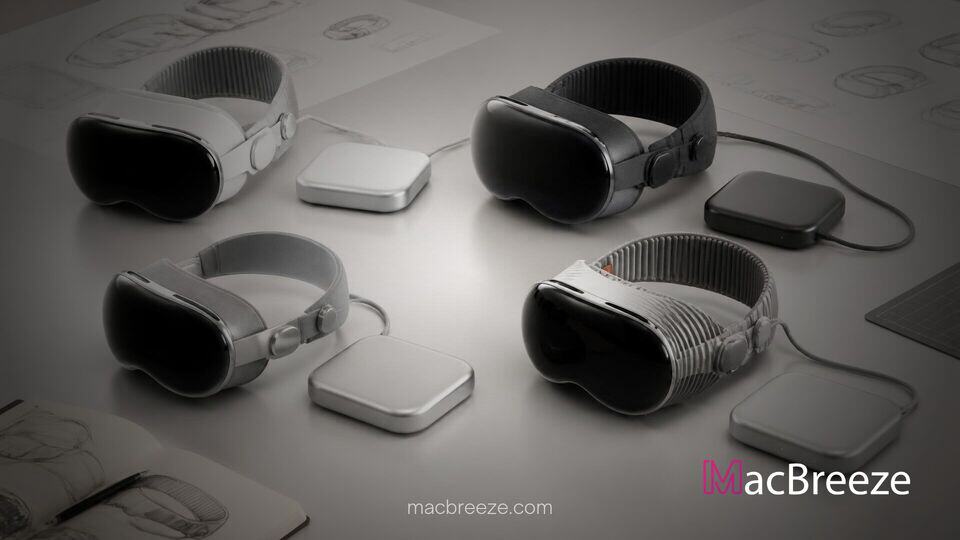
Apple's spatial computing division is evaluating roughly four distinct hardware concepts under the internal codename N224 as it seeks to overhaul its flagship mixed-reality platform . The exploratory efforts aim to drastically cut front-loaded weight, with one high-profile concept moving processing components off the user's head into a connected external puck .
apple vision pro n224 concepts compute puck
According to reports originating from Bloomberg's Mark Gurman, Apple engineers are actively testing multiple hardware layouts for a second-generation Vision Pro successor, internally designated as N224 . The primary goal of the N224 initiative is to resolve comfort issues associated with the original hardware by examining lightweight materials and offloaded compute architectures . Key iterations under review include a design that retains the current visor shape using lighter composites, as well as a radical split-architecture concept that pairs the headgear with a pocketable processing puck .
Bloomberg Report Reveals Next-Gen Apple Vision Pro Codename N224
Details surrounding the N224 project highlight a broader strategic assessment within Apple's Vision Products Group . Following the commercial launch of the original Vision Pro, feedback consistently focused on its head-mounted mass . The current M5-powered model weighs between 750 and 800 grams on the face, excluding its external tethered battery pack .
While software updates for visionOS continue to refine spatial interactions, hardware teams have turned their attention toward physical ergonomics . Previous efforts to build a scaled-down "Vision Air" under codename N100 were ultimately shelved last year . Instead, project N224 serves as a unified research framework intended to determine whether a future flagship device can maintain high-end display standards while shedding significant physical bulk .
This systematic approach to hardware experimentation mirrors tactics Apple uses across other lines . For example, recent leaks regarding a potential MacBook Ultra featuring touchscreen display technology show how Apple tests radically different form factors concurrently before settling on a single commercial path.
Four Distinct Design Concepts Currently Under Internal Evaluation
Inside Apple's design labs, engineers are weighing four clear structural pathways for N224 :
- The Refined Visor: Preserves the familiar egg-shaped aesthetic of the current headset but swaps out heavy glass and aluminum housing in favor of lightweight plastics, high-grade titanium, and specialized alloys .
- The Modular Compute Puck: Offloads the main system-on-chip, board components, active cooling fans, and battery into a single external waist-mounted enclosure, leaving only display drivers, sensors, and micro-OLED panels on the head unit .
- The Compact Hybrid: Keeps essential low-power coprocessors on the headset for ultra-low latency sensor tracking while routing heavy graphic calculations to an external processing brick .
- The Streamlined All-in-One: Re-engineers the internal thermal layer and logic board arrangement to achieve a thinner overall profile without relying on external processing hardware .
External Compute Puck vs Integrated All-in-One Design
The debate over whether to externalize core processing has created an internal rift among Apple decision-makers . Advocates for the compute puck highlight the immediate mechanical benefits: stripping heavy silicon, heat sinks, and power cells from the visor drastically reduces facial torque . Removing thermal output from the user's forehead also allows for quieter, more efficient passive cooling on the module itself .
However, several executive stakeholders reportedly view a tethered compute puck as a compromise in user experience . Critics argue that forcing users to manage thick interconnect cables and carry a hip-mounted accessory undermines the sleek, self-contained aesthetic Apple historically prefers . Because the existing Vision Pro already uses a tethered battery pack weighing around 353 grams, expanding that cable connection to carry high-bandwidth display data presents both ergonomic and technical hurdles .
Evaluating Thermal Management Weight Reduction and Ergonomics
Shifting processing tasks to a waist module requires ultra-low latency data transmission to prevent motion sickness during passthrough rendering . In contrast, an integrated design keeps video pipelines directly adjacent to the micro-OLED panels, maintaining sub-millisecond motion-to-photon latency .
Apple's silicon advances could help bridge the gap without requiring an external puck . Industry observers note that as future chip architectures improve power efficiency, thermal envelopes will shrink naturally . Similar efficiency leaps are anticipated across Apple's hardware portfolio, much like the advancements expected when leaks hint at M6 14-inch MacBook Pro releases featuring next-generation node processes.
Strategic Timeline and Apple's Shift Toward Smart Glasses
Market dynamics have added urgency to Apple's internal deliberations . Rival Meta recently unveiled its own tethered VR glasses, which offload compute and power to an external puck to achieve a frame weight near 100 grams . That competitive pressure has forced Apple's leadership to closely re-examine its hardware roadmaps .
Despite active testing under the N224 project, sources emphasize that a completed product remains far from release . Reporting indicates that N224 is currently in an early phase, with potential launch windows positioned between late 2028 and early 2029 if the device receives final commercial authorization .
At the same time, resource allocation inside Apple's hardware groups appears to be leaning toward displayless smart glasses and wearable audio accessories . Senior leaders under CEO John Ternus continue to champion spatial computing headsets, but company resources are increasingly directed toward lighter wearable form factors targeted for 2027 . In the meantime, software integration across Apple's ecosystem continues to expand, as seen when TestFlight added macOS support for resizable iPhone Mirroring to streamline cross-device usability.
Ultimately, the N224 project reflects Apple's ongoing effort to balance computational performance with everyday user comfort . Whether Apple settles on an external compute puck or waits for silicon improvements that allow a lighter all-in-one chassis, the next generation of spatial hardware will depend heavily on solving these foundational engineering trade-offs .