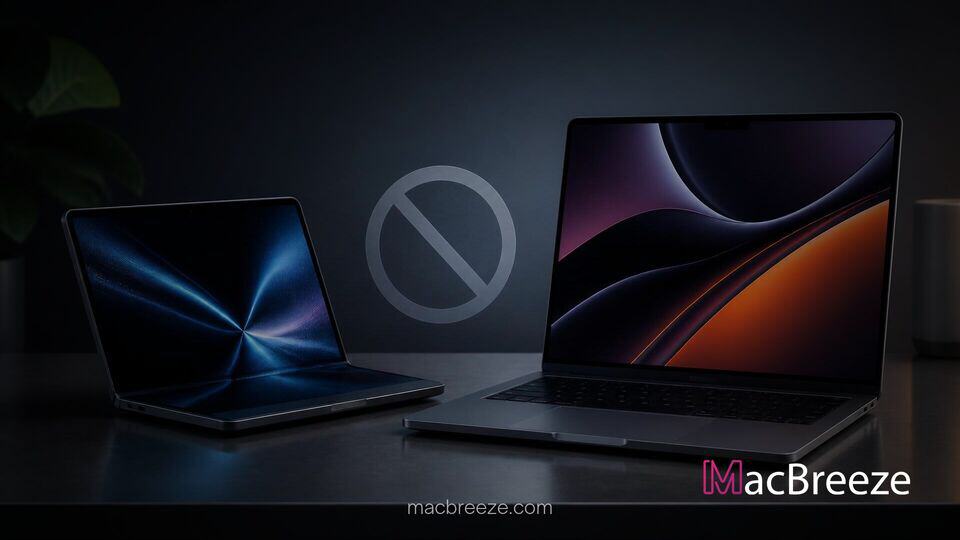
Apple has reportedly cancelled plans to release a large foldable MacBook as well as an intermediate OLED notebook model, according to industry research firm Omdia. The decision marks a significant shift in Cupertino's hardware roadmap as the tech giant streamlines its long term display strategy.
While experimental form factors and mid-tier screen sizes have been shelved, Apple remains committed to transitioning its core portable lineup to organic light-emitting diode technology over the coming years.
Apple Cancels Foldable MacBook OLED and Mid-Tier Display Projects
Research published by market intelligence group Omdia indicates that Apple has officially abandoned two laptop concepts previously under internal evaluation. The first was a large-screen hybrid foldable device featuring a display measuring between 16.1 inches and 18 inches when unfolded. The second was a standalone OLED MacBook variant designed with a screen size between 14.4 inches and 16.1 inches, positioned between standard portables and pro machines.
Rather than diluting its portfolio with overlapping screen sizes or unproven crease-based form factors, Apple is focusing on refining its flagship MacBook Pro and MacBook Air designs. Industry observers note that high production costs, durability hurdles, and software adaptation challenges for dual-screen interactions likely contributed to ending the foldable project.
Omdia Report Details MacBook Roadmap Changes
The revised display roadmap from Omdia offers a comprehensive look at how Apple's hardware strategy has shifted following the cancellation of these two experimental devices. The detailed findings highlight specific display specifications, revised production timelines, and new bridge models planned for later in the decade.
Canceled Foldable MacBook Specs and Timeline
The rumored foldable laptop was long speculated to serve as a dual-purpose hybrid bridging the iPad and Mac ecosystems. Industry analysts had originally anticipated an all-screen foldable device with a screen size hovering around 18 to 20 inches when fully extended. Early expectations pointed toward a launch window as soon as 2026, though supply chain bottlenecks later pushed target dates into 2028 before the project was shelved entirely. While Apple's foldable mobile hardware efforts remain active in smaller form factors, the engineering complexity of a large-screen folding panel ultimately stalled commercial feasibility for laptops.
Scrapped Mid-Tier OLED Laptop Display Size
In addition to abandoning the foldable concept, Apple scrapped plans for a mid-tier OLED MacBook display panel sized between 14.4 and 16.1 inches. This intermediate size was initially evaluated to create a bridge between standard Consumer laptops and high-end workstations. However, supply chain analysts indicate that introducing a mid-size chassis would have cluttered Apple's display hierarchy without providing sufficient differentiation from existing 14-inch and 16-inch form factors.
Impact on Future MacBook Pro and Air Lineups
By canceling these specialized screen sizes, Apple is maintaining a clear distinction between its mainstream consumer notebooks and high-performance professional machines. The existing 14.3-inch and 16.3-inch display dimensions will continue to serve as the exclusive baseline sizes for the MacBook Pro series.
Instead of the scrapped mid-tier model, Omdia reports that Apple is developing a new 13.8-inch OLED MacBook expected to arrive around 2029. This machine will function as a premium bridge option sitting between the entry-level LCD MacBook Air and the top-tier MacBook Pro lineup. Meanwhile, existing LCD panel models utilizing mini-LED backlighting are projected to remain in active production longer than previously anticipated, ensuring mini-LED MacBook Pro models stay available alongside OLED laptops to provide users with proven display choices.
Apple's Broader OLED Transition Strategy
Despite dropping the foldable MacBook and intermediate display sizes, Apple's overarching goal of bringing OLED panel technology to its entire portable catalog remains unchanged. The company continues to roll out tandem OLED panels across its iPad family, with recent discoveries in macOS system code hinting at upcoming OLED MacBook Pro models.
By trimming experimental screen configurations, Apple can channel its engineering resources into perfecting display brightness, energy efficiency, and color accuracy for mainstream MacBooks. As the Mac lineup continues to evolve alongside new silicon innovations, such as the next-generation M6 chip architecture, Apple is opting for stability and proven form factors over niche display designs.
Ultimately, the cancellation of the foldable notebook and intermediate OLED size demonstrates Apple's willingness to abandon secondary projects in favor of a cohesive product line. Mac users can expect a refined transition to OLED technology that prioritizes performance, battery efficiency, and familiar screen proportions.