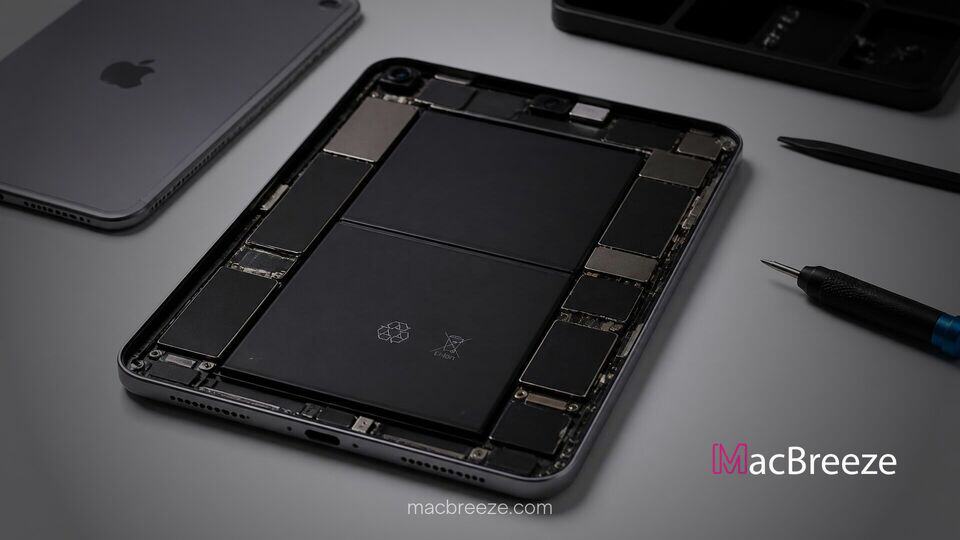
Official regulatory documentation filed in Europe has revealed that Apple's newly announced eighth-generation iPad mini features a 4,900mAh battery cell. The rating represents a slight decrease in physical capacity compared to the 5,034mAh battery found inside the previous seventh-generation model.
Despite the numerical drop in raw capacity, official performance metrics show that overall battery runtime remains unchanged across typical use cases. Technological enhancements in silicon manufacturing and display architecture appear to fully mitigate the hardware reduction.
Regulatory Filing Reveals iPad Mini Battery Specs
Apple published energy compliance documentation within the European Product Registry for Energy Labelling (EPREL) database, providing precise hardware measurements that the company typically omits from standard marketing materials. The public database entry confirms that the upcoming OLED iPad mini features an A20 Pro chip alongside a 4,900mAh rated battery cell.
In terms of energy storage, the new battery provides 18.9 watt-hours (Wh) of total capacity. By comparison, the seventh-generation iPad mini introduced in 2024 carried an 18.9 Wh to 19.3 Wh rating across various manufacturing runs, translating to approximately 5,034mAh to 5,078mAh. The resulting adjustment marks a modest reduction of roughly 2.7 percent in total charge storage.
Regulatory submissions also confirm that the internal battery cell is rated to retain up to 80 percent of its original working capacity after completing 1,000 full charge cycles. The documentation outlines compliance with standard USB Power Delivery protocols, recommending adapters capable of supplying 20W or higher for standard charging speeds.
Comparing Capacity Between iPad Mini Generations
Tracking the physical capacity of Apple's compact tablet line demonstrates how internal layout choices shift alongside hardware generations. The table below illustrates the rated battery specifications and hardware profiles across recent iterations of the small-form-factor device:
- iPad mini 8 (2026): 4,900 mAh (18.9 Wh), 5.4 mm thickness, A20 Pro processor
- iPad mini 7 (2024): 5,034 mAh (19.3 Wh), 6.3 mm thickness, A17 Pro processor
- iPad mini 6 (2021): 5,124 mAh (19.3 Wh), 6.3 mm thickness, A15 Bionic processor
Throughout these hardware refreshes, Apple has consistently targeted a baseline operational target of 10 hours of continuous web browsing or video playback over Wi-Fi connectivity. The hardware changes reflect a broader engineering strategy that prioritizes physical space optimization and component efficiency over expanding raw battery volume.
Design Trade-Offs Behind the Thinner OLED Chassis
The primary factor driving the internal volume adjustment is the device's redesigned external enclosure. The new iPad mini measures just 5.4 mm in thickness, marking a 0.9 mm reduction compared to the 6.3 mm chassis used in the previous generation. Additionally, the Wi-Fi model weighs approximately 255 grams, representing a drop of nearly 38 grams from its predecessor.
Shaving down the outer frame necessitated structural alterations within the interior assembly. The integration of an 8.5-inch Super Retina XDR display required updated structural mounting points and redesigned acoustic chambers. Apple introduced an Acoustic Display system that emits sound through microscopic panel vibrations, eliminating conventional speaker grills along the side edges.
Engineers also added IP67-rated ingress protection for enhanced dust and water resistance, incorporating internal seals that occupy valuable space inside the compact frame. The cumulative structural adjustments left slightly less physical volume available for the lithium-polymer battery pack.
Expected Battery Life and Efficiency Improvements
While the physical hardware sees a small capacity drop, real-world battery longevity is expected to remain equivalent due to system-level power management. The inclusion of custom silicon built on advanced sub-nanometer node architectures dramatically lowers power draw during routine background tasks and active processing. Early benchmarks already show that the A20 Pro chip in the new iPad mini delivers major performance upgrades while optimizing system resources.
The transition from a traditional liquid crystal display (LCD) to an organic light-emitting diode (OLED) panel plays an essential role in power conservation. Because OLED screens utilize self-emissive pixels rather than a uniform LED backlight, individual pixels deactivate entirely when displaying pure black tones. This screen functionality significantly reduces power drain when operating system-wide Dark Mode, viewing letterboxed video content, or reading text-heavy media. Similar architectural benefits were highlighted when Apple detailed tandem OLED display technology on MacBook Pro models.
Software-level optimizations inside iPadOS further manage power consumption across system components. The updated platform dynamically adjusts background process scheduling based on user habits, helping ensure that the smaller cell yields identical operational hours under standard test conditions.
Launch Date and Pricing Details for the OLED iPad Mini
Pre-orders for the eighth-generation iPad mini opened shortly after its initial announcement, with customer deliveries and retail store availability set to begin on Friday, November 6. Pricing for the entry-level 128GB Wi-Fi model starts at $699 in the United States, representing a higher entry point than the previous generation due to the added display and processing hardware.
Models equipped with Wi-Fi plus Cellular capabilities start at $849, while higher storage tier options reach up to 512GB. Educational discounts are available for eligible institutions and students, bringing base pricing down to $649. Educational buyers considering Mac alternatives should note that Apple recently adjusted MacBook Neo pricing across different purchasing channels.
Though an official oled ipad mini battery capacity downgrade might initially raise concerns for users seeking maximum hardware specs on paper, official technical specifications confirm that efficiency gains preserve the device's standard 10-hour runtime. Potential buyers can evaluate whether the thinner, lighter design and vibrant OLED display compensate for the minor decrease in total milliampere-hour rating.