Enterprise IT teams and artificial intelligence engineering departments are rapidly adopting Apple Silicon desktop hardware as a viable alternative to traditional cloud GPU infrastructure for local inference workloads. By pairing high-capacity Mac Studio configurations with Apple's open-source MLX array framework, organizations are building low-power, high-throughput on-premises AI servers right on developer desks.
This architectural shift allows businesses to execute complex large language models, agentic coding tools, and multimodal tasks entirely within their secure local networks. The combination eliminates cloud subscription costs, prevents sensitive corporate data from leaving on-premises environments, and bypasses third-party API rate limits.
Mac Studio MLX Enterprise AI Server Solutions Drive Local Deployment
The rise of the mac studio mlx enterprise ai server ecosystem highlights how quickly desktop hardware is reshaping corporate AI strategy. Rather than relying exclusively on cloud providers like Amazon Web Services or Microsoft Azure, companies are deploying desk-side compute nodes that deliver substantial memory bandwidth while consuming a fraction of the power required by traditional data center racks. Modern tools like OMLX distributed local LLM inference demonstrate how easily multiple Apple Silicon systems can cluster together over high-speed interconnects to host massive open-weight models.
Enterprise Shift Toward On-Premises Mac Silicon Infrastructure
For years, running cutting-edge open-weights models required dedicated server rooms equipped with multi-GPU clusters. However, the cost of renting enterprise cloud GPUs continuously accrued recurring operational expenses, while sending proprietary codebases or confidential records outside corporate firewalls created strict compliance hurdles.
Recent developments in macOS system software and developer tooling have opened up a direct path for enterprises to host high-parameter models on local workstations. Organizations handling regulated financial data, healthcare records, or legal contracts are finding that localized hardware provides a clear privacy advantage without sacrificing model performance. Furthermore, as software integrations mature across macOS, tools such as the Apple Xcode plugin for Claude Code show how developers can hook directly into local endpoints to automate programming tasks without leaking sensitive source code.
How Apple Silicon and MLX Enable Desk-Side AI Server Racks
Apple's open-source MLX framework acts as the core engine driving local machine learning performance on macOS. Designed specifically for Apple Silicon, MLX provides numpy-like array operations, automatic differentiation, and specialized Metal bindings optimized for native GPU cores and tensor math operations.
Unlike cross-platform tools that rely on generic hardware abstractions, MLX executes directly against unified memory architecture. Systems administrators can run simple server scripts that expose OpenAI-compatible API endpoints locally. Internal developer tools, continuous integration pipelines, and local agentic workflows can connect directly to these local endpoints, treating a Mac Studio sitting in an office cabinet exactly like a cloud-hosted LLM service.
Technical Advantages of Unified Memory for Open-Weight Models
The primary hardware bottleneck for running modern AI models locally has long been graphics memory. Traditional PC graphics cards typically cap out at 16GB or 24GB of dedicated VRAM, making it impossible to load larger 70B, 120B, or 400B parameter models without splitting weights across multiple expensive video cards.
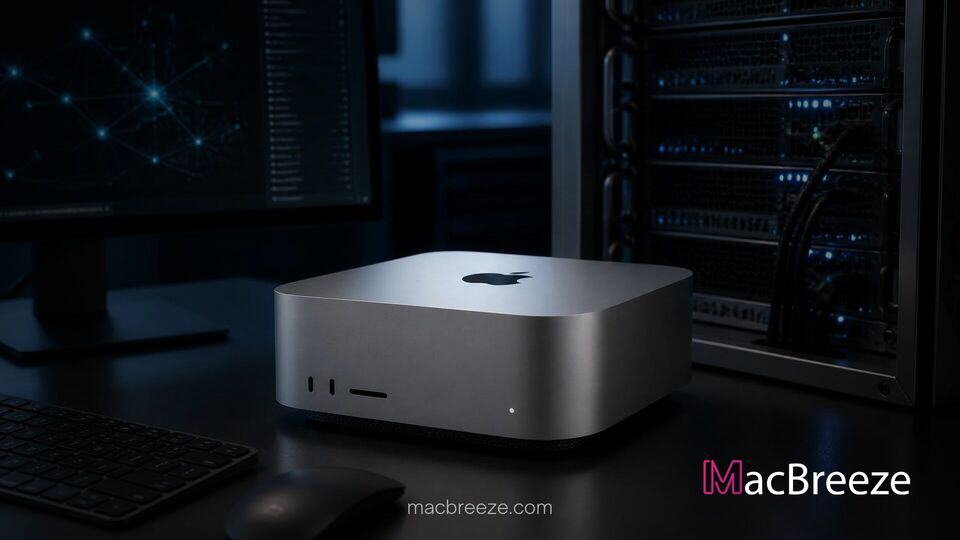
Apple Silicon solves this bottleneck through unified memory architecture. In a high-tier Mac Studio, the GPU, CPU, and Neural Engine share access to a single pool of system RAM that can reach up to 512GB. Because the GPU can directly address this entire pool, an IT department can load massive quantized models into memory on a single compact desktop system, completely bypassing traditional VRAM limits.
Performance Metrics and Energy Efficiency Compared to Data Centers
Energy consumption has become a chief concern for enterprise hardware deployment. A standard multi-GPU server chassis drawing several thousand watts requires specialized electrical circuits and dedicated HVAC cooling systems.
In contrast, an M-series Ultra Mac Studio running continuous inference draws less than 500 watts at peak output while maintaining ultra-quiet thermal performance. The memory bandwidth on top-tier Mac chips provides impressive token generation speeds for team environments. While cloud-hosted enterprise accelerators still lead in raw batch processing throughput for hundreds of concurrent users, a single Mac Studio setup effortlessly handles real-time prompt processing and agentic task loops for small to mid-sized engineering teams.
What This Means for Enterprise IT Workflows and Local AI Adoption
The ability to host private AI models on desk-side hardware is fundamentally changing the build-versus-buy calculus for IT leadership. Rather than budgeting thousands of dollars per month for third-party token consumption, companies can purchase Mac Studio hardware as a one-time capital expense that pays for itself within months.
As developer ecosystems surrounding local AI mature, hardware security mechanisms remain paramount. Operating system capabilities such as Apple Secure Exclaves for Mac privacy complement these infrastructure shifts by keeping system hardware fully protected against unauthorized external tampering. Enterprise administrators are also preparing for wider cross-platform deployments, especially as region-specific features rollout, such as when Apple registers Apple Intelligence in China to expand hardware capabilities globally.
The transition toward local enterprise inference represents a significant shift in corporate computing infrastructure. By combining Apple Silicon unified memory with the high-performance MLX framework, organizations gain total control over their data, reduce cloud dependency, and maintain cutting-edge generative AI tools right within their own physical office spaces.