Apple has published technical documentation outlining its new Secure Exclaves architecture, designed to insulate sensitive sensor data from software exploits. The engineering deep dive explains how isolated runtime environments in Apple Silicon safeguard continuous background processing of camera feeds and microphone input without exposing raw audio or video to the main operating system.
By shifting sensor analysis into hardware-isolated compartments, the architecture ensures that real-time features like face detection, acoustic monitoring, and system status indicators remain tamper-resistant. Even if a high-privilege kernel breach occurs on the main operating system, raw media feeds are kept strictly out of reach from apps, background processes, and third-party software.
Apple Secure Exclaves Camera Microphone Privacy Architecture Explained
Apple published the structural breakdown through its Security Engineering and Architecture (SEAR) division. The documentation explains how modern Apple Silicon chips utilize Secure Exclaves to run ambient sensing workflows—such as background acoustic evaluation and visual detection—without compromising overall system security. Raw video frames and audio streams are processed in isolated hardware memory, reduced down to metadata signals, and then immediately discarded.
Apple Outlines Secure Exclaves Architecture for Hardware Privacy
The core philosophy of Secure Exclaves centers on reducing privilege and enforcing tight boundaries around environmental perception. Modern computing features increasingly depend on continuous ambient awareness, such as identifying when a user approaches a screen or listening for specific wake phrases. Traditionally, handling such sensor streams required giving background daemons access to incoming media feeds, raising potential privacy risks if those daemons were targeted by malicious code.
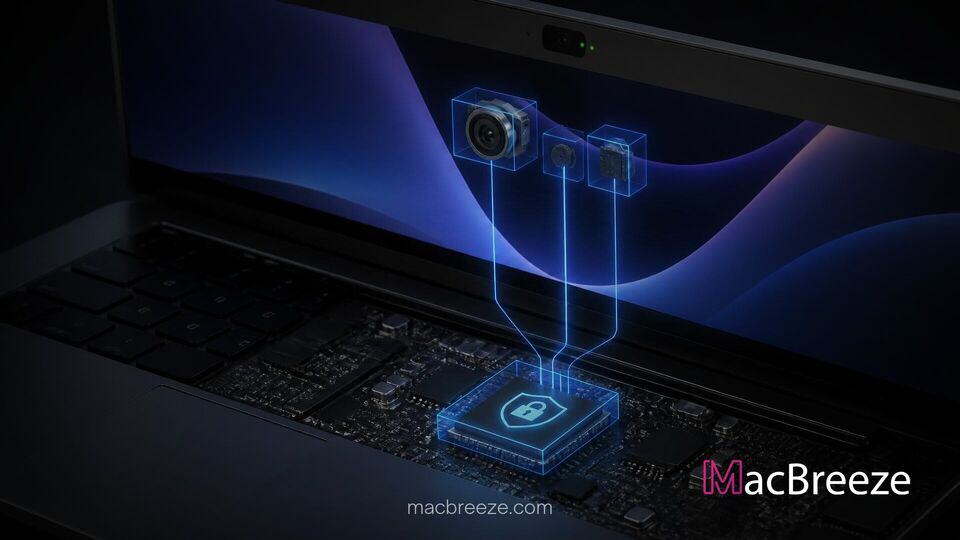
Secure Exclaves solve this challenge by decoupling sensor capture from the primary operating system. When a camera or microphone records background input, the data streams directly into a microkernel-based execution domain running alongside the main processor. A specialized hardware component called the Secure Page Table Monitor prevents the primary kernel from reading or modifying the memory assigned to these exclaves.
As a result, raw camera images and microphone recordings exist only inside the protected hardware runtime during the brief moments required to complete analysis. Once localized compute models evaluate the data, the exclave sends brief, structured flags to the operating system, such as a boolean confirmation that a person has been spotted or a wake word was detected. The raw input streams are instantly erased from memory.
Isolated Security Runtimes for Camera and Microphone Processing
To power these isolated runtimes, Apple built a dedicated microkernel environment based on a customized L4 architecture. Unlike typical userland applications or kernel extensions that share system resources, exclaves run as independent, memory-safe compartments. Communication between separate exclaves and the main host system relies on strict messaging layers written in Swift, preventing memory corruption vulnerabilities from jumping across process boundaries.
For processing intensive tasks such as computer vision or acoustic pattern matching, Secure Exclaves map securely into the Apple Neural Engine. This allows complex machine learning workloads to execute at full speed on native hardware while remaining strictly segregated from main memory access.
This design is particularly relevant as hardware capabilities evolve across the Mac ecosystem. Recent hardware tear downs, such as those detailing the internal layout in the touchscreen MacBook Pro teardown, demonstrate how closely Apple ties hardware thermal and silicon layout to dedicated security hardware. By containing high-throughput media pipelines directly within specialized silicon blocks, devices maintain peak compute efficiency without expanding their attack surface.
Protected Hardware Features Across Mac and iOS Lineups
The implementation of Secure Exclaves extends across several key features in Apple's current product lineup. Beyond background sensor analysis, the system plays an essential role in driving hardware-backed user interface indicators.
On devices featuring on-screen privacy indicators, such as the green and orange status dots, Secure Exclaves directly manage the display rendering pipeline. This guarantees that software cannot spoof or suppress privacy indicators when a camera or microphone becomes active. On laptops like the compact MacBook Neo, camera indicator management is tied into this protected runtime to prevent stealthy optical capture.
The architecture also underpins voice interaction pipelines. Rather than keeping the main system audio server awake to constantly listen for spoken commands, low-power coprocessors pass short audio buffers into an audio exclave for multi-stage verification. System daemons running on the main operating system receive no raw audio during this initial listening window.
Impact on Third-Party App Privacy and User Data Security
The introduction of Secure Exclaves changes how third-party software interacts with ambient context. Software developers building Mac applications will no longer need direct access to continuous video or audio feeds simply to detect user presence or proximity. Instead, system APIs will surface simple status notifications generated by the secure runtime.
This structural change reduces the reliance on traditional system permission prompts while simultaneously enhancing data safety. In the past, granting an app access to a microphone or camera opened a broad window of potential access. Under the exclave model, apps receive high-level contextual outputs without ever holding digital asset handles for raw sensor buffers.
The architectural shift aligns with recent operating system updates focused on tighter application boundaries, such as those introduced in macOS Golden Gate 27.2.1 and the granular permissions configured in iOS 27.2 Siri privacy controls. System level updates are increasingly shifting sensitive compute into hardware-verified sandboxes before handing controls back to general applications.
Broader Implications for Apple Ecosystem Security Standards
Apple's publication of its Secure Exclaves documentation reflects a broader industry trend toward zero-trust design within local hardware architectures. As artificial intelligence models demand deeper integration with user environments, isolating perceptual sensors becomes critical to preventing unauthorized data collection.
By combining custom L4 microkernel runtimes, memory-safe code implementations in Swift, and strict hardware memory partitioning, Apple is establishing a technical blueprint for ambient processing. Security researchers will be able to evaluate these boundary implementations as Apple continues to publish formal proofs and technical details surrounding its silicon architecture.
Overall, Secure Exclaves represent a significant step forward in hardware-level privacy, ensuring that next-generation Mac and iOS devices can perceive their surroundings intelligently while keeping user media strictly private.