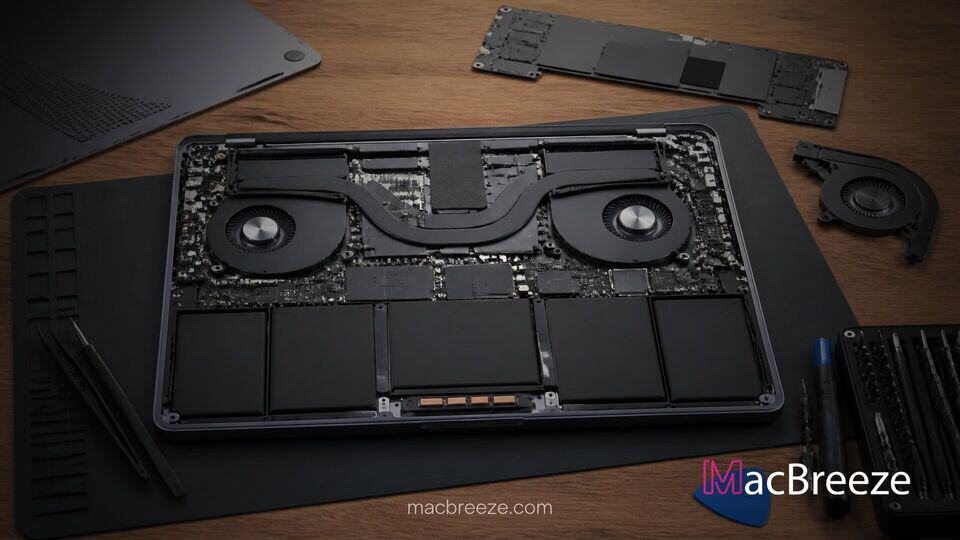
A comprehensive disassembly by teardown authority iFixit has offered a detailed look inside Apple's flagship touchscreen MacBook Pro. The teardown reveals a thoroughly redesigned internal thermal architecture engineered to redirect exhaust heat away from the sensitive display assembly and maintain performance.
Beyond the thermal updates, the teardown highlights structural chassis modifications that yield noticeable weight savings, alongside subtle shifts in component modularity and repairability. The findings provide technical insight into how Apple adapted its professional laptop hardware to accommodate multi-touch interactions and modern display tech.
Teardown Details Internal Changes in Touchscreen MacBook Pro
The teardown of the touchscreen MacBook Pro demonstrates how Apple shifted away from its traditional internal layout to accommodate new physical requirements. While previous generations directed thermal exhaust across the lower glass bezel, the internal architecture of the new chassis changes how air moves through the enclosure.
Engineers opening the device noted that while the exterior retains Apple's familiar aluminum silhouette, access to the internal components has been adjusted. The lower case now fastens with just four main screws rather than eight, making initial entry into the chassis faster. However, the layout beneath the aluminum casing features tight component integration designed around a revised internal frame.
New Hinge-Based Thermal Architecture
The core focus of the thermal redesign centers on exhausting heat away from the user touch surface and the delicate display layers. In prior iterations, hot exhaust air was pushed upward past the bottom bezel of the screen. In the updated touchscreen chassis, Apple introduced a hinge-integrated ventilation path that directs warm airflow straight back out through the rear hinge assembly.
This rearward thermal path keeps high temperatures away from the bottom edge of the panel, preventing localized heating during heavy workloads. The setup pairs with re-engineered cooling fans that feature adjusted blade spacing and higher rotational velocity while maintaining quiet acoustic profiles. This layout works to preserve consistent heat dissipation without letting thermal buildup affect the touch sensor layer.
Weight Savings and Chassis Modifications
Despite adding touch-sensing layers and additional display structural components, the disassembled laptop shows an overall reduction in physical weight. iFixit's measurements show that the 14-inch model weighs roughly 1.38 kg, marking a weight reduction of approximately 170 to 200 grams compared to older enclosure designs.
The teardown attributes these weight savings to several key areas:
- Display Assembly: Eliminating traditional backlighting layers allowed the entire lid structure to shed about 100 grams, offsetting the weight of added touch sensors.
- Enclosure & Frame: Redesigned internal ribbing and a thinner main enclosure wall reduced lower chassis weight by roughly 92 grams.
- Input Components: A refined trackpad design saved an additional 8 grams, while structural tweaks to the battery enclosure saved additional weight without reducing capacity.
The assembly also incorporates specialized internal support structures. To protect the thin panel during finger taps and pinches, Apple added dual foam support pads behind the display matrix, giving the lid added rigidity when pressure is applied to the screen.
Repairability and Modular Component Findings
iFixit awarded the touchscreen MacBook Pro a repairability score of 5 out of 10, highlighting a mix of minor improvements and lingering repair hurdles. On the positive side, display replacements benefit from streamlined cable routing and the removal of the dedicated lid-angle sensor, which simplifies lid swaps. Furthermore, logic board replacements showed improved compatibility. Tests confirmed that system features like True Tone, Touch ID calibration, and touch controls remained fully functional following board transfers.
However, modularity remains limited in key areas. Critical ports, including HDMI, as well as the solid-state storage chips, remain soldered directly to the main logic board, making individual component repairs impossible. Additionally, high-wear parts like the USB-C ports and cooling fans are positioned underneath the main board, requiring complete teardowns of the primary motherboard just to perform basic replacements.
Attempts to disassemble the screen assembly further underscored these repair challenges. Separating the outer glass from the internal display layers caused severe glass cracking and delamination, indicating that individual sub-components within the display lid cannot be repaired independently.
Impact on Sustained Workload Performance
The teardown findings align with early performance benchmarks testing sustained processor workloads under thermal load. By channeling heat away through the hinge structure, the redesigned cooling system reduces performance throttling when operating under heavy CPU and GPU stress.
Thermal testing highlighted an additional advantage of the rear-venting hinge: improved heat management when operating in clamshell mode. When connected to external displays with the lid closed, earlier MacBook designs often experienced accelerated thermal throttling due to restricted airflow against the closed screen. The new rearward ventilation path maintains an unobstructed exhaust route, allowing the laptop to sustain top clock speeds for longer durations regardless of whether the lid is open or shut.
In closing, iFixit's detailed look inside the touchscreen MacBook Pro reveals an impressive engineering effort that balances thermal management, structural weight loss, and display protection. While repairability continues to face hurdles from soldered components and fused display layers, the internal redesign represents a significant step forward in laptop thermal management.