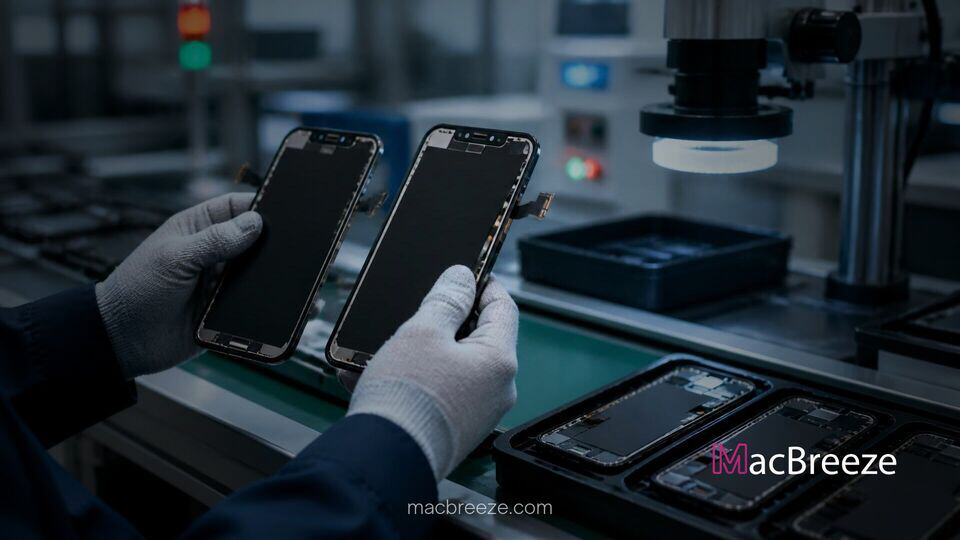
Emerging reports from East Asian supply chains indicate that manufacturing partners are grappling with low production yields for the upcoming iPhone Duo. As Apple prepares for pre-orders starting October 16 followed by market availability on October 23, initial inventory may be considerably more limited than expected.
Industry sources disclose that main manufacturing facilities have encountered hurdles while scaling production up to mass commercial output. These assembly constraints stem from strict internal build tolerances alongside component delays, threatening to restrict retail stock during the critical launch window.
Low Final Assembly Yields Reported for Foldable iPhone Duo
According to supply chain details initially reported by Jiemian News, primary contract manufacturer Foxconn recorded final assembly yields for the iPhone Duo slightly above 60 percent as of mid-September. A yield rate near 60 percent means that nearly four out of every ten manufactured units fail to pass final factory quality control standards, requiring rework or total scrappage.
Engineers and manufacturing technicians at Foxconn are reportedly making continuous recalibrations to equipment, assembly line speeds, and robotic tooling parameters to improve output. However, insiders note that under Apple's unwavering structural and cosmetic standards, reaching a fully mature yield rate of 85 to 90 percent could require another six to twelve months of ongoing production line refinements.
Contract manufacturers have reportedly approached Apple leadership to discuss operational trade-offs. Chinese technology outlet MyDrivers reported that factory management asked Apple whether to prioritize yield stabilization or accelerate total unit throughput. Running assembly lines at full speed yields higher absolute hardware volumes but leads to elevated defect rates and increased factory waste. Apple has historically maintained strict quality guidelines rather than relaxing hardware defect thresholds, opting to accept temporary supply shortages to protect hardware durability.
Hinge and Screen Component Supply Bottlenecks
The manufacturing friction extends well beyond the final assembly line. Upstream component vendors providing core elements for the foldable design have faced their own production challenges. Samsung Display, which produces the flexible foldable OLED panels for the handset, has reportedly encountered yield bottlenecks and last-minute design tweaks demanded by Apple. Any delay in panel deliveries compresses the available timeline for assembly workers to fine-tune final production processes.
The device's central folding mechanism represents another core point of complexity. Apple's custom hinge mechanism consists of more than 100 individual components protected by a 3D-printed enclosure. Manufacturing friction increased when Apple evaluated Liquid Metal alloy for key structural hinge parts before revising its approach shortly before commencing commercial mass production. The tight engineering tolerances required to minimize display creasing and ensure smooth folding motion mean that minor component variations can lead to failed final testing. Developers have already begun working with software tools like the iPhone Duo hinge API to tailor interface transitions for various folding angles, underscoring the vital reliance on exact hardware alignment.
Estimated Launch Supply and Shipments for 2026
Due to ongoing yield limits, current total production estimates for the device remain modest compared to traditional flagship launches. Industry analysts and supply chain sources indicate that Apple's global stocking target for the iPhone Duo throughout 2026 ranges between six million and eight million total units. Some market observers, including TF International analyst Jeff Pu, recently trimmed annual delivery projections down toward six million units citing persistent hinge component constraints.
To put these numbers into context, a standard individual iPhone Pro or Pro Max model typically ships between 20 million and 30 million units across its initial product cycle. While the foldable handset commands a premium $1,999 starting price point and enters the market late in the fourth quarter, early retail stock could sell out rapidly. Leaked details surrounding customized features like dedicated StandBy Mode faces for foldable iPhone Duo have built significant consumer interest ahead of pre-orders. Retail sources indicate Apple's internal sales guidance exceeds five million units for the remainder of the calendar year, meaning demand could outpace early supply.
Impact on Apple's Foldable Smartphone Strategy
Manufacturing hurdles are a common occurrence when tech companies introduce brand new form factors. Entering the foldable smartphone market requires balancing delicate mechanical engineering with mass-market manufacturing durability. Rivals in the foldable space spent years optimizing screen crease reduction and hinge assembly before achieving steady high-volume yields.
The company continues to expand its broader hardware and software ecosystem in tandem. While assembly lines adjust to the complex dual-screen hardware, Apple has also rolled out updates such as TestFlight support for resizable iPhone Mirroring to refine cross-device experiences. Additionally, executive commentary around stylus compatibility, including statements on why the iPhone Duo supports Apple Pencil, highlights how the new layout is meant to serve both creative and productivity workflows.
For buyers planning to purchase Apple's first foldable phone on day one, supply chain realities suggest placing pre-orders immediately when windows open on October 16. As Foxconn and component suppliers continue refining assembly protocols, production yields are expected to improve gradually over the coming quarters. Until these assembly lines mature, early availability for the iPhone Duo will remain tightly constrained.