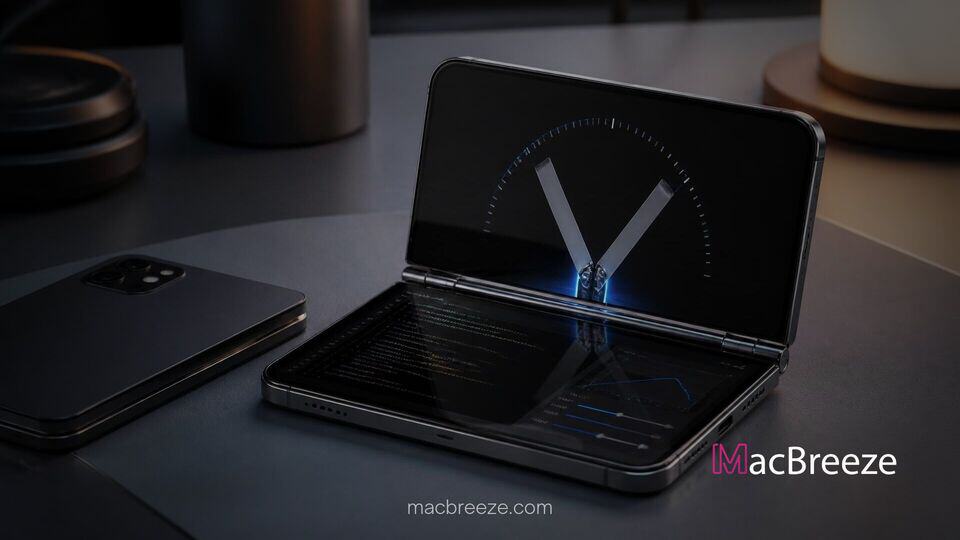
Apple Senior Vice President of Software Engineering Craig Federighi has provided new technical details regarding how the operating system handles the hinge mechanism on the upcoming iPhone Duo . In a detailed interview discussing the dual-screen foldable hardware, Federighi outlined how iOS exposes angle data to third-party developers and detailed a signature UI visual effect that bridges the transition between folded and unfolded states .
According to Federighi, the engineering goal behind the iPhone Duo software suite is to deliver absolute continuity between device states . Rather than treating the folding action as a disruptive mode switch, Apple built dedicated frameworks that automatically adjust layouts based on physical device orientations while still giving creative developers direct access to underlying hardware telemetry .
Craig Federighi Explains iPhone Duo Developer Integration
Addressing how third-party applications interact with the folding hardware, Federighi confirmed that Apple built a high-precision API specifically tailored to the device's custom mechanical hinge . The framework allows software to register raw hardware metrics alongside high-level system states .
Hinge Angle Tracking and Pose Detection Capabilities
The core of the developer integration is a low-latency API capable of measuring the opening angle of the hinge with a high degree of precision . Federighi noted that the API can read the physical angle of the hinge within an accuracy of approximately five degrees, giving software real-time awareness of how far open the device is positioned at any given millisecond .
Alongside raw degree values, iOS categorizes physical device configurations into explicit structural states called poses . These predefined states make it straightforward for developers to reconfigure user interfaces without having to compute custom trigonometric math manually .
Translucent Screen Defocus Transition Effect
Federighi also highlighted a key software feature designed directly around the hinge sensor data: a dynamic display preview that activates as the phone opens . As a user unclasps the iPhone Duo, the active outer display subtly defocuses and turns semi-translucent, giving a peek through to the main interior canvas before the device is fully unfolded .
Federighi described the effect as a subtle but magical approach to software continuity . The intent was to eliminate rigid UI jumps by making the front glass act as a visual viewport into the content coming into focus on the inner panel .
What the Hinge API Enables for Third-Party Developers
While Apple uses the raw angle metrics to drive system-level animations and transitions, the developer framework is designed to abstract away complexity for standard app development while retaining depth for specialized software .
Supported Device Poses and Framework Automation
For the vast majority of app creators, Apple recommends relying on high-level pose states rather than raw hinge angles . Standard operating poses exposed by the framework include:
- Book Pose: Held like an open notebook in portrait orientation for reading and side-by-side app pairing .
- On-Table Pose: Resting partially folded on a flat surface with one screen acting as a base, useful for media playback or laptop-style typing interfaces .
- Tent Pose: Placed key-side down in an inverted V-shape for shared viewing, presentations, or nightstand display modes .
By registering support for these pose categories, apps can utilize layout engines to auto-flow UI elements seamlessly . A communications tool like Slack, for instance, automatically separates room lists onto the left pane and message threads onto the right pane when folded into a dual-screen state .
Creative App Applications for Foldable Hardware
Federighi drew a direct line between the new hinge telemetry and Apple's historical decision to grant third-party apps raw access to sensors like the accelerometer and gyroscope . Just as motion sensors unlocked new classes of mobile games and utility software years ago, fine-grained access to the hinge angle allows indie developers to craft immersive interactive experiences .
Early examples of this flexibility include creative utility concepts that map physical actions to the phone's mechanics . Developer experiments already range from digital audio software that turns the device into a retro cassette player where opening the hinge operates the virtual tape door, to custom drawing and reading utilities that react dynamically to partial folds .
Timeline and Availability Ahead of iPhone Duo Launch
The detailed breakdown of software integrations comes as excitement builds around Apple's official entry into foldable hardware . The company has made developer toolkits and updated SDKs available so developers can optimize their existing App Store offerings ahead of the device's public retail debut .
By combining raw angle accuracy with high-level device pose abstractions and custom display transition engines, Apple aims to establish a software foundation that prevents early dual-screen apps from feeling stretched or unoptimized . As third-party developers continue building out tailored experiences, the flexibility of the hinge API will play a central role in defining how software adapts to foldable mobile devices .