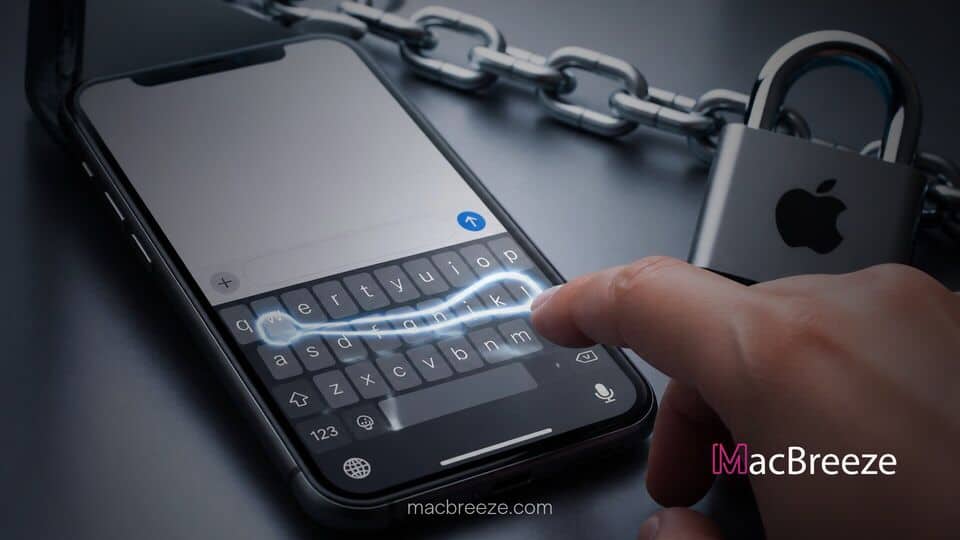
An independent cybersecurity report has revealed that Apple maintains an undisclosed multilingual digital gray list containing an estimated 100,000 words and phrases. The system hidden inside iOS actively prevents these terms from appearing in predictive text suggestions and restricts them during QuickPath swipe typing.
While users can still manually tap out any word letter by letter, the automated engine silently suppresses these combinations from predictive suggestions. This discovery has ignited discussions regarding software transparency, content filtering, and subtle nudges in everyday mobile communication.
Report Uncovers Hidden Autocomplete and Swipe Restrictions in iOS
The research, published by independent investigator Derik Kauffman, details how internal iOS language files house thousands of pre-configured rules designed to filter output. The study discovered that the iOS swipe keyboard restricted words list spans nearly 30 languages and writing systems, applying strict limits on what the software anticipates when a user glides across the glass screen.
Kauffman initially began investigating the phenomenon after noticing reproducible inconsistencies while using swipe gestures on his iPhone. Certain everyday word pairings would effortlessly render on screen, whereas other seemingly similar phrases would routinely fail, auto-correcting to phonetically or structurally distant words instead. Using automated code analysis tools to dissect iOS system data, he unearthed a deeply embedded hash table containing thousands of restricted phrases per localized dictionary.
Cybersecurity researcher Matt Suiche from Tolmo independently verified the dataset, confirming that the recovered hash tables closely match internal system parameters operating within recent operating system builds. Rather than functioning as a total ban, the restriction acts as a functional gatekeeper. It removes suggestions before they surface on the predictive bar and modifies continuous swiping trajectories.
How the 100,000-Word Gray List Affects Swipe Typing
The operational mechanics of the gray list rely on continuous matching during text entry. When a user attempts to swipe a phrase included on the list, the iOS gesture engine intercepts the input. Instead of matching the intended sequence, the algorithm selects an alternative dictionary candidate or alters previously swiped words to prevent the blocked combination from forming.
For instance, attempts to swipe localized terms like "United Ireland" or "Tibetan independence" frequently default to alternative outputs such as "United Iceland" or structural variations like "Tibetan independences". Similarly, attempting to swipe political slogans or controversial phrases results in missing predictive candidates, forcing users to delete automated guesses and peck out text manually.
This behavior is distinct from standard spellchecking. While traditional dictionaries assist users by suggesting complex words, the gray list operates in reverse by withholding valid linguistic entries. As Apple continues advancing software functionality across platforms, such as integrating Siri AI integrations for third-party apps and refining system tools in recent developer previews like iOS beta updates, the presence of legacy automated filtering rules shows how deeply guardrails are embedded across user interfaces.
Political and Geopolitical Terms Included in Keyboard Filtering
While the vast majority of entries on the list comprise profanity, explicit content, slurs, and references to drugs or violence, researchers noted that thousands of entries cover political figures, international conflicts, and ideological slogans. The broad scope of these political inclusions has drawn scrutiny from privacy advocates and tech analysts.
In the English language dictionary, the list flags phrases such as "Dictator Trump", "Sleepy Joe", "right wing conspiracy", and "left wing conspiracy". Geopolitical references are similarly affected, with expressions involving regional sovereignty, historical conflicts, and government monitoring facing restrictions. The filtering extends globally across localized iOS dictionaries:
- Hindi: Excludes swipe suggestions for political taunts referencing major party leaders.
- French: Filters phrases related to public debate, including statements like "immigration too high".
- Hebrew: Restricts autocomplete completions for phrases like "occupied territories".
- Russian: Contains hundreds of restricted entries covering military operations and government leadership.
The findings highlight apparent logic inconsistencies across different terms. Certain gendered or demographic pairings pass through gesture filters smoothly while inverse phrasing triggers restrictions. Analysts suggest many entries may have been generated through automated broad-brush templates rather than hand-curated decisions for every individual line item.
Differences Between Manual Tapping and Predictive Swipe Input
Apple clarified that its iPhone keyboard is designed to prevent users from receiving inappropriate, explicit, or unwanted predictive recommendations. The company emphasized that users retain full freedom to write whatever they choose, as manual tap-typing bypasses the gray list entirely.
However, modern smartphone usage relies heavily on predictive algorithms and continuous swiping to increase typing speed. When automated systems systematically suppress specific phrases, it creates subtle friction for the end user. Pecking out individual characters requires extra effort compared to a single fluid motion across the screen.
Privacy Implications and Potential User Impact
The discovery of the hidden blocklist has raised important questions regarding algorithmic transparency. Digital rights organizations argue that undisclosed content filtering on consumer hardware can shape communication habits without explicit user consent. When millions of consumers rely on predictive tools daily, minor modifications to software defaults can influence phrasing choices at scale.
This situation reflects broader discussions surrounding system-level guardrails across consumer electronics. As Apple implements stricter software policies elsewhere, such as updating standards to scan publicly shared iCloud links for harmful content, balancing security, user safety, and open communication remains a complex challenge.
Furthermore, developers and privacy advocates note that secret lists complicate the user experience. Because users are rarely informed why swipe gestures fail for specific words, many assume software bugs rather than intentional dictionary filtering.
In summary, the revelation of Apple's extensive iOS keyboard gray list demonstrates the fine line tech companies navigate between protecting users from inappropriate content and inadvertently restricting benign political expression. As mobile operating systems grow more reliant on predictive algorithms, callouts for greater transparency regarding hidden device rules will likely continue to grow.