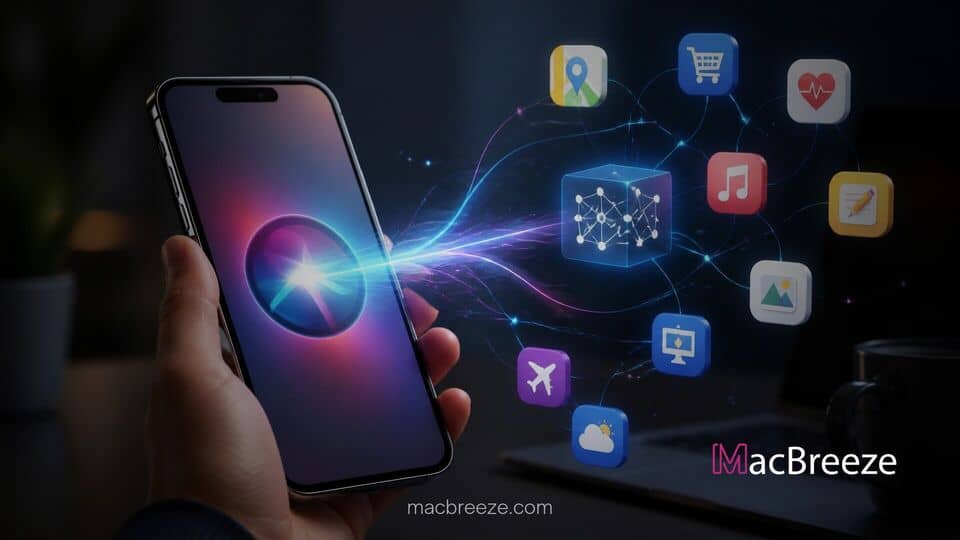
Apple has officially expanded its Siri AI platform to third-party software developers with the release of the iOS 27.3 preview build. The update provides external applications with system-level access to the assistant's underlying intelligence, allowing users to execute complex tasks using conversational voice commands.
Through the updated App Intents framework, developers can now make custom actions, specialized in-app content, and contextual data accessible directly to Siri AI across iOS, iPadOS, macOS, and visionOS environments.
Siri AI App Intents Preview Opens to Developers
The developer release marks a significant transition in Apple's artificial intelligence strategy. Previously, deep voice assistant integrations were limited to standard system-defined categories or native Apple applications like Mail, Messages, Notes, and Maps. With the release of the developer preview alongside the iOS 27.3 developer beta, software creators across all categories can define custom capabilities for their services.
Under this updated structure, external software can expose custom entities and operations to the assistant. For example, users can ask the assistant to check active delivery statuses in a third-party tracking application, modify an existing dinner reservation, or initiate a retail purchase without needing to open the specific application or navigate manual menus.
Core Capabilities: Context, Natural Language, and On-Screen Awareness
The integration framework relies on three fundamental technical capabilities powered by Apple Intelligence:
- Personal Context Understanding: Siri AI processes indexed user data and behavioral patterns across participating apps to deliver personalized responses tailored to user history.
- Natural Language Processing: The assistant interprets dynamic, conversational queries without requiring strict command phrases or exact menu matching.
- On-Screen Awareness: Siri can analyze active elements visible on a device display, letting users refer conversationally to content such as photos, documents, or ongoing chat threads.
How App Intents Power Next-Gen Siri Interactions
At the center of this update is the expanded App Intents framework. Rather than forcing users to memorize specific voice triggers, developers declare their app's core actions, entities, and parameters as structured schemas. These schemas feed directly into Spotlight's semantic search index, enabling the system to understand dynamic requests even when phrasing is vague.
Additionally, the preview introduces App Skills, a system capability that allows Siri AI to chain multiple actions across separate applications into a single task flow. For instance, a user can instruct the assistant to find product details inside a specialized shopping tool and send those specs to a contact via a third-party messaging app in one step.
The assistant can also infer which application to invoke based on visual context. If a user views a Live Activity or works within an open foreground view, they can give commands without explicitly naming the underlying application. Background queries that are not tied to active screen elements will still require naming the target app for safety and precision.
This deep hardware and system integration aligns with Apple's broad cross-platform vision. Similar underlying system optimizations were highlighted when Apple CEO John Ternus outlined on-device AI strategy details for Mac hardware, emphasizing how custom hardware engines process localized AI tasks securely without sacrificing performance.
Global Expansion and Technical Requirements for Developers
To support software engineers in implementing these features, Apple has provided targeted tools inside the Xcode development suite. The platform includes a Siri Integration Advisor to deliver code feedback and a Siri Evaluation framework that allows developers to test scripted natural language requests and measure response accuracy.
Developers retain full administrative control over what information is exposed to the system. Developers choose which data models are indexed and which actions are actionable by the assistant, ensuring proprietary business logic remains protected. Custom data views can also be displayed natively inside interactive card snippets rendered within the Siri interface.
From a policy standpoint, Apple has made the preview accessible through the standard Apple Developer Program without requiring special privileges or approval tiers. However, Apple notes that functionality is restricted to development builds and internal TestFlight builds during the initial preview cycle. External TestFlight builds and App Store submissions featuring the new capabilities cannot be published until the final platform tools open.
The broader software ecosystem continues to prepare for these software shifts alongside recent regulatory updates, such as when Apple updated location and content descriptors in App Store Connect for international developers.
Release Timeline and Expected Rollout for iOS Users
While developer testing is currently underway across the beta seeds of iOS 27.3, iPadOS 27.3, macOS 27.3, and visionOS 27.3, general consumers will need to wait before these third-party voice actions become available on production devices. Developers are expected to submit updated applications using the new App Intents extensions when final developer tools ship.
Public availability for end users is projected for early next year, following the completion of the preview cycle. As third-party software updates roll out to the App Store, consumers will begin experiencing a more flexible virtual assistant capable of bridging complex workflows across their favorite applications.
By making Siri AI accessible across the broader application landscape, Apple is positioned to transition its digital assistant into a unified control layer for mobile and desktop software.