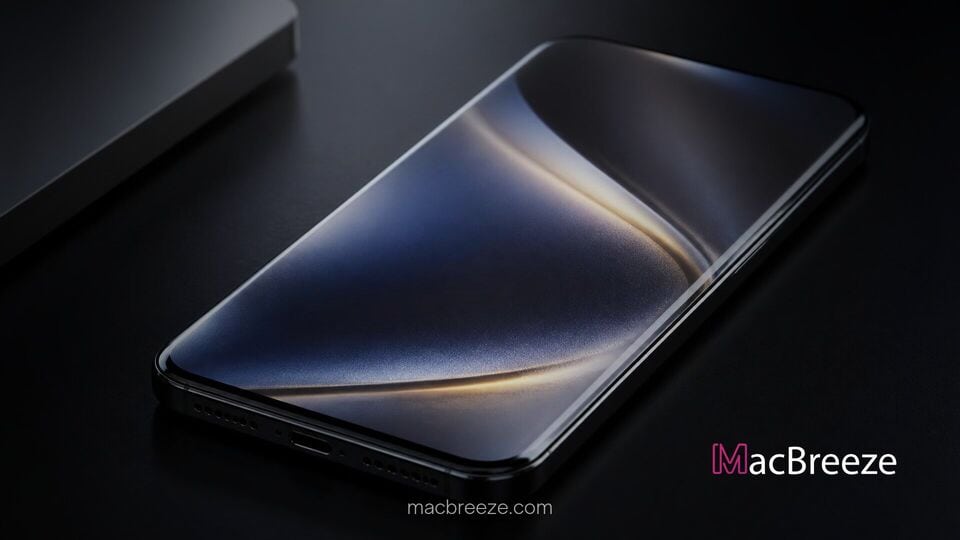
Apple is reportedly waiting on Samsung Display to complete work on an ambitious new OLED panel that bends downward at 90-degree angles across all four edges, opening the door for a truly bezel-free iPhone. According to supply chain leaks originating from Chinese insider Instant Digital, the ultimate goal is to replace the traditional metal frame with active display real estate, rendering the front borders completely invisible.
Bezel Free iPhone Samsung Quad Curved OLED Screen Development
Industry reports indicate that Apple has long envisioned an all-glass front surface for its flagship smartphones, but current manufacturing limits have kept thin borders intact. Rather than utilizing traditional waterfall curves that distort the primary screen area, Samsung's in-development bezel free iPhone Samsung quad curved OLED technology keeps the central display region flat while folding the panel sharply around the perimeter. This structural shift allows display driver circuits and internal wiring to sit along the physical sides of the device.
By moving essential components away from the front bezel, the physical border surrounding the active screen drops virtually to zero. While Apple continues pushing hardware design boundaries, like its recent efforts toward a reengineered OLED MacBook Pro with significantly lighter design, display innovations for the company's mobile lineup remain heavily tied to its key manufacturing partner.
Samsung Reportedly Building Quad-Curved Display Panel
How 90-Degree Folded Edges Could Replace the Physical Frame
Internally referred to by Samsung as a full-surround or full-screen display, the design approaches smartphone chassis engineering from a radically different angle. Instead of housing the display inside an aluminum or titanium outer frame, the folded sections of the OLED panel itself effectively become the outer sidewalls of the smartphone.
This construction could allow Apple to eliminate mechanical side buttons altogether in favor of touch-sensitive solid-state controls. Apple has frequently explored hardware reduction across its lineup, as seen in how Apple removes Intel Mac compatibility from Magic Mouse and Trackpad specs to focus on modernized hardware architectures. Replacing physical buttons with haptic edge interfaces represents a natural progression in that broader design philosophy.
Technical Hurdles Standing in the Way of a Bezel-Free iPhone
Distortion Signal Quality and Button Removal Challenges
Despite the promise of a completely seamless front glass surface, significant engineering obstacles remain before commercial mass production can begin. Display engineers are currently working through three primary technical challenges:
- Optical Distortion: Sharp 90-degree bends at the four corners of the display introduce color shifts and visual stretching that compromise image uniformity.
- Panel Encapsulation: Flexing delicate OLED layers so tightly risks micro-fracturing the thin-film encapsulation required to protect organic LEDs from moisture and oxygen exposure.
- Antenna Placement: Modern smartphones rely on tiny cutouts in their metal frames to transmit cellular and Wi-Fi signals, an approach that becomes impossible when screen glass covers all four sides.
Antenna placement poses a particularly complex dilemma, as insulating glass walls block traditional signal routing through frame splits. Apple has previously dealt with severe network connectivity issues when hardware integration falls short, as highlighted when Apple confirms AT&T iPhone 18 Pro Max network failure requires hardware swap due to underlying antenna dropping issues. Ensuring rock-solid wireless stability on a wraparound glass chassis remains a critical priority before finalizing production approval.
What the Quad-Curved Display Means for Apple's Product Roadmap
Supply chain analysts caution that this extreme 90-degree wraparound design should not be confused with the micro-curved panels anticipated for upcoming flagship iterations. Reports suggest that a milder, four-sided micro-curved panel may serve as an intermediate stepping stone on the road toward an ultimate 20th-anniversary iPhone design.
At the same time, Apple continues testing multiple form factors in parallel, including foldable screen technologies. For instance, recent supply chain leaks indicate that Apple confirms iPhone Duo pre-orders begin with October 12 get ready launch, while software updates show that an iOS 27 leak reveals minimalist Lock Screen Focus mode controls engineered specifically for dual-screen and foldable devices.
By letting Samsung Display refine the complex encapsulation, optical, and structural requirements behind the scenes, Apple aims to avoid premature hardware flaws when it eventually debuts its first completely borderless smartphone. Until Samsung solves these core manufacturing bottlenecks, the full-surround display will remain in development, setting up the next major evolutionary leap in mobile hardware design.