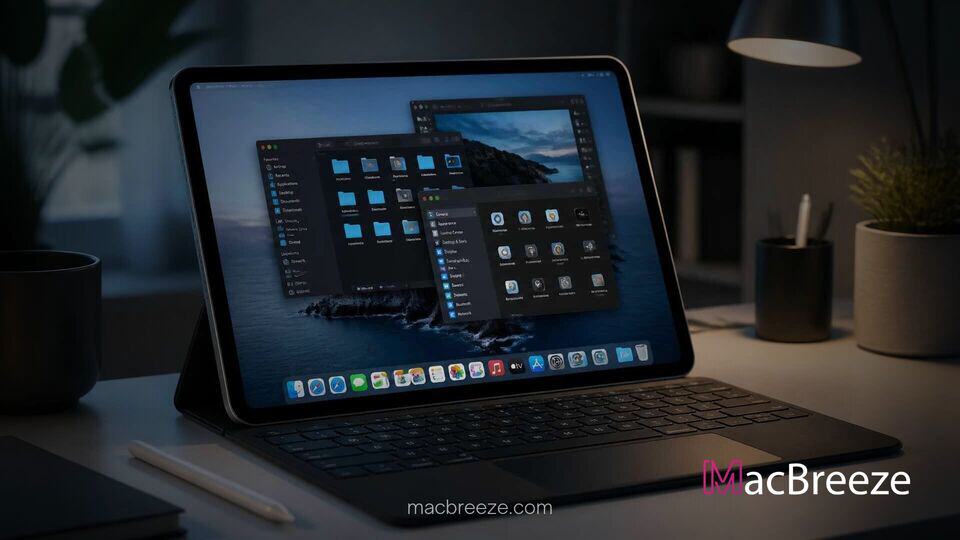
Apple has successfully executed internal builds of macOS on iPad hardware, according to recent industry reports, but the company has no intentions of shipping a Mac-powered tablet to consumers. The internal testing leverages the shared Apple Silicon architecture across both product families, allowing engineers to experiment with desktop software on tablet displays behind closed doors.
Despite the technical feasibility of running full desktop operating systems on tablets, Apple remains firmly committed to maintaining iPadOS as a distinct entity. Insiders confirm there is no active commercialization project or unified operating system in development, ensuring that the iPad hardware line retains its dedicated touch-first user experience for the foreseeable future.
Internal Testing Confirms macOS Running on iPad Hardware
The existence of an apple testing macos on ipad internal build was highlighted by Bloomberg reporter Mark Gurman during a Q&A segment on his Power On podcast. According to Gurman, Apple engineers have maintained functional test benches running macOS on iPad units for some time. These prototype environments allow internal teams to test cross-platform framework interactions, evaluate touch interfaces, and gauge how desktop software handles tablet display configurations.
However, Gurman emphasized that the presence of these working internal prototypes does not mean a consumer release is on the horizon. There is currently no project underway within Apple to commercialize macOS for iPad or to replace iPadOS with a desktop hybrid. For users hoping to replace their laptops with a tablet running full desktop software, the internal builds remain strictly research and development tools rather than upcoming products.
Technical Feasibility of Shared Apple Silicon Architecture
The ability to boot macOS on iPad hardware stems directly from Apple's unified chip architecture. Since the transition to M-series processors, iPad Pro and iPad Air models utilize the exact same system-on-chip designs found in entry-level MacBooks and desktop Mac computers. Because both hardware families share underlying instruction sets, memory architectures, and media engines, porting an operating system build between them requires minimal low-level engineering.
This architectural parity has allowed software engineers to swap operating systems inside test labs without creating custom hardware prototypes. Similar cross-pollination strategies have been noted in other platform developments, such as early work on the MacBook Air silicon roadmap and performance optimization for future M-series processor generations. The shared hardware foundation gives internal teams full flexibility to experiment with cross-platform features, even when those features are never intended for public deployment.
Why Apple Retains iPadOS Separation for Commercial Products
Apple executives have consistently defended the separation of macOS and iPadOS, citing fundamental differences in user input models and ergonomics. Software engineering chief Craig Federighi has previously described the iPad as a touch-first experience, arguing that forcing a desktop interface onto a tablet risks compromising both paradigms. A mouse-driven desktop operating system features dense menus and small control targets that do not translate cleanly to direct finger interaction.
Furthermore, product lines are structured to serve distinct market segments without cannibalizing sales. Merging the iPad and Mac into a single dual-booting or hybrid device would undermine MacBook hardware sales and complicate developer guidelines. European regulatory scrutiny also plays a role in keeping the platforms apart. Regulatory bodies evaluate operating systems individually under digital market competition rules. Maintaining separate software platforms helps Apple manage compliance obligations across different operating system classifications.
Incremental Mac Feature Porting Strategy for Future iPadOS Updates
Rather than replacing iPadOS with macOS, Apple has chosen to gradually port desktop capabilities into tablet updates. Over successive software generations, iPadOS has gained windowed multitasking via Stage Manager, advanced external display support, proper background file transfers, and desktop-class app extensions. Professional software releases such as Final Cut Pro and Logic Pro for iPad demonstrate how Apple prefers to rebuild desktop workflows around touch interfaces rather than shipping unmodified desktop apps.
This strategy is evident across the broader ecosystem, where key features are shared across systems while operating systems remain distinct. System-level advancements like real-time Visual Intelligence features and background intelligence processing continue to launch on iPadOS natively without needing a full macOS foundation. Similarly, developer tool updates and local AI infrastructure like autonomous agent capabilities on Mac reflect dedicated platform focus rather than OS consolidation.
Market Consequences for iPad Pro and Mac Desktop Lineups
The news that internal builds will remain unreleased reinforces the positioning of high-end iPad hardware. Power users who purchase M-series iPad Pro models frequently express frustration over software constraints, arguing that powerful hardware is held back by mobile software limitations. However, Apple's commercial strategy continues to push users toward buying both an iPad for touch-centric tasks and a Mac for desktop productivity.
As enterprise software demands shift, third-party developers continue adapting to this dual-platform reality. Enterprise infrastructure toolmaker updates, such as software inventory auditing on macOS fleets, remain distinctly tailored to Mac environments while iPad apps target mobile workflows. By keeping the boundaries clear, Apple ensures that each hardware category maintains a defined role within its hardware portfolio.
While internal macOS builds on iPad prove that Apple can bridge the software gap at any time, commercial strategy and platform design keep the two operating systems on parallel tracks. Consumers looking for a full macOS experience will need to remain on Mac hardware, as iPadOS continues its slow, selective adoption of desktop features.