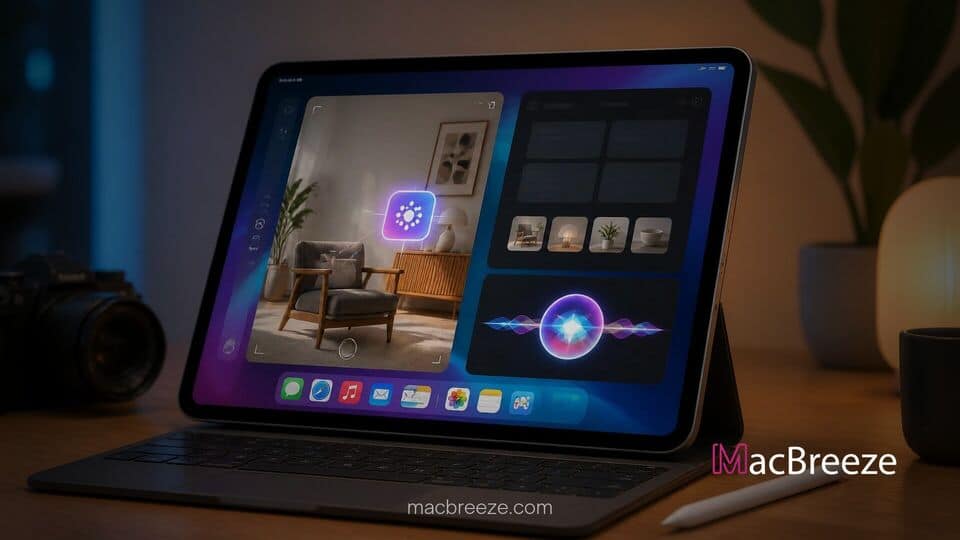
Apple has officially expanded its spatial recognition tools by releasing the developer beta of iPadOS 27.3. The update integrates a dedicated Siri mode directly into the native iPad Camera app interface.
This update bridges a functionality gap between iOS and iPadOS, offering tablet users a streamlined workflow to capture, analyze, and query real-world objects in real time through Apple Intelligence.
iPadOS 27.3 Expands Visual Intelligence Beyond iPhone
The addition of dedicated visual recognition in iPadOS 27.3 represents a major milestone in Apple's push to make artificial intelligence accessible across its hardware lineup. Previously, tablet users seeking to analyze real-world scenes had to rely on custom shortcuts, Control Center toggles, or secondary photo analysis menus. By embedding these capabilities directly into the default camera viewfinder, Apple simplifies visual queries for millions of tablet users.
This feature expansion builds upon Apple's ongoing system architecture enhancements across its platform ecosystem. While developer previews previously introduced refined system security models to patch zero-day flaws—similar to findings highlighted when researchers discovered 35 security flaws in iOS and iPadOS systems—the focus of the 27.3 cycle highlights consumer-facing productivity enhancements. The update ensures that the iPad hardware platform maintains parity with key software innovations originally developed for iPhone displays.
Dedicated Siri Mode Arrives in iPad Camera App
Within the updated Camera interface on iPadOS 27.3, users can navigate to a newly added dedicated tab alongside standard options like Photo, Video, and Portrait. Selecting the Siri tab transforms the standard shutter control into a dynamic Siri icon. Tapping this button instructs the system to analyze the live camera feed, identify key objects in frame, and provide instant textual context.
This streamlined interface removes friction when identifying storefronts, translating foreign text, or identifying unknown items in complex surroundings. Rather than snapping a traditional photo to inspect later in the Photos app, users get instant ambient assistance right inside the live viewfinder view.
Key Capabilities of iPadOS 27.3 Visual Intelligence
The integrated software framework unlocks several practical tools for everyday workflows. Beyond basic text recognition, the system offers deep integrations with third-party web indexes and specialized reference databases.
- Instant Web Search: Query highlighted items directly against Google, Amazon, or custom web destinations.
- Text Translation & Summarization: Translate foreign signs, menus, or printed pages directly inside the camera interface.
- Biological Identification: Identify plant species, animal breeds, and landmark structures with high accuracy.
- Product & Price Lookup: Quickly locate retail listings and contextual product detail links for real-world items.
Interactive Object Recognition and Contextual Queries
A major distinction of the iPad implementation is its deep integration with stylus input. iPad users can leverage an Apple Pencil or their finger to draw precise circles, highlight specific regions, or scrub over individual items within the live scene. Siri then isolates the specified target and performs tailored searches or answers targeted follow-up questions.
This interactive precision makes the iPad uniquely suited for research, educational environments, and technical design tasks. For instance, a student pointing an iPad at a complex anatomical model can circle a specific component to retrieve explanatory material without selecting unwanted foreground elements.
System Requirements and Expected Availability
Because visual processing relies heavily on local Neural Engine performance, the new camera capabilities are tied to specific hardware configurations. Compatible hardware includes iPad Pro and iPad Air models equipped with Apple Silicon M1 chips or newer, alongside the iPad mini powered by the A17 Pro processor or later. Furthermore, devices must have Siri AI enabled in system settings and be configured to a supported region language.
This incremental feature deployment coincides with broader regional rollouts for Apple Intelligence services. As Apple navigates global regulatory approvals—a process reflected when Apple registered Apple Intelligence for Mac and iPad use in China—system updates like iPadOS 27.3 continue to deliver structural refinements worldwide.
The iPadOS 27.3 update is currently available to registered developers and public beta testers. Barring unexpected development delays, Apple is expected to release the software update to all compatible device owners in the coming weeks.