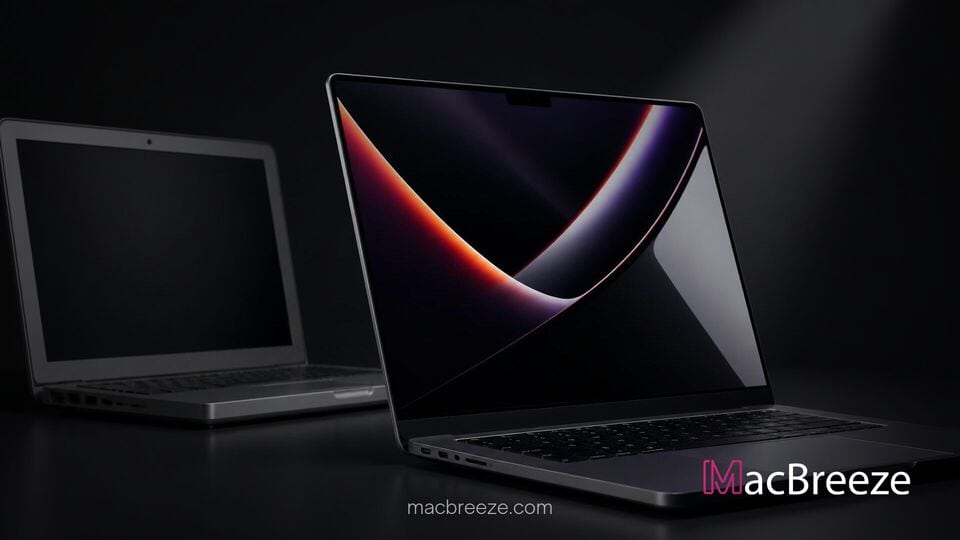
Apple may consolidate its high-end laptop portfolio around touchscreen displays, according to industry reports. Following the recent unveiling of its first touchscreen laptops, the tech giant is expected to discontinue non-touch configurations for its most powerful models during the next major silicon refresh.
While Apple currently sells older non-touch M5 Pro and M5 Max configurations alongside its flagship touch-enabled models, this dual-track strategy is likely temporary. The move suggests that future iterations of the company's professional laptop family will fully embrace direct touch interaction as a standard hardware feature.
Apple Phase Out Non Touch MacBook Pro Options in Favor of Unified High-End Lineup
The core of the shift involves Apple phasing out traditional non-touch screens on its M Pro and M Max tier laptops. When Apple announced its redesigned laptops featuring PROLED XDR display technology, it introduced touch support exclusively on premium configurations. However, to accommodate traditionalists and offer lower entry prices, Apple retained older non-touch models in its lineup.
According to Bloomberg reporter Mark Gurman, this setup will not persist indefinitely. Supporting parallel product lines across development, manufacturing, and marketing requires substantial corporate resources. As a result, when Apple transitions its flagship laptops to second-generation touch architecture powered by M7 Pro and M7 Max processors, non-touch variants in the higher tier are expected to be retired completely.
Bloomberg Report Highlights Shift Toward All-Touch MacBook Pros
Writing in his Power On newsletter, Bloomberg's Mark Gurman outlined how Apple's hardware roadmap is leaning heavily into touch integration. Apple introduced its first touch-capable laptops with tandem OLED technology—branded as PROLED XDR—delivering up to 2,000 nits of peak brightness and an ultra-thin chassis. You can read more about how Apple details 2,000-nit tandem OLED panels on new MacBook Pro models to understand the display advancements driving this change.
The introduction of touch screen hardware has required significant software enhancements. Apple adapted its desktop operating system to handle finger input seamlessly alongside precision trackpads. Industry coverage shows how macOS adapts UI controls for touchscreen MacBook Pro models, ensuring touch targets and system gestures feel natural on a desktop canvas. As software maturity increases, maintaining legacy non-touch display assemblies becomes less practical for supply chains.
Potential Phase-Out of Non-Touch Flagship Models
The transition is set to affect the high-performance tier of Apple's portable lineup. Currently, buyers who want M5 Pro or M5 Max hardware can choose between the newer touch-enabled chassis and the previous non-touch design. The premium touch version carries a $400 price increase over its non-touch predecessor, starting at $2,899 for the 14-inch version and $3,399 for the 16-inch variant.
Reports suggest that once Apple introduces its next generation of chips, users seeking high-end performance will no longer have the choice to opt out of the touch display. By phasing out non-touch premium options, Apple can simplify assembly pipelines and focus component orders around advanced OLED touch panels.
Product Lineup Strategy and Expected Transition Timeline
The transition is anticipated to take full effect with the release of the second-generation touchscreen laptops. Reports indicate that Apple is actively developing new hardware around M7 Pro and M7 Max processors, targeted for launch down the road. Early details on this effort show that Apple is developing M7 touchscreen MacBook Pro models to build upon its initial touch architecture.
This timeline gives Apple time to monitor user feedback and assess demand for touchscreen features among creative professionals, video editors, and software developers. It also coincides with broader growth across the platform; recent financial disclosures revealed that Mac revenue surged 24% as Apple reported $114.5 billion in Q4, demonstrating strong underlying consumer demand for Mac hardware updates.
Why Apple May Retain Non-Touch Displays on Base MacBooks
While high-end models transition to touch-only configurations, Apple's entry-level laptops are expected to retain traditional non-touch displays. The standard 14-inch MacBook Pro is scheduled to adopt the thinner enclosure and slimmer bezels of the new flagship design when it upgrades to standard M7 silicon, but it will likely stick to a conventional mini-LED screen without touch hardware.
Keeping touch technology off entry-level machines allows Apple to maintain a clear tier structure. It ensures that budget-conscious professionals and students have access to a lower price point, while preserving touchscreen interactive functionality as a defining marker of the premium tier. Apple's recent push into mainstream and educational markets highlights this strategy, seen in developments like the TechRadar Laptop of the Year award for the MacBook Neo.
Ultimately, consolidating touch technology into flagship models reflects Apple's broader ambition to modernize the Mac user experience. By phasing out legacy non-touch options on high-end configurations, Apple aims to establish touch as an essential capability for professional computing while keeping entry-level devices accessible.