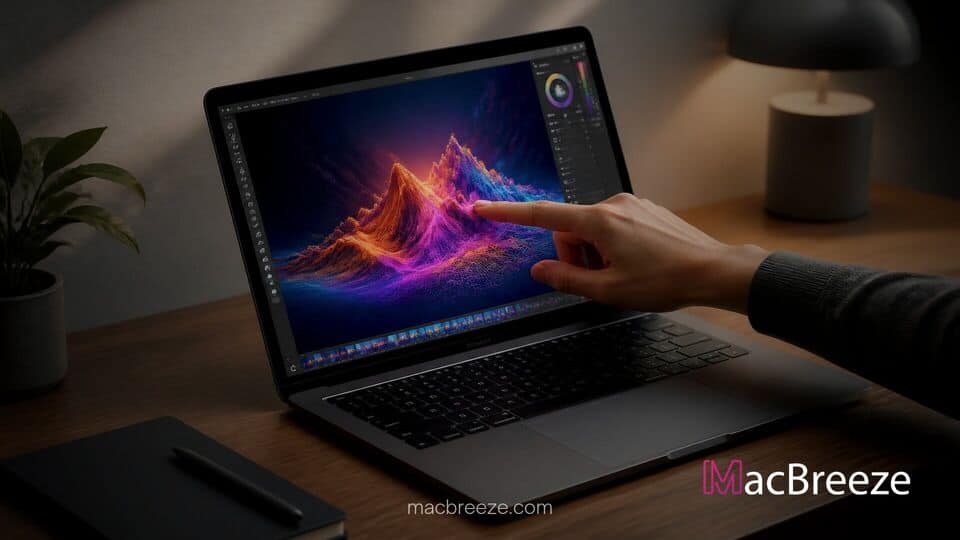
Apple is accelerating its long-term roadmap for touch-enabled Mac hardware following recent flagship display debuts. Fresh industry intelligence reveals that the Cupertino tech giant is working on a second-generation touch-enabled laptop powered by next-generation M7 architecture, scheduled to debut by late 2027.
The upcoming lineup will refine high-end professional performance while trickling physical redesigns down to entry-level configurations. With updated supply chain indications and software frameworks aligning around direct display interactions, Apple appears committed to solidifying touch functionality across its premium portable computers.
M7 Touchscreen MacBook Pro 2027 Rumors Point to AI-Focused Silicon
According to initial reports detailing the M7 touchscreen MacBook Pro 2027 rumors, Apple plans to skip high-performance variants of the intermediate M6 family. Instead of introducing M6 Pro and M6 Max processors for its touch-enabled laptops, the company is leaping directly to the M7 family to introduce specialized system-on-chip architectures.
Industry analysts project that the premium 14-inch and 16-inch laptops will deploy M7 Pro and M7 Max chips built on advanced semiconductor nodes. These chips are anticipated to deliver significant leaps in thermal efficiency, multi-core throughput, and dedicated execution modules tailored specifically for complex artificial intelligence operations.
Next-Gen M7 Silicon Leaks and AI Capabilities
The architectural shift behind the M7 processor family focuses heavily on expanding hardware-level artificial intelligence acceleration. As on-device processing requirements increase for system tasks, the upcoming silicon is expected to feature a dramatically expanded Neural Engine capable of running complex multi-modal intelligence models locally without relying on cloud infrastructure.
This push toward hardware-bound AI performance matches broader company initiatives outlined across executive leadership. Apple CEO John Ternus outlined an on-device AI strategy that emphasizes local processing security, high bandwidth memory access, and seamless system integrations. The M7 generation will serve as a physical foundation for these expansive software capabilities, allowing context-aware automation directly on desktop-class notebooks.
Upgrades Expected in M7 Pro and M7 Max Chips
The high-end M7 Pro and M7 Max configurations are set to bring substantial architectural changes compared to previous pro-grade silicon:
- Expanded Unified Memory Bandwidth: Substantial speed improvements to support heavy local AI models and high-resolution creative assets.
- Dedicated AI Coprocessing: Advanced execution units designed to accelerate real-time voice, vision, and contextual computer interactions.
- Enhanced GPU Compute: Next-generation graphical cores built for real-time ray tracing and complex 3D rendering environments.
- Improved Power Efficiency: Advanced silicon node manufacturing allowing longer battery longevity under intense workflows.
Slimmer Chassis Redesign for Entry-Level 14-Inch Model
While the top-tier touch-enabled laptops push computational limits with M7 Pro and M7 Max configurations, Apple is also planning updates for entry-level buyers. The standard 14-inch MacBook Pro will move to a base M7 chip while adopting the thinner chassis, lighter physical footprint, and narrower display bezels originally introduced on premium models.
However, reports emphasize that the standard entry-level configuration may remain distinct from its costlier siblings. Apple will likely preserve non-touch display panels on base models to keep introductory price thresholds accessible for mainstream consumers and institutional enterprise deployments. This hardware tiering ensures that high-end interactive display features remain positioned as premium options for creative professionals.
Long-Term Transition Plan for Touchscreen Macs
The introduction of touch hardware marks one of the most significant shifts in macOS history. Behind the scenes, software development teams have been laying the groundwork for fluid display interaction without sacrificing traditional desktop utility. System updates reflect this evolution, as seen when Apple released macOS 27.2 with newly discovered touch frameworks.
To support touch interaction on large displays, operating system controls are being tuned for hybrid input workflows. Apple detailed how macOS adapts UI controls for touch screen interactions, ensuring that on-screen buttons, contextual menus, and multi-finger gestures expand dynamically when a user reaches toward the screen.
Hardware suppliers are ramping up production capacity to accommodate high-end panel demands. Display partners like Samsung Display are expanding specialized production facilities to handle advanced tandem OLED manufacturing. Early market analysis projects that Apple could ship up to 1.5 million touch-enabled units during its launch window, boosting broader consumer acceptance of high-end touch laptops across the entire industry.
By pairing powerful M7 processors with specialized display components and adaptable software, Apple is establishing a long-term foundation for touch computing on the Mac. As development progresses toward 2027, the upcoming MacBook Pro lineup promises to refine how professionals interact with digital workspaces.