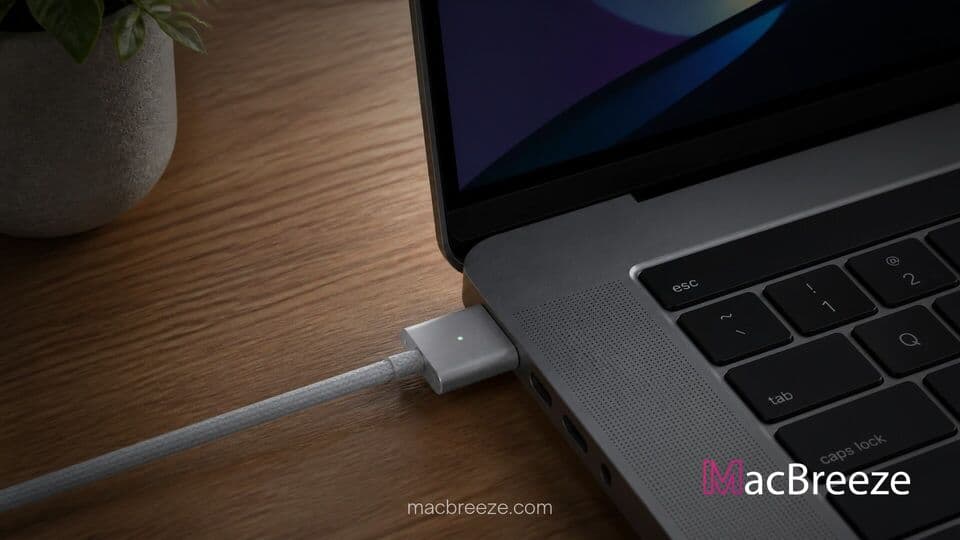
Apple has quietly rolled out a new software revision for its USB-C to MagSafe 3 charging cable, bringing the internal accessory software to version 3.2.0. The unexpected update replaces the previous version 3.1.12 build, marking the first firmware refresh for the braided power cord since February 2023.
As is customary with power delivery accessories and charging adapters, Apple has not provided official release notes or documentation detailing the specific enhancements. While the exact contents of the release remain unconfirmed, updates of this nature typically target power delivery efficiency, thermal management, status LED behavior, or compatibility refinements across current and upcoming portable Mac hardware.
Unannounced 3.2.0 Firmware Update Rolls Out to MagSafe 3 Cables
The new software package arrives automatically for users without requiring manual downloads, software installers, or user intervention. Apple handles peripheral maintenance silently in the background whenever an affected cable is connected to a active Mac system while simultaneously drawing power from a compatible USB-C power brick.
While major operational changes in minor point releases are rare, background maintenance keeps power negotiation standards aligned across evolving macOS environments. The quiet release highlights Apple's habit of pushing incremental fixes to its active accessory ecosystem. Similar silent deployments frequently occur across AirTags, AirPods, MagSafe Battery Packs, and official USB-C charging bricks when minor optimizations are necessary.
Supported MacBook Pro and MacBook Air Models
The 3.2.0 firmware applies universally to all standalone and bundled USB-C to MagSafe 3 cables. First reintroduced alongside the redesigned Apple Silicon laptop lineup, the magnetic quick-release power connector is standard equipment on several current Mac models:
- 14-inch MacBook Pro models equipped with M1, M2, or M3 series processors
- 16-inch MacBook Pro models equipped with M1, M2, or M3 series processors
- 13-inch and 15-inch MacBook Air models featuring M2 or M3 chips
Because the hardware design remains identical across standalone retail purchases and in-box laptop accessories, every official MagSafe 3 lead currently in circulation is eligible for the automated update.
Automatic Delivery and Verification Challenges
Unlike standard external accessories or Thunderbolt displays, checking the precise firmware build of a charging cable presents a unique technical challenge. macOS does not traditionally surface explicit revision numbers for standard power cables within the System Information application or System Settings.
Because there is no manual trigger to force the installation, MacBook owners simply need to use their laptops normally while plugged into AC power. Over time, the host system negotiates the background installation with the cable's internal controller chip.
The Role of Active Controllers in Apple Power Accessories
Modern high-wattage power cords are sophisticated micro-computing devices rather than simple copper wires. Apple's MagSafe 3 cable incorporates integrated circuit controllers tasked with managing fast-charging handshakes, monitoring thermal levels, and controlling the multi-color charging status LED located inside the aluminum connector housing.
When connected to a high-output charger, the cable communicates with both the power adapter and the laptop's internal power management controller. This active negotiation prevents over-voltage conditions, regulates power flow, and safely enables high-speed charging up to 140W on supported 16-inch laptops. Firmware updates allow Apple to continuously refine these safety protocols and maintain operational stability as underlying platform operating systems evolve alongside cumulative updates like macOS security patches.
While consumers should not expect noticeable functional alterations following the update, keeping the laptop connected to power ensures the cable successfully completes the background upgrade process.