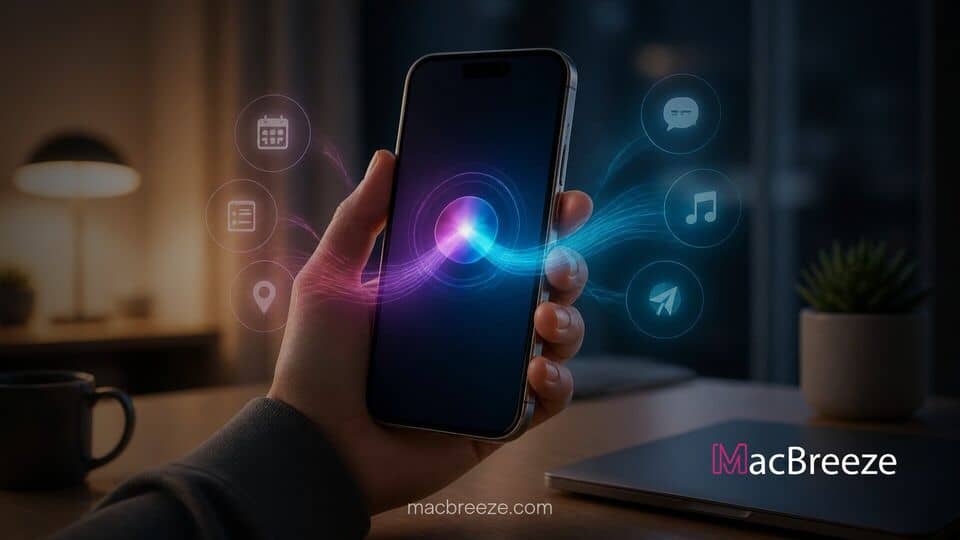
Apple executive leadership is reportedly pushing software teams to transform Siri from a prompt-based voice assistant into an autonomous digital agent capable of handling multi-step tasks across operating system frameworks. According to industry reports, the initiative is slated to culminate in major architectural upgrades for iOS 28 and related software platforms.
The strategic shift aims to help Apple keep pace with rapid developments in background AI processing, where competitor systems independently track goals, execute actions, and report back to users without requiring continuous manual prompts for every subtask.
Apple CEO Pushes Software Team Toward Multi-Step Siri AI Capabilities
In recent internal strategy meetings, Apple leadership has made expanding artificial intelligence capabilities a top priority across the engineering organization amid shifting internal AI investments. Executives are focused on accelerating the virtual assistant roadmap to move beyond single-turn commands and simple search queries.
Rather than simply waiting for a user to trigger a command, the envisioned assistant would handle persistent responsibilities. For example, if a user asks the system to handle travel arrangements, an agentic voice assistant would monitor flight availability, reserve hotel accommodations, update calendar schedules, and inform contacts, carrying out the sequence in the background under set security boundaries.
Goal of Proactive Task Completion Over Command Parsing
Historically, virtual assistants have relied on command parsing, translating specific spoken phrases into defined system actions. The transition toward an agentic architecture represents a fundamental shift in how user intents are processed on-device and in the cloud.
Instead of executing one isolated function per request, an agentic assistant maintains context over time, tracks overall project goals, and autonomously determines the necessary logical steps to reach completion. This approach leverages structured system hooks to perform multi-app routines without requiring constant step-by-step user confirmation.
iOS 28 Development Schedule Expanded to Six-Week Feature Cycles
To support the ambitious timeline for iOS 28, Apple is reportedly altering its traditional internal software engineering schedule. Traditionally, operating system feature development operated on alternating four-week cycles: four weeks dedicated to feature creation and coding, followed by four weeks of integration and bug fixing.
For the upcoming update cycle, software engineering management has reportedly adjusted this workflow to a six-week coding and exploration block followed by a two-week integration period. This 50 percent increase in initial feature iteration time gives developers broader latitude to build complex AI frameworks, test intent chaining, and refine background model execution before merging code into main release builds.
Balancing AI Innovation With Operating System Stability
The revised engineering schedule aims to reduce mid-cycle feature delays while maintaining system-wide performance standards. By granting software teams extended focused coding windows, Apple hopes to avoid the staggered feature rollouts that characterized earlier software releases.
The extended cycle also provides hardware and software integration teams more time to optimize local model performance on Apple Silicon devices. Ensuring that background reasoning models consume minimal battery and system memory remains a core requirement for on-device agent execution.
Impact on iPhone Users and Apple Intelligence Roadmap
The push toward an autonomous assistant builds directly upon incremental software foundations currently reaching developers and public beta testers. Recent incremental releases, such as the first iOS 27.3 public beta update, have expanded internal application actions, while initiatives allowing Siri AI integration for third-party developers have established broader intent mapping.
While earlier features enabled single-app deep linking and basic context awareness across native apps, iOS 28 is expected to unify these endpoints into automated task chains. Apple continues to emphasize privacy guardrails, ensuring that agentic background tasks operate within user-defined permissions without transmitting sensitive data outside secure environments.
As competitors introduce background processing interfaces powered by remote virtual machines, Apple is positioning its deep integration with on-device hardware and local APIs as an efficient, privacy-focused alternative. If development targets remain on schedule, users can expect the first official preview of these proactive capabilities at Apple's annual developer conference next year.