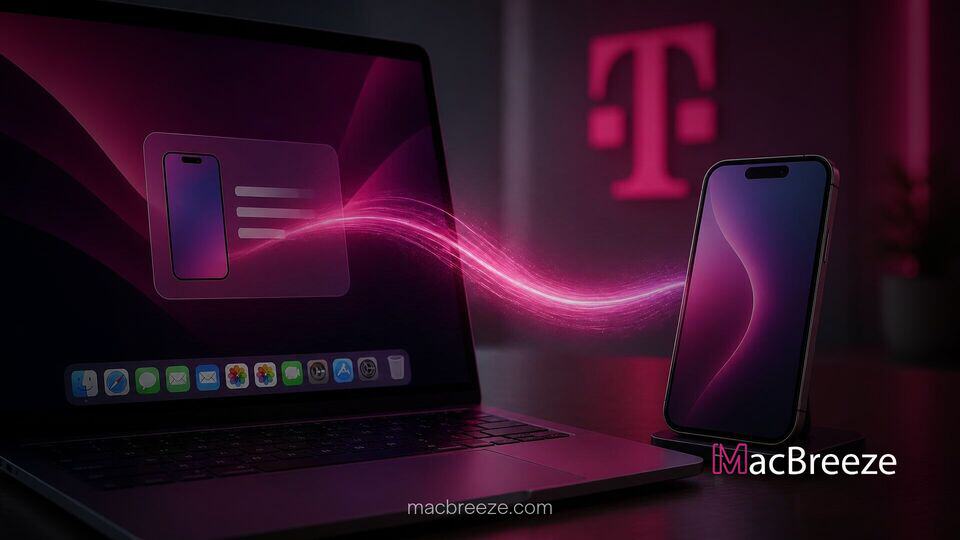
T-Mobile has officially confirmed that it will charge customers an additional $5 monthly fee to access Apple's new iPhone Handoff feature introduced in iOS 27. The upcoming operating system capability allows users to seamlessly share a single phone number across two active iPhones using advanced eSIM technology.
T-Mobile Confirms $5 Monthly Fee for iOS 27 iPhone Handoff
Following Apple's unveiling of its latest software update, T-Mobile revealed its pricing structure for the feature, establishing a $5 per month subscription fee for subscribers who wish to utilize iPhone Handoff. The add-on cost applies to eligible wireless plans and allows a single cellular subscription to extend its active service to a secondary handset. While Apple developed the underlying technology in iOS 27, carrier integration is required to manage network authentication and routing across multiple eSIM profiles. T-Mobile is among the first wireless operators to support the function, positioning it as a convenience option for multi-device owners.
How iPhone Handoff Operates Across Two Handsets
Apple designed iPhone Handoff to simplify device management for people who carry separate smartphones for different scenarios, such as business travel, outdoor activities, or using specialized hardware. Under the system, one handset is designated as the primary device while a secondary handset shares the same line. When a user unlocks the secondary iPhone, the network instantly transfers the active phone line to that device. A notification banner reading "Switched to this iPhone" appears at the top of the display to confirm the handoff.
Calls, text messages (SMS/MMS, iMessage, and RCS), voicemail, and Find My location services automatically route to whichever handset is currently unlocked and active. Additionally, third-party apps, payment cards in Apple Wallet, and general iCloud data continue to sync seamlessly between both units. However, Apple notes that a single phone number can only be active on one device at a time, meaning both phones cannot receive incoming cellular calls simultaneously. Certain carrier administrative tools, including Caller ID configuration and call forwarding options, remain permanently tied to the primary device.
Carrier Requirements and Launch Availability
To use iPhone Handoff at launch, customers must meet specific hardware, software, and carrier conditions. Both smartphones must be running iOS 27 or later, signed into the same Apple Account, and connected to Wi-Fi during the initial provisioning process. FaceTime, iMessage, and Messages in iCloud must also be enabled across both devices to maintain message thread synchronization. Crucially, the cellular connection relies entirely on eSIM provisioning from a participating network provider.
T-Mobile and Deutsche Telekom Support Details
At launch, T-Mobile is the exclusive wireless operator offering iPhone Handoff in the United States, while its parent corporation, Deutsche Telekom, provides the service in Germany. T-Mobile confirmed that the $5 monthly charge grants full access to calls, messaging, high-speed data, mobile hotspot sharing, Scam Shield protection, and satellite connectivity on eligible mobile tariffs. The service is fully supported on current-generation hardware, including the flagship iPhone 18 Pro lineup and the foldable iPhone Duo, as well as older models updated to iOS 27.
Expected Rollout for Additional Network Carriers
Although T-Mobile and Deutsche Telekom are leading the initial launch, other global telecommunications providers have committed to adding support in the coming months. Apple confirmed that Verizon in the United States and EE in the United Kingdom plan to deploy iPhone Handoff support before the end of the year. Pricing structure details for these upcoming networks have not yet been announced, leaving it unclear whether rival carriers will adopt a similar $5 monthly add-on fee or bundle the feature into premium unlimited service tiers.
What iPhone Users Should Know Before Enabling Handoff
While iPhone Handoff offers clear advantages for users who prefer switching between a heavy-duty flagship handset and a lighter secondary device, consumers should consider several functional limitations. Apple clarified that transit passes, corporate ID badges, and select regional digital keys stored in the Wallet app might not mirror across both devices, requiring users to authenticate those credentials on a single designated handset. Furthermore, pairing an Apple Watch remains tied to one specific iPhone; the smartwatch connection does not automatically transfer when switching the active phone number between devices.
Subscribers interested in setting up the service can do so through the Cellular menu inside the iOS Settings app or during the initial setup process of a new device. Once configured, the recurring carrier fee will be added directly to the subscriber's monthly T-Mobile statement. Users can manage or cancel the add-on feature at any time by contacting carrier customer support.
In summary, T-Mobile's $5 monthly fee introduces a low-cost option for users who want dual-device flexibility without paying for a full second mobile plan. As iOS 27 rolls out globally, additional carriers are expected to share their pricing models for Apple's multi-device network feature.