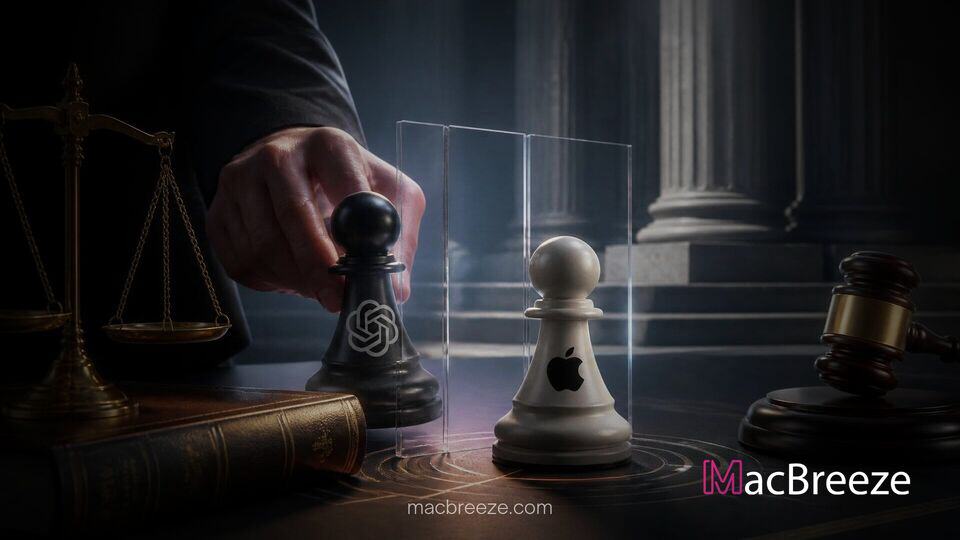
OpenAI filed counterclaims against Apple in a California federal court, alleging that the iPhone maker engaged in trade secret theft, coerced shared hardware suppliers, and implemented restrictive employment practices designed to trap departing engineers . The filing turns the tables on Apple after the Cupertino giant initiated a trade secrets lawsuit earlier in the year, dramatically expanding the legal battlefield surrounding consumer artificial intelligence hardware .
OpenAI Files Counterclaim Against Apple in Trade Secrets Dispute
The counterclaims, submitted in the US District Court for the Northern District of California in San Jose, mark a major escalation in the legal dispute between the two technology leaders . OpenAI alleges that Apple obtained confidential information about OpenAI's upcoming personal hardware products through a former employee who spent six months at OpenAI before returning to Apple . In addition to allegations of intellectual property misappropriation, the lawsuit claims Apple used its immense market power to discourage third-party component vendors and manufacturing partners from working with OpenAI on new hardware initiatives .
Key Allegations of Supplier Restrictions and Talent Blocking
According to the court documents, OpenAI claims Apple instituted aggressive practices to monitor and restrict hardware suppliers . The filing alleges that Apple required shared manufacturers to identify which employees were working on OpenAI projects and demanded updates on those contracts . In several instances, suppliers reportedly rescheduled meetings or altered manufacturing schedules, such as shifting OpenAI production runs to overnight shifts, out of fear of retaliation or loss of business from Apple .
OpenAI also targeted Apple's internal exit procedures . The countersuit asserts that Apple encourages employees to mix personal and work files across personal accounts and then requires same-day departures upon resignation . OpenAI claims this environment creates trapdoors that allow Apple to accuse virtually any departing engineer who moves to a competitor of carrying trade secrets .
Background of the Ongoing Legal Battle Between Apple and OpenAI
The conflict originated when Apple sued OpenAI, alleging that former Apple employees, including chief hardware officer Tang Tan and systems engineer Chang Liu, misappropriated proprietary hardware designs and manufacturing techniques to jump-start OpenAI's physical device ecosystem . Apple claimed that confidential data was transferred to personal storage devices before key executives transitioned to OpenAI's hardware unit, io Products .
The relationship between the two tech leaders was not always so contentious. The companies previously established a high-profile integration partnership, bringing ChatGPT features to Siri and system-level writing tools across Apple operating systems . However, as software systems continue to evolve, the distinction between operating platforms and dedicated AI hardware has blurred. Similar shifting dynamics are visible in Apple's broader ecosystem strategy, where software developments often signal underlying platform transitions, such as work on an autonomous AI agent to control Mac apps or efforts to refine platform features like the iPhone notification center redesign.
An Apple spokesperson pushed back firmly against OpenAI's new claims, describing the counterclaims as a transparent attempt to distract from the core substance of Apple's original complaint . Apple maintained that its legal action focuses directly on former employees deliberately accessing and utilizing confidential product roadmaps and proprietary manufacturing details, rather than routine administrative issues .
Potential Impact on AI Hardware and Ecosystem Competition
The intensifying legal battle underscores how vital proprietary silicon, custom thermal design, and supply chain allocation have become to the future of AI. While software models remain central, consumer hardware optimized for low-latency local inference is quickly becoming the next competitive arena. Apple's long-term hardware roadmap continues to emphasize custom architecture across its computer lineup, with reports suggesting plans for M7 chips with advanced AI speed to handle intensive processing directly on device.
At the same time, the broader hardware landscape is seeing independent developers and researchers push for local AI execution on existing platforms Thinking Machines released Inkling 2 Mini for Mac users, illustrating how software optimization can run alongside heavy dedicated silicon. If OpenAI successfully brings its own standalone AI consumer hardware to market in partnership with former Apple design leaders, it could pose a direct challenge to mobile operating systems, changing how consumers interact with digital services without relying entirely on traditional app stores.
What Lies Ahead in the Apple vs OpenAI Litigation
With both companies now lodging formal claims of trade secret misappropriation, the litigation moves into a comprehensive discovery phase . Court proceedings are expected to examine internal communications, supplier non-disclosure agreements, and exit protocols for high-level engineering talent across both organizations. Legal experts anticipate that pretrial motions will consume significant time as both parties seek protective orders for sensitive technical documentation.
As the case progresses in federal court, the outcome could establish crucial precedents regarding employee mobility, supplier exclusivity, and trade secret boundaries within the rapidly growing artificial intelligence hardware sector.