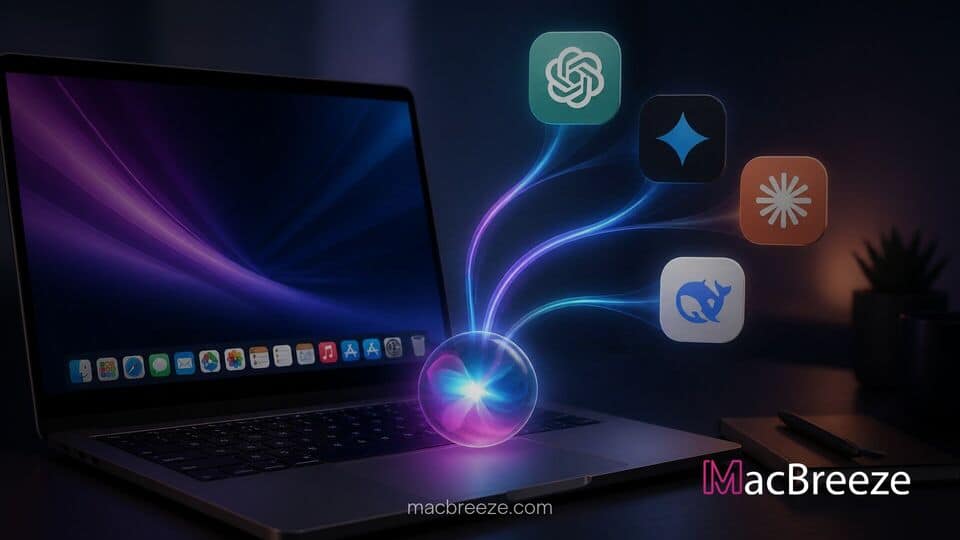
Newly uncovered framework code inside recent builds of macOS 27 suggests Apple is developing system level support that would allow users to swap Siri out in favor of third-party artificial intelligence models. The hidden architecture points to a significant shift in how the operating system handles voice queries and automated workflows.
Instead of relying exclusively on native Apple Intelligence processing, the underlying software includes hooks designed to route requests directly to alternative large language models.
Framework Code Reveals macOS 27 Siri Third Party AI Models Integration
Developers examining private frameworks in macOS 27 Golden Gate builds discovered internal references to a mechanism known as Model Delegation. This API structure extends Apple's existing App Intents architecture, enabling external services to plug directly into system wide entry points that were previously reserved for Siri and the built-in ChatGPT extension.
The code findings show that external providers can declare agent capabilities to the operating system. When a user invokes a command, macOS 27 can delegate the request context, text prompt, and necessary metadata to a designated third-party model. This mechanism operates at a much deeper level than standard third-party desktop utilities, providing direct access to system prompt interfaces, Writing Tools, and context menus.
How Siri Model Delegation Works in macOS 27
The Model Delegation architecture relies on a structured protocol that translates incoming system intents into format agnostic payload packages. According to developer analysis, when a request is issued through the Mac interface, the underlying AgentIntent framework packages the user input along with relevant active window metadata.
The system then forwards the payload to an authenticated background service or bridge app. That bridge communicates with the selected third-party artificial intelligence platform, returning text output, file objects, or structured actions back into the macOS UI stream. If a user asks an external model to perform a hardware level task such as toggling a system setting, the external provider can send a structured handoff back to Siri to execute the action safely.
Potential Integration With Claude and ChatGPT
While OpenAI's ChatGPT already enjoys a specialized partnership inside Apple's ecosystem, code sleuths have verified that alternative platforms like Anthropic's Claude can also be registered as native providers through this framework. In technical proof-of-concept tests, custom extensions built on the new internal APIs allowed Claude to handle queries directly within the system wide query bar.
This means users could theoretically select Claude, ChatGPT, or Google Gemini as their primary intelligence provider across macOS 27. Independent developers have already demonstrated that external models integrated via these hidden hooks can generate complex file types like CSV spreadsheets and pass them back to the desktop, expanding functionality beyond what default system tools currently offer. Similar integration moves are taking place across the software suite, as seen when ChatGPT for Mac added an Apple Messages plugin that allows direct text analysis.
Regulatory and Ecosystem Impact of Open Assistant Frameworks
The presence of an open delegation framework inside macOS 27 aligns with growing global regulatory scrutiny surrounding platform competition. Digital market authorities in both North America and Europe have increasingly pressured major tech companies to avoid favoring their own proprietary services on desktop and mobile platforms.
By building a modular architecture capable of routing user prompts to competing large language models, Apple lays the groundwork to avoid anti-competitive claims regarding default virtual assistants. Giving users the choice to swap default assistants transforms the Mac operating system into a neutral distribution hub for artificial intelligence services.
The open design also benefits enterprise environments where security compliance requires specific AI vendors. Organizations that mandate the use of dedicated Claude or Azure OpenAI endpoints could theoretically configure system level policies that direct all user requests away from default public cloud servers.
Availability and Next Steps for Apple Intelligence
Apple has not formally announced the user-facing model picker during its primary developer presentations, leaving the functionality disabled by default in current software releases. Reports indicate that backend feature flags and preliminary settings panels remain toggled off while negotiations with major partner companies proceed.
Nevertheless, the presence of fully functional underlying frameworks confirms that Apple is actively preparing for a multi-model ecosystem. As Apple rolls out its latest operating systems, developers expect further updates regarding software entitlements and App Store submission guidelines. This structural shift occurs alongside broader system preparations, such as when Apple confirmed all macOS 27 compatible Macs support Apple Intelligence natively without feature fragmentation.
In summary, while Apple continues to refine its own internal machine learning models, the code discovered in macOS 27 demonstrates a clear commitment to flexibility. By establishing standardized APIs for third-party AI delegation, Apple is positioning macOS as an open platform capable of adapting to whichever AI assistant users prefer.