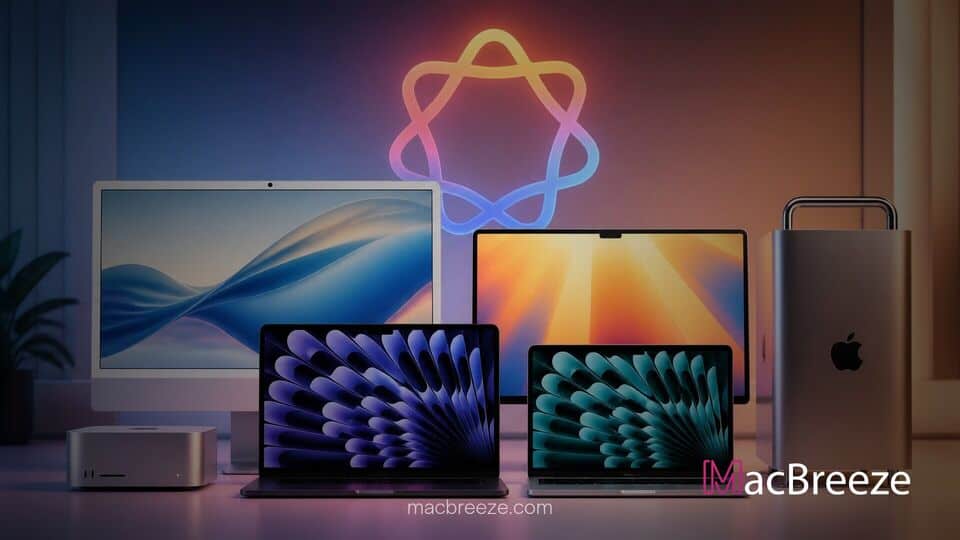
Apple has officially confirmed that all Mac models compatible with the upcoming macOS 27 update will support its suite of Apple Intelligence features. The announcement establishes a single compatibility standard for desktop and laptop Mac users ahead of the operating system's general availability.
Unlike iOS and iPadOS, which enforce different hardware cutoffs for advanced artificial intelligence capabilities, macOS 27 will offer unified feature parity across every supported system. Any Mac owner who can install the new operating system will have complete access to Apple's latest generative writing, image generation, and workflow automation tools.
macOS 27 Apple Intelligence Mac Compatibility and Unified Requirements
Apple clarified that macOS 27 Apple Intelligence mac compatibility covers every computer that meets the baseline installation requirements for the operating system. By tying system support directly to AI capabilities, Apple eliminates the confusion caused by tiered feature rollouts on mobile devices. The software suite leverages the Neural Engine across the Apple Silicon ecosystem to execute local models while using Private Cloud Compute for complex requests.
Single Hardware Cutoff for All Supported Macs
By establishing a unified baseline, Apple ensures that Mac users will not encounter soft hardware barriers after installing macOS 27. Every supported machine contains a dedicated Neural Engine capable of running on-device large language models and diffusion models. This architectural consistency allows Apple to maintain identical feature sets across the entire Mac lineup, from ultra-portable laptops to high-end workstation desktops.
Comparison With Tiered iOS 27 Compatibility Wall
This streamlined approach contrasts sharply with the strategy for mobile devices. Following the recent release of the macOS 27 Golden Gate Release Candidate, developers noted that mobile operating systems maintain stricter hardware divides. While older iPhones and iPads run base versions of iOS 27 and iPadOS 27 without full access to next-generation Siri processing, the Mac ecosystem remains fully unified. Desktop hardware historically ships with higher unified memory configurations, enabling older Apple Silicon chips to process local AI parameters without compromising system stability.
Mac Models Eligible for Apple Intelligence Features
The confirmed support matrix covers every Apple Silicon computer released since the transition away from legacy processors began. Because Apple dropped support for Intel-based processors in earlier software updates, every Mac compatible with macOS 27 features custom silicon equipped with a hardware Neural Engine.
The list of fully compatible hardware includes:
- MacBook Air: All models powered by M1, M2, M3, M4, and newer Apple Silicon chips.
- MacBook Pro: All 13-inch, 14-inch, 16-inch, and 15-inch models equipped with M-series processors.
- iMac: 24-inch iMac models featuring M1, M3, or newer chipsets.
- Mac mini: Every Apple Silicon Mac mini configuration, starting from the M1 baseline.
- Mac Studio: All configurations powered by Max and Ultra series chips.
- Mac Pro: All workstation models configured with Apple Silicon processors.
Because Apple plans to phase out Rosetta support for Intel Mac apps, focusing software innovations exclusively on Apple Silicon architecture has simplified background optimization. Developers writing software for macOS 27 can target a single hardware standard without designing fallback modes for machines lacking Neural Engine acceleration.
Core AI Capabilities Arriving With macOS Golden Gate
With compatibility confirmed for all supported machines, Mac users can expect a comprehensive range of intelligence enhancements integrated deeply across the system interface. Key features include upgraded Writing Tools that allow users to rewrite, proofread, and summarize text across native and third-party apps.
The operating system also introduces dynamic image creation in Image Playground, personalized Genmoji generation, and prioritized notification summaries in Notification Center and Mail. Additionally, a redesigned Siri features enhanced rich language understanding, enabling natural conversation handling and contextual awareness across multiple desktop applications simultaneously.
Privacy remains a central focus of the implementation. Tasks that require cloud compute resources utilize dedicated Apple Silicon servers running Private Cloud Compute, ensuring that user data is never stored, logged, or made accessible to third parties.
Release Schedule and Final Launch Expectations
Apple confirmed that macOS 27 Golden Gate will launch alongside companion updates across the product ecosystem. The public rollout matches the broader release timeline, mirroring launches like the watchOS 27 release with Siri AI capabilities.
As the final public build arrives, developers are finishing optimization updates using the latest SDKs. By guaranteeing that every macOS 27 user enjoys full Apple Intelligence access, Apple creates a consistent foundation for software creators building next-generation productivity apps for the Mac ecosystem.