Google has officially started rolling out a dedicated Gemini app for Apple CarPlay, allowing iPhone users to access the tech giant's flagship artificial intelligence assistant directly from their vehicle displays. The global rollout brings full support for Gemini Live, enabling hands-free, back-and-forth conversational capabilities while driving.
By bringing its standalone conversational assistant to CarPlay, Google is transforming how commuters interact with digital tools while navigating their daily trips. The release allows drivers to summarize email threads, review calendar entries, and brainstorm ideas on the move without picking up their smartphones.
Google Expands Gemini AI Access to Apple CarPlay
The arrival of the dedicated app marks a major step forward from Google's previous automotive integrations on iOS devices. While Google previously offered lightweight navigation-centric Gemini features inside the Google Maps CarPlay interface, this update delivers the full, standalone Gemini experience directly to the dashboard.
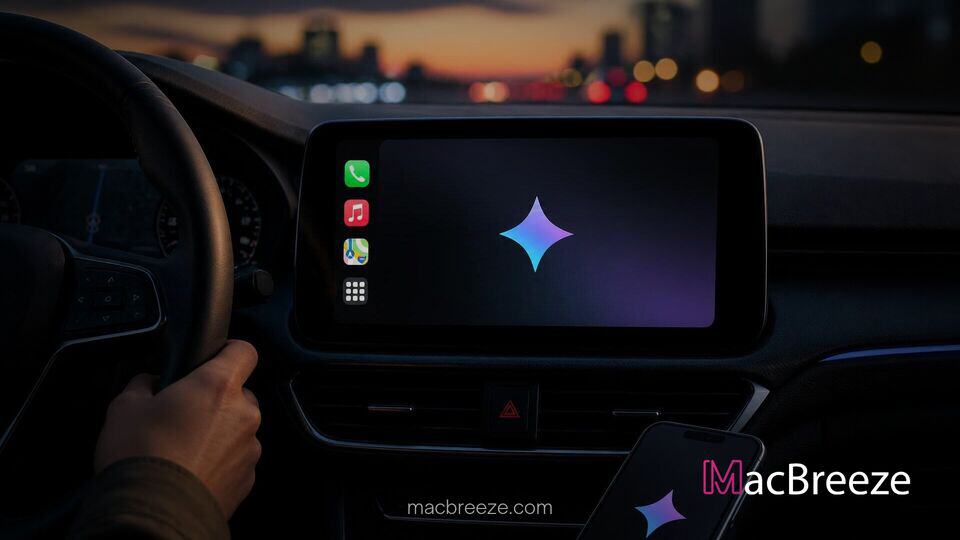
To use the new software, iPhone owners must install the latest version of the Gemini app from the App Store, enable microphone permissions, and complete at least one Gemini Live session on their handset. Once connected to a CarPlay vehicle, a dedicated Gemini icon appears in the car's app grid and side rail. Tapping the icon immediately activates the assistant, presenting a sleek audio visualizer waveform on the dashboard screen to signal when Gemini is listening, processing, or speaking back.
Synchronization between platforms is automatic. Drivers can initiate a topic on their iPhone while walking to their car, pick up the discussion hands-free while driving, and then review all generated summaries or meeting notes inside the iPhone app after parking.
New Voice Capabilities and In-Car Assistant Controls
Central to the update is Gemini Live, Google's fluid voice experience designed to handle complex, multi-turn conversations. During a drive, users can naturally interrupt the chatbot to provide updated context, ask follow-up questions, change topics, or temporarily pause the audio response when traffic demands their full attention.
The integration connects deeply with Google Workspace applications such as Gmail and Google Calendar. Drivers can request a customized morning brief to catch up on unread emails, review their schedule for the day, or ask for quick summaries of dense project threads. Beyond productivity, the assistant can suggest nearby restaurants, explain local landmark histories, or serve as a sounding board for practicing upcoming business presentations.
However, the software operates strictly as a conversational layer rather than a deep vehicle controller. Because Gemini runs inside the CarPlay app sandbox, it cannot adjust cabin air conditioning, modify vehicle climate controls, or interact directly with car hardware. Furthermore, drivers must initiate sessions by tapping the screen icon rather than uttering a hands-free wake phrase.
How Gemini Integrates With the CarPlay Interface
The user interface has been tailored to maintain driver safety and minimize visually complex elements. When active, the display shows minimal text, featuring large touch targets for muting the microphone or ending the active session. The visual feedback waveform informs the user of state changes, ensuring they can keep their eyes on the road as much as possible.
This update follows a series of broader software changes across the mobile ecosystem. Users tracking operating system updates may note that system performance and background stability remain vital for real-time voice processing, similar to improvements introduced when Apple released iOS 27.2.1 and iPadOS 27.2.1 to address core system security. As AI applications become more demanding, maintaining low latency over cellular and wireless CarPlay links remains critical for responsive spoken feedback.
For users who regularly employ multi-device workflows, the cross-platform synchronization offers significant efficiency gains. Developers continue to explore distributing computational tasks across hardware environments, reminiscent of how tools like OMLX v0.7.4 enable distributed local LLM inference across desktop devices. While Gemini's car experience relies heavily on cloud infrastructure, seamless handoffs across endpoint devices represent a growing standard in modern software design.
Implications for AI Ecosystems in Connected Vehicles
Google's entry into the CarPlay space completes a notable expansion of third-party AI assistants onto Apple's automotive platform. After Apple opened CarPlay to voice-centric conversational software categories, platforms such as ChatGPT, Claude, Perplexity, Copilot, and Meta AI quickly deployed dedicated dashboard utilities. Gemini was one of the last major standalone AI holds out on the system.
The launch highlights a unique dynamics shift between the tech giants. While Apple continues refining its own Siri assistant and deep system controls, allowing rival AI engines onto CarPlay ensures iPhone users can tap into their preferred workspace services regardless of their car's native operating software. Furthermore, as Apple explores future features, such as pushing for proactive agentic Siri capabilities in iOS 28, third-party assistants are pushing the boundaries of continuous audio interaction inside the vehicle cabin.
The global rollout of the Gemini CarPlay app is available immediately to all iOS users across every region and language supported by Gemini Live. As connected vehicle software matures, third-party AI platforms are proving that the daily commute can double as a productive, hands-free workspace.