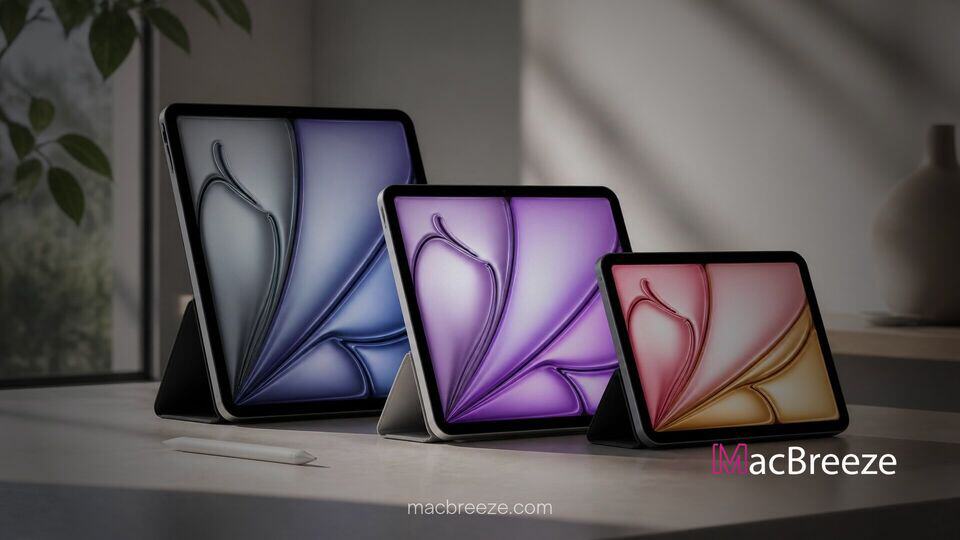
Apple is reportedly preparing a concentrated refresh of its tablet portfolio, targeting the first half of 2027 for a major hardware rollout. Industry reports indicate that the company plans to introduce three distinct tablet revisions during this window, sweeping across its entry-level, mid-tier, and top-end lineups.
According to supply chain details and industry analysts, the upcoming wave will refresh the standard base-model iPad, bring panel upgrades to the iPad Air, and introduce enhanced thermal architecture to the high-end iPad Pro. The strategy focuses heavy development resources into the first six months of the year, with virtually no additional tablet releases planned for the remainder of 2027.
Apple Three New iPad Models 2027 Strategy Overview
The roadmap points to a strategic realigning of Apple's tablet segment, bringing performance parity and display tech improvements across every tier. While consumers recently saw smaller releases, this early 2027 window consolidates hardware updates into a unified spring release schedule. The initiative follows broader silicon shifts across the hardware catalog, echoing trends seen where Apple CEO John Ternus outlined on-device AI strategy as a cornerstone of future product developments.
Gurman Report Outlines Apple 2027 iPad Roadmap
Writing in his weekly newsletter, Bloomberg reporter Mark Gurman revealed that Apple is pacing its release schedule to ensure all three key iPad updates land early in the calendar year. Rather than staggering releases across distinct autumn and spring media events, Cupertino is aiming for a consolidated launch window between March and June 2027.
Gurman highlighted that after this initial spring burst, tablet revisions will conclude for the year. This concentrated approach gives consumers a clear view of the entire lineup at once, preventing buyers from waiting on late-year surprise hardware announcements.
Entry-Level iPad 12 Gaining A19 Chip and Apple Intelligence
The most accessible device in the lineup, the 12th-generation entry-level iPad, is scheduled for its long-awaited update. Having retained older silicon in previous generations, the new base model is expected to feature Apple's A19 system-on-chip. This chip jump represents a significant leap forward in raw processing speed and power efficiency.
Crucially, pairing the A19 processor with an upgraded 8GB of RAM brings native support for Apple Intelligence to the entry-level tier. Earlier hardware revisions lacked the required memory bandwidth for complex localized machine learning tasks. Adding this capability democratizes on-device AI capabilities across Apple's entire tablet catalog. Furthermore, internal code points to the inclusion of Apple's proprietary N1 wireless module and C1X cellular modem, modernizing the tablet's connectivity stack.
OLED Display Upgrade Coming to Next-Gen iPad Air
The mid-range iPad Air is set to receive one of its most substantial hardware enhancements to date. Apple plans to transition the iPad Air lineup to OLED display panels, expanding high-contrast screen technology beyond the top-tier flagship units.
This panel transition promises deeper blacks, higher color saturation, and improved power efficiency for mid-tier users. While ProMotion high-refresh rates may remain exclusive to the Pro line to maintain product segmentation, bringing OLED technology to the Air significantly narrows the visual quality gap between mid-range and professional models. The device is also slated to receive Apple's M-series silicon refresh to power the expanded screen real estate.
iPad Pro Redesign to Incorporate Vapor Chamber Cooling
At the top tier, the upcoming iPad Pro iteration focuses on sustained hardware performance. Internal hardware details indicate Apple is introducing vapor chamber cooling into the ultra-thin iPad Pro chassis.
As computational demands rise with next-generation M-series processors and complex graphics rendering, heat dissipation becomes critical. A vapor chamber allows heat to spread evenly across the chassis interior, preventing thermal throttling during extended video editing, 3D modeling, or intensive gaming sessions. This cooling architecture mirrors thermal solutions developed for high-end mobile devices, ensuring the iPad Pro maintains peak processing power over longer durations.
Timeline and Strategic Context for Apple Tablet Lineup
Launching three distinct tablets in early 2027 reflects Apple's effort to streamline its supply chain and marketing efforts. By establishing clear feature tiers early in the year, Apple provides enterprise buyers, educational institutions, and casual consumers a complete picture of their hardware options.
This timing also allows Apple's hardware roadmap to sync smoothly alongside desktop innovations, such as rumors that Apple is developing an M7 Touchscreen MacBook Pro for 2027. Similar hardware synchronicity is visible in rumors around the laptop segment, including reports that Apple is planning a second-gen MacBook Neo launch for early 2027.
What Existing iPad Owners Should Expect Next
For current tablet owners, the prospective 2027 lineup offers significant reasons to evaluate upgrade paths. Base-model users gaining access to advanced AI tools and faster wireless chips will experience a modern computing environment. Meanwhile, creative professionals relying on sustained performance will benefit directly from the thermal stability offered by vapor chamber designs.
As trade-in programs evolve, users looking to transition to upcoming models may want to monitor secondary market values. Recent trade-in adjustments highlight how Apple boosts Mac and iPad trade-in values prior to major hardware hardware updates. As early 2027 approaches, further details regarding exact release dates and regional pricing are expected to surface.
In short, Apple's early 2027 tablet roadmap represents a comprehensive modernization of the iPad family. By delivering OLED screens, localized AI processing, and advanced cooling across the portfolio, Apple is setting a high bar for mobile computing performance in the coming years.