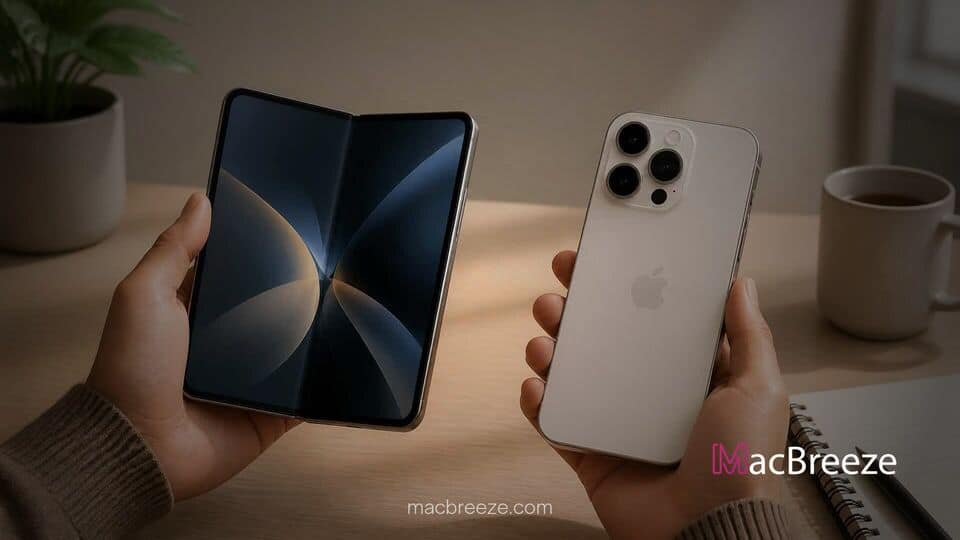
Apple has begun distributing digital questionnaires to select customers who recently purchased the company's first foldable smartphone, the iPhone Duo. The outreach effort focuses on gathering direct user feedback regarding key hardware decisions, including the inner display crease and the performance of the under-display camera.
Apple Collects Early Feedback via iPhone Duo Customer Surveys
Following the official launch of the iPhone Duo, Apple is sending detailed email questionnaires to understand how early adopters are responding to the new form factor. Post-launch outreach is a standard practice for Apple after introducing major new product categories, but this specific campaign targets several design compromises unique to flexible hardware. The launch of the foldable device comes during a busy autumn season for Apple, which also saw high demand across its conventional device lineup, such as when iPhone 18 Pro sales surged 29% in China to offset shifting global market trends.
The survey opens by exploring customer purchasing motivations. Recipients are asked to select primary reasons for buying the foldable device upon release, with options such as wanting to experience Apple's initial entry into the foldable market, making an impulse purchase, or anticipating broader price increases across high-end smartphones in the near future.
Key Questions Focus on Display Crease and Under-Display Camera
Subsequent sections of the questionnaire turn directly toward hardware usability and visual compromises. Apple asks respondents to evaluate the 5.4-inch outer display when the handset is closed, a compact footprint comparable to Apple's discontinued mini phone line. The company then inquires about the visibility of the horizontal crease across the primary 7.6-inch folding screen, asking users how noticeable the seam is during daily operation.
Another major focus of the survey is the under-display camera located beneath the internal screen. Apple asks whether the module causes visual distractions or discomfort during screen use and prompts owners to rate the photo quality produced by the 4-megapixel sensor. Early hands-on reviews cited the under-display camera resolution and lower light capture as notable trade-offs made to deliver an uninterrupted internal workspace.
The questionnaire finishes with an open-ended feedback field, giving users the freedom to state what features or hardware adjustments they would like to see added or modified on the iPhone Duo in future iterations. Interestingly, the survey avoids asking about unoptimized third-party apps or recent social media reports of minor hinge noises, focusing almost entirely on display ergonomics and imaging.
Why Apple Is Gathering Foldable Hardware Input
Collecting structured feedback allows Apple engineers and product planners to quantify how real-world users perceive technical trade-offs compared to initial lab testing. While structural durability tests have shown promising resilience, customer sentiment often highlights everyday friction points that lab automation cannot fully capture.
The tech industry has observed similar customer surveys during previous major product debuts, such as when Apple polled early Vision Pro owners regarding headset weight and battery pack utility. Gathering early data on the iPhone Duo gives executive teams clear indicators of consumer satisfaction while demand remains high, even in markets where AI bots and scalpers snatched initial stock within seconds.
Additionally, gathering insights on how customers adapt to new input models coincides with broader software initiatives across Apple's platforms. For example, as the company rolled out expanded developer tools like when Apple opened Siri AI integration to third-party developers in iOS 27.3, understanding physical screen interaction helps refine future operating system layouts.
Implications for Future iPhone Duo Hardware Updates
While an email questionnaire does not confirm immediate production line revisions, responses gathered from early buyers frequently shape software updates and secondary generation hardware refinements. Apple could potentially tweak display calibration, camera processing pipelines, or multitasking software gestures based on user responses.
The survey strategy demonstrates that Apple is actively measuring whether early adopters view these design trade-offs as acceptable compromises for a pocketable large-screen experience. As feedback continues to roll in over the coming weeks, the input will provide Apple with critical data to steer the ongoing evolution of its foldable product portfolio.