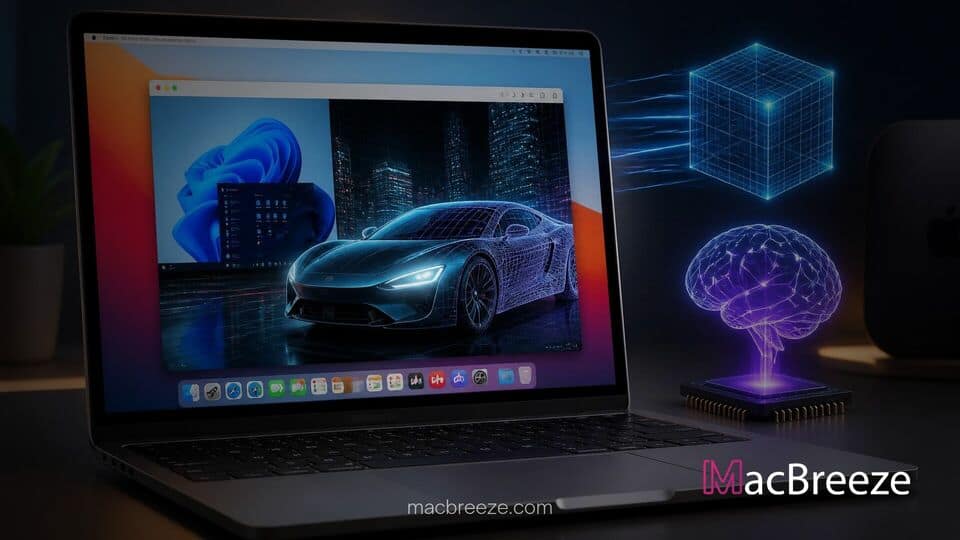
All-in-one virtualization developer Alludo has officially unveiled its Parallels Desktop 27 software release, bringing expanded graphics standard capabilities and hardware-accelerated machine learning processing to Mac users running Windows applications. The annual software upgrade focuses on narrowing the performance gap between native Windows PCs and virtualized environments hosted on Apple Silicon hardware.
By leveraging updated display rendering pipelines and providing direct virtual guest access to the Neural Engine on modern Mac hardware, the release targets developers, industrial engineers, and enterprise users who depend on resource-intensive legacy software and modern AI tools side by side.
Parallels Desktop 27 Mac Update Overview
The latest Parallels Desktop 27 Mac update delivers long-awaited graphics rendering enhancements alongside dedicated framework support for local artificial intelligence workflows. Chief among the platform refinements is support for the OpenGL 4.3 graphics specification inside guest operating systems, allowing complex 3D modeling, computer-aided design, and data visualization programs to execute with higher fidelity and improved stability.
In tandem with graphics upgrades, the new version introduces direct pass-through capabilities for machine learning operations. Windows virtual machines running under Parallels Desktop 27 can now route workloads directly to Apple's Neural Engine. This hardware acceleration significantly lowers CPU utilization and reduces latency when running local AI assistants, automated language processing models, and local code synthesis utilities.
Key Features in Parallels Desktop 27
Enhanced Metal Graphics Driver and OpenGL 4.3 Support
Graphics virtualization has historically presented a technical bottleneck for cross-platform virtualization platforms on macOS. With version 27, developers revamped the underlying graphics translation engine, converting guest OpenGL 4.3 calls directly into optimized Apple Metal commands. This system overhaul allows software applications relying on advanced shading pipelines, tessellation, and compute shaders to run natively inside a Windows 11 virtual machine.
Engineers using popular industrial software, architectural CAD suits, and legacy Windows simulation tools will notice substantial performance gains. Beyond professional workflows, the expanded graphics API compatibility broadens the library of Windows-exclusive games capable of running smoothly on Apple Silicon systems, including modern desktops like the recently announced refreshed Mac mini models.
Local AI Workload Acceleration on Apple Silicon
As desktop platforms increasingly integrate machine learning tasks into everyday software, efficient hardware access is critical. Parallels Desktop 27 introduces a dedicated virtual Neural Processing Unit (NPU) architecture designed specifically for Apple Silicon. This framework routes guest platform AI requests directly to the host system's hardware engine rather than relying on software translation or general GPU execution.
This approach speeds up localized machine learning models, modern developer tools, and productivity applications that run inference on device. By keeping processing local, users retain greater privacy and avoid subscription costs associated with cloud services, complementing native operating system innovations such as redesigned AI writing features in macOS.
Enterprise Features and Security Updates
For IT administrators and enterprise environments, Parallels Desktop 27 introduces refined management controls for automated deployments. Corporate environments can now configure granular peripheral permissions, secure virtual machine isolation settings, and streamline single sign-on authentication across distributed teams.
Additionally, the release enhances support for guest operating systems running alongside preliminary developer previews of future Apple operating system updates, ensuring enterprise software compatibility remains intact ahead of major system software transitions. Security protocols surrounding virtual storage containers have also been updated to protect sensitive local data against unauthorized access.
Pricing, Compatibility, and Release Details
Parallels Desktop 27 is available immediately as a standard perpetual license upgrade or as a continuous annual subscription for standard, Pro, and Business editions. Standard licenses cater to home and student users, while Pro and Business tiers unlock additional virtual RAM allocations, multi-core CPU virtual assignment, and advanced command-line management utilities.
The update natively supports Apple Silicon hardware spanning from the M1 generation up to current chips, while continuing to offer baseline support for legacy Intel-based Mac systems. Existing subscribers can update directly from within the application, while new users can evaluate the software through a standard 14-day free trial download.
As desktop environments blur the line between local processing and cross-platform virtualization, Parallels Desktop 27 provides Mac users with a flexible bridge to run specialized Windows applications with native-level graphics capability and localized hardware acceleration.