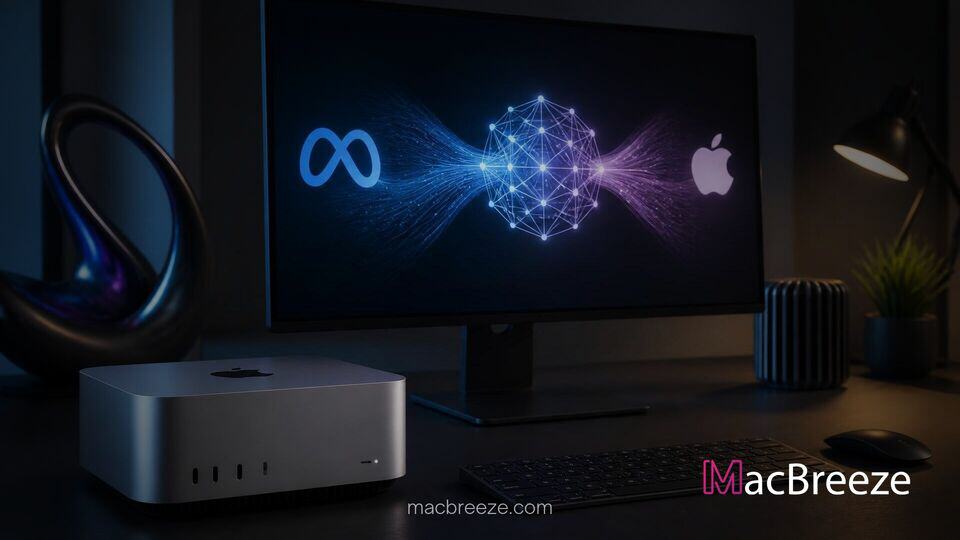
Meta and Apple have joined forces in an unexpected software engineering collaboration to optimize Meta's newly released frontier-class AI model, Muse Spark Open, for high-end Apple Silicon hardware. The initiative allows developers to execute the massive 816-billion-parameter open-weight model locally across connected Mac Studio workstations using Apple's open-source MLX array framework.
This technical milestone marks a significant step forward for desktop artificial intelligence capabilities. By leveraging Apple Silicon's unified memory architecture and specialized bandwidth capabilities, researchers and enterprise software teams can run complex open-weight model inference at their desks rather than relying exclusively on centralized data center infrastructure.
Meta and Apple Partner to Bring Muse Spark Open to Mac Studio
Meta officially released Muse Spark Open, detailing it as an open-weight foundation model specifically designed for advanced software engineering, code generation, and complex multi-step reasoning. The architectural design features 816 billion total parameters with 42 billion active parameters per token pass, backed by a sprawling 1-million-token context window.
To ensure the massive model could be deployed on local workstations rather than strictly server clusters, Meta worked directly with Apple engineers to optimize performance through the Apple MLX ecosystem. Public acknowledgments on social media highlighted the coordination between the tech companies, emphasizing that desktop systems can now achieve inference speeds suitable for real-time development. Similar advancements in system-level architecture show how Apple continues optimizing hardware integration, as seen when Apple detailed its Minions system to turn idle Macs into virtual GPU clusters.
Hardware Requirements: Dual M5 Ultra Setup and Unified Memory
Running an 816-billion-parameter model locally introduces extreme memory overhead. Even with quantized weights and active parameter routing, loading the model into memory requires hundreds of gigabytes of RAM before allocating space for the context window and output buffers.
To address this requirement, Apple confirmed that local execution relies on multi-node desktop setups using the high-end M5 Ultra Mac Studio. The primary deployment configuration requires two M5 Ultra Mac Studio units equipped with 512GB of unified memory each, providing a collective memory pool of 1TB. Alternative distributed setups support up to four Mac Studio units with 256GB of unified memory each.
Apple's unified memory architecture allows the system's integrated graphics cores and CPU pipelines to access the same shared memory space directly. Paired with memory bandwidth reaching 1.2TB/s per M5 Ultra chip, connected Mac Studio systems operate cohesively to maintain processing speeds.
meta muse spark open mac studio mlx integration and performance
The successful execution of Meta Muse Spark Open on Mac Studio systems relies heavily on recent updates to Apple's open-source MLX machine learning framework. Apple updated MLX to implement advanced distributed inference techniques, including pipeline and tensor parallelization across interconnected desktop nodes.
Inter-device communication is managed via high-speed Thunderbolt 5 connections using Remote Direct Memory Access (RDMA) drivers. This protocol allows memory transfers between physical Mac Studio units with minimal CPU intervention, drastically reducing networking overhead during distributed token processing. Furthermore, the updated MLX package includes direct support for the M5 Ultra's dedicated GPU Neural Accelerators to accelerate matrix multiplication tasks.
In official performance benchmarks released by Apple's machine learning research division, a distributed cluster of four M5 Ultra Mac Studio computers running Muse Spark Open achieved a decoding speed exceeding 36 tokens per second at an 8,192-token context length. This output speed significantly surpasses average human reading rates, demonstrating the practical viability of desktop inference for large models.
Use Cases for Developers and Enterprise Workflows
The ability to run an 816B parameter model on desktop hardware introduces new possibilities for software development teams and enterprise environments. Because Muse Spark Open is tailored for agentic coding and multi-step reasoning, engineers can integrate the model into automated development pipelines, code review routines, and architectural analysis workflows without routing sensitive code bases through external cloud endpoints.
Local deployment eliminates recurring cloud API hosting fees and mitigates bandwidth limitations associated with transmitting massive prompt contexts across external networks. Software organizations operating under strict regulatory constraints or IP protection guidelines can utilize high-capacity local inference while keeping sensitive proprietary source code completely contained within corporate networks.
Developer interest in local hardware capabilities comes alongside broader changes across Apple's desktop and mobile software ecosystem, such as when Apple opened app submissions for new platform form factors and updated developer guidelines.
Data Privacy and On-Device Processing Implications
The collaboration highlights a shared interest in expanding privacy-focused AI processing on local devices. While cloud computing remains dominant for massive multi-user consumer services, desktop execution provides guaranteed operational privacy. Prompts, source files, system context, and generated outputs never leave the local hardware.
This privacy-first approach addresses mounting industry concerns regarding vendor data retention policies, third-party model training on user submissions, and network vulnerabilities during API transmissions. By enabling local execution for frontier-class open weights, developers retain full control over operational security, system availability, and data sovereignty.
Apple's emphasis on local system architecture extends across its entire product lineup, from high-end workstation clusters to consumer devices. Recent system updates across the ecosystem reflect this ongoing refinement, including software adjustments like when Apple adjusted default update management in settings to streamline platform management.
Closing Summary
The optimization of Meta's 816B Muse Spark Open model for Mac Studio hardware demonstrates the expanding capabilities of desktop AI inference. By combining Apple Silicon's unified memory architecture, high-bandwidth interconnects, and targeted software enhancements within the MLX framework, Meta and Apple have shown that desktop clusters can run large open-weight models locally with competitive performance. As open-weight foundation models continue to evolve, high-performance desktop hardware will play an increasingly vital role in localized development and enterprise artificial intelligence workflows.