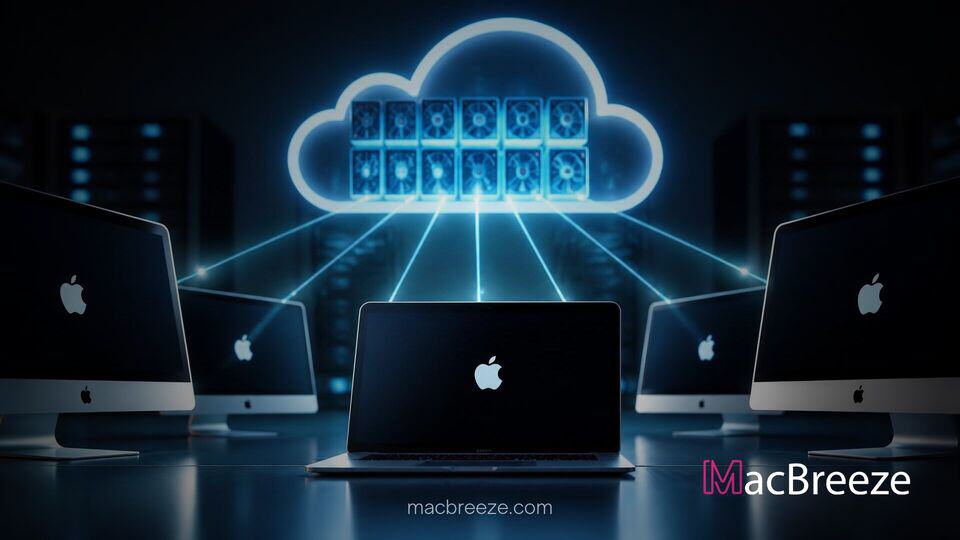
Apple machine learning researchers have published a detailed technical paper outlining Minions, a novel platform designed to aggregate idle Apple Silicon GPUs across networked Mac computers into a dynamic, virtual GPU cloud. The system enables organizations to harness untapped compute resources already sitting on employee desks to run complex artificial intelligence inference tasks without buying additional data center hardware.
By splitting large machine learning workloads into smaller subtasks and distributing them across available Mac hardware, Apple internal teams reduced job queue wait times from more than 10 hours down to mere minutes. The system demonstrates how corporate environments with large fleets of Mac computers can create an elastic pool of GPU acceleration to support enterprise artificial intelligence demands efficiently.
apple minions virtual gpu cloud mac
The system, officially titled Minions: A Dynamic and Distributed Virtual GPU Cloud Built on Idle Apple Silicon Devices, addresses the growing bottleneck of centralized artificial intelligence infrastructure. Modern AI workloads like text generation and embedding calculations traditionally rely on dedicated server clusters. These centralized setups are costly to scale and frequently experience severe congestion. Apple researchers recognized that while centralized clusters face long queues, hundreds of Apple Silicon laptops and desktops spend much of their day running light interactive tasks with their graphics engines sitting largely dormant.
Apple Machine Learning Research Details Minions Platform
According to the paper published on Apple Machine Learning Research and arXiv, Minions creates a unified pool of compute capacity out of these idle local resources. Rather than replacing dedicated cloud servers, Minions operates as an opportunistic, secondary layer. When a Mac sits idle or experiences low utilization, its graphics processor automatically joins the virtual cluster to process pending queue items.
The research emphasizes that modern Mac hardware is exceptionally well suited for this distributed approach. Apple Silicon features unified memory architecture, allowing the graphics core to access large amounts of high-speed system RAM without moving data across a traditional PCIe bus. This capability allows relatively small desktop machines like the Mac mini or Mac Studio to hold substantial large language model weights in memory, making them ideal worker nodes for AI inference tasks.
How Idle Apple Silicon GPUs Are Pooled for Inference Workloads
Minions currently focuses on two core categories of AI processing: embedding generation using transformer models from Hugging Face, and text generation powered by large language models. These tasks form the backbone of modern search engines, internal documentation tools, and conversational assistants.
When an internal developer submits an inference request, the system evaluates the payload and splits it into discrete subtasks. Machines enrolled in the Minions network check in periodically over REST APIs to request work. Once a node accepts a subtask, it executes the model locally using hardware acceleration provided by Apple Metal framework and local inference tools like Ollama. Finished results are stored centrally in cloud storage buckets, such as Amazon S3, where they are reassembled for the user.
System Architecture: Server, Executor, and Watchdog
The Minions system operates through a coordinated three-tier architecture that manages task allocation, node management, and resilience:
- Minion Server: Serves as the primary control plane, managing job submissions via web interfaces or chat integrations like Slack. It breaks down larger requests into subtasks and writes metadata to a centralized PostgreSQL database.
- Minion Executor: A background service running on individual Mac devices. It monitors system utilization, fetches assigned subtasks over REST APIs when the host machine is idle, executes the workload, and uploads the results to object storage.
- Minion Watchdog: A monitoring process responsible for fault tolerance. Because worker nodes are user workstations, a computer may be closed, disconnected from the network, or woken by an employee at any time. The Watchdog detects non-responsive nodes, re-queues unfinished subtasks, and assigns them to other active devices without losing progress.
How Subtasks Are Distributed Across Networked Macs
Because employee workstations are fundamentally unpredictable worker nodes, task distribution requires careful chunking. The Minion Server converts massive document sets or multi-prompt batch jobs into micro-batches. If a user opens a heavy application like Final Cut Pro or unplug their MacBook Pro, the local Executor immediately pauses or drops its current micro-batch. The Watchdog reassigns that small chunk to another idle device on the network, ensuring zero interruption to the user experience and minimal lost progress for the larger workload.
Impact on Enterprise AI Queues and Resource Costs
In practice, Apple internal testing showed striking improvements in operational efficiency. Prior to deploying Minions, internal development teams faced long hardware queues on dedicated server infrastructure. Large embedding jobs and batch inference evaluation tasks often sat waiting for hours during peak working times.
By routing these secondary tasks to idle Mac fleets, wait times dropped dramatically to a few minutes. Furthermore, organizations can significantly reduce capital expenditure by squeezing extra utility out of existing hardware deployments. Enterprise deployments that already provide employees with high-end MacBook Pro workstations or workstation-class desktop hardware can tap into gigabytes of underutilized unified memory overnight or during off-peak hours.
Recent market research highlights that enterprise Mac adoption remains robust. Reports from industry analysts like IDC indicate PC market share resilience for Apple hardware across business sectors. This growing footprint gives organizations a expanding base of distributed compute nodes.
Limitations and Requirements for Apple Silicon Systems
Despite its performance advantages, the Minions platform introduces unique operational considerations. Apple researchers noted that data privacy and permissions require careful management. In corporate settings, individual departments occasionally expressed concern over proprietary project data passing through hardware owned by separate teams. Security policies must ensure that task data is fully encrypted in transit and at rest, with temporary local files wiped immediately after job completion.
Hardware requirements also restrict the platform to Apple Silicon devices. Older Intel-based Macs lack the unified memory bandwidth and Metal optimization needed to process large language models efficiently. While recent additions to Apple hardware lineup—such as high-speed Thunderbolt interconnects on desktop hardware—allow local hardware clustering, distributed networks like Minions rely primarily on standard local network bandwidth.
Apple continues to refine its machine learning software stack across both consumer software and developer platforms. As software tools like MLX evolve alongside hardware updates, distributed frameworks could eventually extend beyond internal developer tools into broader enterprise server management utilities. For now, Minions stands as a compelling proof-of-concept for turning desktop fleets into cost-effective AI computing platforms.