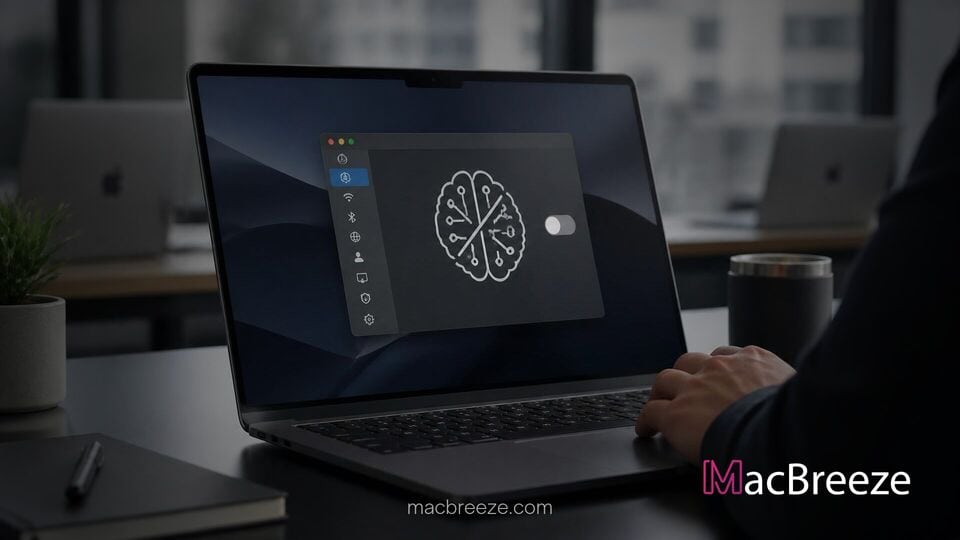
Apple is weighing the introduction of an official macOS mechanism to completely uninstall and erase Apple Intelligence assets from enterprise Mac hardware. The potential strategic shift comes as corporate IT departments and regulated institutions voice concerns over mandatory generative AI integrations and the local storage footprint of foundation models.
Industry analysts and tech commentators highlight growing institutional friction, noting that strict compliance frameworks at government agencies, financial firms, and healthcare organizations are threatening corporate hardware refresh cycles unless system administrators gain absolute control over AI removal.
Enterprise Pushback Against Mandatory macOS AI Features
Recent updates to macOS 27 Golden Gate removed the unified toggle that previously allowed users to turn off Apple Intelligence across the operating system in a single step. Instead, administrators must navigate fragmented settings across individual applications or apply complex Screen Time restriction policies to limit individual feature capabilities.
This operational friction triggered widespread pushback from system administrators managing corporate Mac deployments. Independent developers responded by publishing command-line tools like RemoveMacAI to forcibly block AI services and purge internal model files. However, enterprise IT teams remain hesitant to rely on third-party scripts that alter system configuration profiles without official support from Apple.
Institutional Compliance Rules and Data Privacy Concerns
For organizations operating under rigid regulatory frameworks, the presence of active or dormant generative AI models poses severe legal and operational risks. Many enterprise compliance policies explicitly prohibit the deployment of unauthorized machine learning software on company workstations, citing fears of sensitive data leakage or unverified background processing.
Security concerns have intensified following recent industry debates around autonomous software agents. Earlier this year, reports raised questions regarding agentic tools accessing local data stores. In response, Apple announced stricter macOS Full Disk Access controls to prevent background AI processes from inspecting protected user files without explicit user consent. For regulated enterprises, however, software-level permissions are often insufficient; complete hardware-level or binary-level absence of AI frameworks is required to meet internal auditing standards.
Limitations of Current Device Management Controls
While Apple provides mobile device management (MDM) keys that allow IT administrators to disable specific client-facing capabilities like Siri, Writing Tools, and Genmoji, these policies do not erase the underlying neural network models. The operating system continues to maintain local AI assets on disk, leaving files intact even when feature access is restricted.
Tech analyst John Gruber pointed out that certain institutional procurement groups maintain strict rules banning hardware containing active AI engines. Without an official tool to scrub these binaries completely, enterprise buyers cannot clear new Mac models for deployment.
Impact on Enterprise Mac Upgrades and Hardware Adoption
The enterprise market represents a vital revenue engine for Apple's Mac line, driven by large-scale enterprise deployments and engineering fleet upgrades. As corporate procurement teams prepare for upcoming purchasing cycles, the inability to scrub AI frameworks threatens to slow down hardware transitions.
Organizations planning hardware upgrades, such as anticipating future M6 MacBook Pro launch schedules and silicon strategies, may delay purchase orders if the underlying operating system forces non-compliant features onto employee workstations.
Risks to Corporate Fleet Refresh Cycles
Beyond regulatory hurdles, storage overhead presents a immediate logistical challenge for IT departments managing mass-deployed hardware. The foundational language models driving Apple Intelligence consume between 12GB and 30GB of internal solid-state drive capacity, depending on the active configuration and workload.
On enterprise fleets provisioned with base 256GB SSD storage configurations, dedicating over 10 percent of the drive to unused AI models creates severe storage constraints for developer tools, virtual machines, and local database caches. IT departments are unwilling to pay higher hardware premiums for expanded storage simply to accommodate mandatory software packages that corporate policies forbid employees from using.
Proposed Official AI Uninstallation Framework
To mitigate the risk to hardware sales, Apple is reportedly evaluating a native uninstallation pipeline built directly into macOS settings and MDM profiles. This proposed framework would allow administrators to execute a clean removal command that entirely purges local foundation models, halts ambient asset downloads, and reclaims system storage.
Such an official solution would ensure system stability while maintaining core macOS functionality. Unlike unapproved third-party utility scripts that risk breaking integrated system tools, an Apple-sanctioned removal procedure would safely detach AI workflows without triggering unexpected operating system behavior.
What Apple’s Policy Shift Means for Mac System Administrators
Providing an official, granular removal tool would mark a major shift in how Apple balances consumer features with corporate enterprise demands. Historically, Apple has tightly integrated its flagship software frameworks into macOS, making system-level components difficult to remove. However, the commercial necessity of maintaining enterprise fleet sales is forcing a more flexible management strategy.
This evolving software posture aligns with broader structural changes within Apple's hardware and engineering divisions. As detailed in recent reports on engineering restructuring under CEO John Ternus, Apple is increasingly prioritizing enterprise execution and streamlined product cycles. Adapting macOS management policies to meet corporate compliance requirements is a natural extension of this strategy.
For Mac system administrators, an official Apple Intelligence removal tool will simplify endpoint compliance, protect device storage, and streamline corporate procurement. By offering full control over AI features, Apple can address enterprise privacy concerns while maintaining strong Mac hardware sales across commercial, financial, and government sectors.