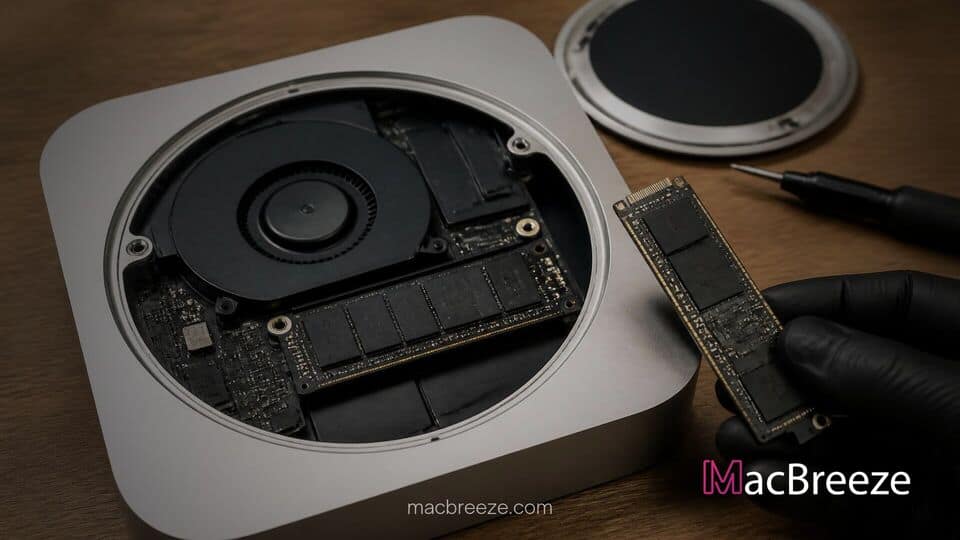
Initial hardware teardowns of Apple's newest desktop computers reveal that the company has reverted to permanently soldered storage chips on the M6 Mac Mini logic board. The discovery marks an abrupt end to the modular socketed storage design featured in the previous M4 generation.
Hardware enthusiasts and independent repair technicians who opened the fresh desktop models confirmed that the removable NAND daughterboard is gone. Buyers looking to acquire the compact desktop must now select their required internal storage capacity at the time of purchase, as post-purchase internal upgrades are no longer physically possible.
Launch Day Teardowns Uncover Soldered NAND on M6 Mac Mini
As Apple confirms new Mac mini and Mac Studio launch availability today, teardown videos and repair reports from early adopters have flooded online tech communities. Physical inspection of the internal circuitry confirms that the NAND flash storage chips are soldered directly onto the main logic board. The change affects both standard M6 configurations and higher-end M5 Pro variants of the desktop enclosure.
When teardowns of the M4 Mac Mini made headlines, repair technicians celebrated the inclusion of a proprietary removable storage module held in place by screws. While those drives required specific Apple controller communication and Apple Configurator software pairing, third-party repair vendors had begun successfully manufacturing aftermarket replacement modules. The complete removal of the socket in the M6 generation eliminates that emerging upgrade path entirely.
Comparison With Slotted Storage on New Mac Studio
Interestingly, Apple's approach to internal storage across its desktop line remains split. Official repair documentation and early teardowns of the simultaneously launched Mac Studio show that it retains a removable SSD module design. Technicians can physically remove and replace storage modules on M5 Max and M5 Ultra Mac Studio systems during official servicing procedures, provided the replacement parts match the specific hardware profile required by Apple's software calibration tools.
The contrast between the two desktop lines highlights a distinct product segmentation strategy. While the higher-priced Mac Studio retains modular components for enterprise repairability, the entry-level Mac Mini relies on fully integrated silicon to streamline interior space and manufacturing complexity.
Technical and Practical Impact for Mac Mini Buyers
The return to integrated NAND flash carries immediate real-world consequences for consumers and IT administrators alike. Because the storage chips are bonded directly to the logic board alongside the central system-on-chip, any severe hardware failure involving the NAND chips will necessitate replacing the entire main board.
Furthermore, internal storage tiers remain locked to initial factory configurations. Users who opt for base storage limits will need to rely heavily on external Thunderbolt enclosures or cloud storage solutions when space runs low. While desktop setups easily accommodate external drives, offloading system files or primary software installations to external media remains less convenient than running everything off internal high-speed storage.
Community reaction across tech forums has been largely disappointed, especially after retailers offer first pre-order discounts on Apple's new M6 Mac Mini encouraged an early wave of buyer enthusiasm. Repair advocate organizations noted that while the overall disassembly of the Mac Mini enclosure remains simple, soldering the primary wear component reduces the long-term serviceability score of the machine.
Historical Context of Mac Desktop Storage Upgrades
Apple has maintained a complex relationship with modular desktop storage over the past decade. For years, Mac computers featured soldered flash memory across both laptop and desktop lineups. That trend briefly shifted when the Mac Studio and the redesigned M4 Mac Mini introduced socketed storage boards.
At the time, industry analysts speculated that modular storage was adopted to streamline internal assembly across different storage tiers during factory builds, rather than to encourage end-user upgrades. However, the thriving aftermarket created by independent modders may have prompted Apple to reconsider board layouts for its most affordable desktop. With board space at a premium inside the ultra-compact chassis, returning to soldered NAND allows engineers to optimize thermal management and power routing.
The internal changes come at a time when desktop software and operating system features demand more local disk capacity than ever. For example, expanding system services like Apple Intelligence storage footprint expands to 14GB in iOS 27 and macOS updates demonstrate how quickly default local drive allocations can fill up over a computer's lifespan.
What Buyers Should Consider Before Ordering
For potential customers evaluating the M6 Mac Mini, calculating future storage requirements before placing an order is essential. Upgrade prices for internal storage at checkout remain high compared to off-the-shelf consumer SSDs, but upgrading after purchase is no longer an option.
Buyers planning to utilize the machine for heavy media editing, software development, or local database management should strongly consider configuring higher internal storage capacities at the time of purchase. Alternatively, users planning to stick with entry-level storage tiers should budget for fast external Thunderbolt 4 or Thunderbolt 5 storage enclosures to complement their desktop setup.
While the M6 Mac Mini delivers impressive processing performance and efficiency gains, the hardware teardowns serve as a clear reminder that internal expandability has taken a step backward on Apple's most compact desktop.