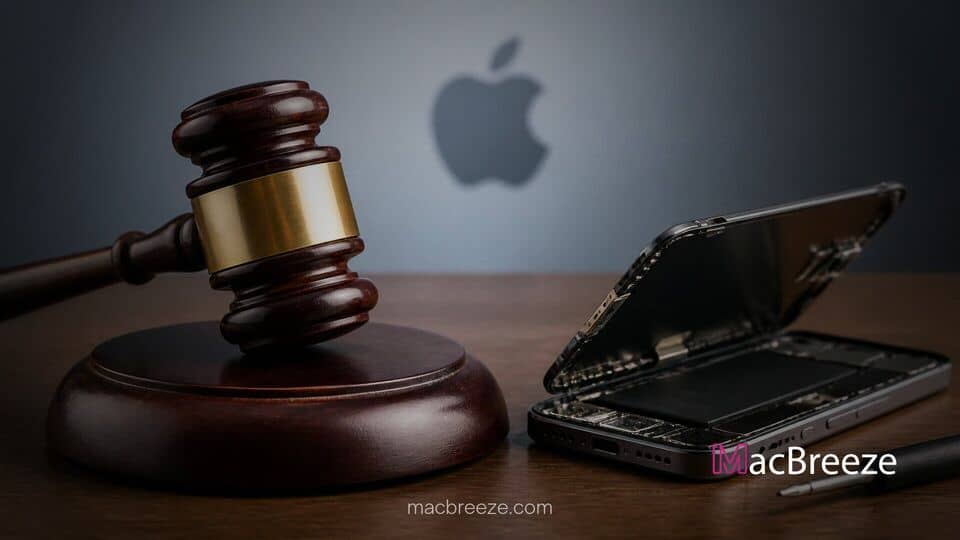
A California appellate court has revived a class-action lawsuit challenging restrictive repair practices by Apple Inc., ruling that consumers have adequately alleged unfair competition under state law. The decision reverses a lower court dismissal, allowing claims to move forward that accused the tech giant of artificially inflating repair pricing by withholding diagnostic software, tools, and replacement components from independent repair providers.
The panel from the Sixth Appellate District of the California Court of Appeal found that the plaintiffs provided sufficient factual basis to show that Apple's policies inflict economic harm on consumers. By restricting out-of-warranty options and tying warranty terms to authorized service centers, the court concluded that Apple may be unfairly steering consumers toward higher-priced internal repairs or complete device replacements.
Appeals Court Decision on Lawsuit Apple iPhone Repair Restrictions
The ruling directly addresses ongoing legal claims regarding the lawsuit Apple iPhone repair restrictions, finding that the trial court erred when it sustained Apple's demurrer and dismissed the complaint. The action was originally brought by consumers Jesse Granato and Janice Zarad, who alleged that they incurred inflated out-of-pocket costs to repair cracked screens through Apple after store representatives informed them that third-party service would void their warranty protection.
Writing for the unanimous three-judge panel, acting presiding Associate Justice Cynthia Lie highlighted that the plaintiffs pleaded reasonable inferences connecting market supply constraints directly to consumer pricing impact. Justice Lie observed that, as alleged, Apple's practices cause substantial harm by enabling the corporation to exact inflated payments for maintenance services or to incentivize full hardware replacements rather than physical repairs.
The appellate court stressed that at the initial pleading stage, consumers needing out-of-warranty services have no practical means of avoiding market-wide pricing dynamics created by restrictive ecosystem rules. Because Apple did not establish an immediate, overarching business benefit that clearly outweighed the alleged consumer harm, the panel determined that the statutory unfair competition claims must proceed to discovery.
Key Allegations in the Class-Action Lawsuit
The central grievance outlined in the operative complaint focuses on systemic barriers built into the hardware and software architecture of modern electronic devices. Plaintiffs contend that Apple enforces restrictive ecosystems through several distinct operational mechanisms, including:
- Withholding specialized repair tools, technical manuals, schematics, and diagnostic software from independent repair businesses.
- Pairing specific hardware components to individual logic boards through serial number matching software, preventing unauthorized component swapping.
- Conditioning standard warranty coverage on obtaining maintenance exclusively from Apple Stores or certified Apple Authorized Service Providers.
- Warning consumers that utilizing independent technicians will compromise device security, integrity, or existing warranty status.
According to the lawsuit, these integrated measures suppress traditional market competition by limiting the supply of third-party repair services. As a result, third-party operators face severe operational hurdles, leaving consumers with few alternatives beyond paying official out-of-warranty rates set directly by the manufacturer.
Apple Legal Defense and Right to Repair Regulations
Apple has historically defended its repair ecosystem by citing user privacy, personal data security, and hardware reliability. The company argues that restricting complex component installations to trained technicians prevents hardware damage, preserves battery safety, and protects integrated security chips such as Touch ID and Face ID sensors from potential tampering.
In recent years, regulatory pressures and public support for Right to Repair legislation have prompted incremental shifts in corporate strategy. Apple introduced its Self Service Repair program, allowing individual owners access to genuine parts, manuals, and rental tools for designated hardware models. However, critics and independent repair advocates note that software calibration requirements and serial-number locks continue to restrict third-party shops from buying components in bulk or performing full-scale independent servicing.
The California appellate ruling arrives as legal frameworks governing device maintenance undergo significant changes across North America and Europe. State legislatures have progressively passed statutes requiring tech manufacturers to make service resources available to independent providers under reasonable commercial terms.
Potential Impact on iPhone Owners and Independent Shops
The revival of the California litigation represents a notable legal development for millions of device owners and thousands of independent repair storefronts. If the plaintiffs ultimately prevail, the case could set precedent regarding how tech corporations control post-sale service markets and manage component pairing protocols.
For small business owners in the repair sector, broader access to diagnostic tools and genuine hardware components without strict diagnostic software locks could expand commercial opportunities. Increased market participation by independent service centers typically drives down service fees and reduces turnaround times for common hardware fixes, such as screen replacements, camera repairs, and battery swaps.
For consumers, a legal finding against restrictive ecosystems could establish clear boundaries regarding warranty enforcement. Under federal statutes such as the Magnuson-Moss Warranty Act, manufacturers generally cannot void a product warranty simply because a consumer used an unbranded replacement part or third-party service, unless the manufacturer proves the specific repair work caused the underlying defect.
What Happens Next in the Legal Process
With the appellate court's reversal, the case returns to the Superior Court of California in Santa Clara County for further proceedings. Apple will be required to file a formal response to the operative complaint, after which both parties will enter the evidentiary discovery phase.
During discovery, legal teams will examine internal communications, pricing strategies, service department profitability metrics, and supply chain constraints related to replacement components. Depending on future motions, the plaintiffs are expected to seek class certification to represent a broader group of affected device owners across the state.
While the lawsuit faces substantial litigation steps before reaching a trial or prospective settlement, the appellate panel's decision establishes that consumer protection laws remain applicable to corporate repair restrictions. The proceeding will be monitored closely by legal analysts, consumer advocacy groups, and technology manufacturers evaluating the boundary between intellectual property protections and fair consumer market practices.