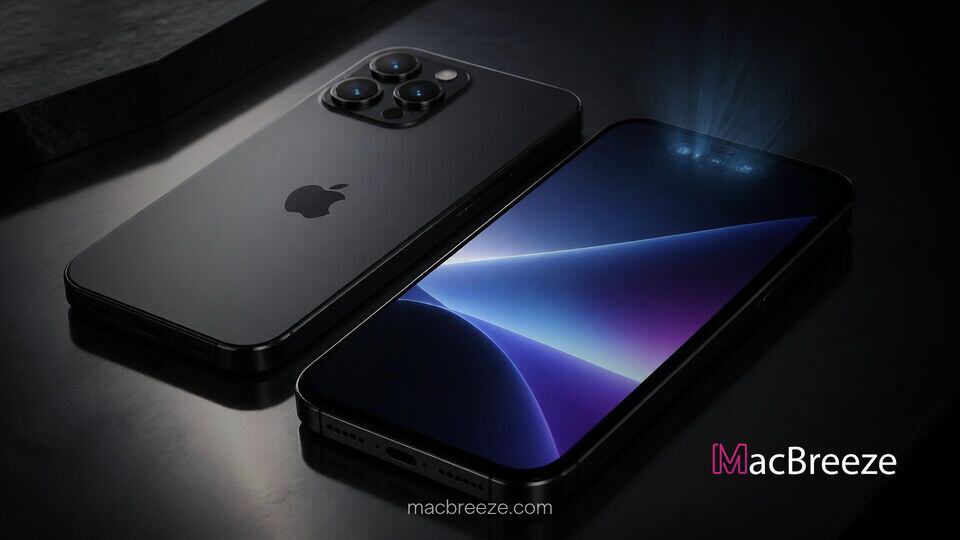
Early internal hardware builds at Apple indicate that the tech giant is actively working to bring biometric facial recognition to its foldable line, addressing one of the primary criticisms of its first-generation foldable hardware. According to Bloomberg reporter Mark Gurman, early prototypes of the second-generation foldable feature Face ID hidden directly beneath the outer cover screen.
While the original device relies on a side-mounted capacitive fingerprint sensor built into the power button, these new test units demonstrate that Apple is pushing hard to restore its signature TrueDepth security system to future iterations.
iphone duo 2 under display face id
Early testing reveals that Apple is evaluating prototypes of the second-generation foldable equipped with under-display facial recognition technology on its cover display. By embedding infrared sensors and illuminators behind the display panel, Apple aims to deliver seamless biometric unlock capability without needing an expanded screen notch or dynamic island cutout. The development comes as Apple seeks to unify the user authentication experience across its premium mobile lineup, though internal testing does not guarantee the feature will be locked in for the final retail release.
Early Testing Reveals Under-Display Face ID in iPhone Duo 2
Reports from Bloomberg's Mark Gurman indicate that engineering teams inside Cupertino are actively iterating on hardware variants designed for the next foldable generation. A major focus of this early testing is the integration of under-display optical and infrared sensors beneath the cover panel.
When Apple announced its entry into the foldable segment, analysts and early reviewers quickly noted the omission of facial recognition as a noticeable software and hardware departure from standard Pro-tier iPhones. The inclusion of under-display hardware in test units shows that Apple views facial authentication as a long-term requirement rather than an optional luxury.
Prototype Hardware and Biometric Sensors
The prototypes currently circulating within Apple's hardware labs integrate an updated version of the TrueDepth camera array directly beneath the glass layer. By routing infrared light through specialized pixel sub-matrices in the display, the sensor can read a user's facial geometry without disrupting the visual quality of the screen.
It remains unclear whether Apple intends to completely phase out Touch ID on the second-generation model or retain the side-mounted scanner as an alternative authentication method. Maintaining both options could give users flexibility whether the device is folded shut or unfolded into its main interior display.
Potential Action Button and Design Changes
Beyond biometric upgrades, internal sources suggest Apple hardware designers are exploring additional physical layout changes. Engineers are reportedly testing prototype chassis variations that reintroduce the customizable Action button, a component omitted from the original foldable due to tight internal spatial limitations.
Bringing back configurable hardware shortcuts alongside under-display sensors would align the foldable chassis much more closely with flagship slab designs. However, fitting these extra components within a ultra-thin frame presents steep thermal and mechanical packaging challenges.
Current Biometric Constraints on First-Generation Foldables
The decision to utilize a side-mounted Touch ID sensor in the original foldable was largely dictated by physical dimensions. To keep the dual-screen chassis reasonably thin when folded, Apple engineers faced extreme constraints regarding Z-height internal clearance. Traditional TrueDepth sensor assemblies required depth that simply could not be accommodated behind the flexible glass or outer cover screen without increasing overall device thickness.
While the side sensor provided reliable unlocking performance, early unboxings and initial device hands-on coverage highlighted that long-time iOS users found transitioning back to manual fingerprint placement jarring. Despite overwhelming pre-order demand pushing delivery timelines significantly out, addressing biometric parity with conventional iPhones remains a key priority for Apple's product roadmap.
Expected Release Timeline and Future Hardware Strategy
Although under-display Face ID is actively functioning on internal test devices, industry observers emphasize that hardware features tested in early development cycles are always subject to delay or revision. If manufacturing yields and sensor accuracy meet Apple's strict internal benchmarks, the technology could debut as early as late 2027. If technical bottlenecks persist, the feature may slip to a third-generation revision.
As Apple continues to refine its foldable supply chain, expanding component partnerships and domestic production will play a critical role in scaling advanced displays with embedded sensor arrays. Additionally, ongoing system software updates will need to accommodate shifting hardware configurations as Apple refines its multi-screen user experience.
Ultimately, the testing of under-display Face ID demonstrates Apple's commitment to eliminating early design trade-offs. If successfully commercialized, the second-generation foldable will close the gap between experimental form factors and the seamless user experience expected from top-tier Apple devices.