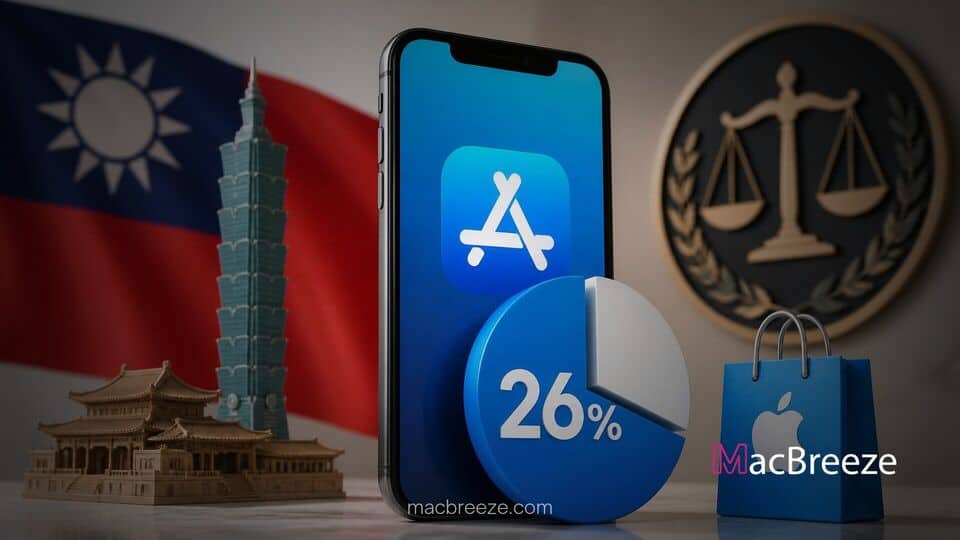
Apple has officially announced a reduction in its standard App Store commission rate for developers in Taiwan, lowering the fee from 30 percent to 26 percent. The policy change takes effect on October 31, 2026, and applies directly to standard paid apps and in-app purchase transactions made through the Taiwanese storefront on iOS and iPadOS.
The decision comes after extensive discussions and an investigation by Taiwan's Fair Trade Commission (FTC), which examined whether the company's long-standing fee structures and developer restrictions breached domestic competition laws. By accepting Apple's voluntary commitment to reduce commission fees, local regulators agreed to suspend their antitrust inquiry, placing the market under active compliance monitoring.
apple taiwan app store commission 26 percent
Under the revised terms, the standard apple taiwan app store commission 26 percent rate will apply automatically to all qualifying digital sales originating on the Taiwanese App Store storefront. Software creators operating in the region do not need to submit formal applications or complete complex paperwork prior to the effective date to benefit from the lower rate.
Apple updated its Developer Program License Agreement to incorporate the lower percentage tier. For every NT$1,000 (roughly $32 USD) earned in digital transactions subject to the standard tier, Apple will now collect NT$260 instead of the previous NT$300 fee. This structure allows developers to retain an additional 4 percent of their earnings directly from digital sales.
Automatic Terms and Eligibility for Local Developers
The technical transition has been designed to operate seamlessly across developer accounts registered in Taiwan. In an official update posted to its developer portal, Apple clarified that developers are not strictly required to sign the newly revised agreement by October 31 to begin receiving the benefits of the 26 percent rate cut on that date.
The revised commission rate targets standard paid applications and digital content purchased within iOS and iPadOS applications. While standard developers receive immediate relief from the standard 30 percent cap, smaller creators enrolled in the Apple Small Business Program already benefit from a reduced 15 percent commission tier globally. However, for mainstream application publishers earning above the small business threshold, the adjustment offers tangible financial relief across local distribution channels.
The policy update reflects ongoing adjustments to Apple's digital commerce software stack, similar to structural updates seen across hardware systems, such as when macOS 27.2 prevents software upgrades from removing Rosetta installation routines for continuous developer software compatibility.
Regulatory Context Behind Taiwan Fair Trade Commission Probe
The regulatory review by the Taiwan Fair Trade Commission focused heavily on whether the customary "Apple tax" combined with strict payment routing requirements created an anti-competitive environment for local application creators. Regulators evaluated whether the restrictions unfairly limited commercial freedom or hindered fair market competition within Taiwan's digital economy.
Apple addressed the investigation by submitting formal commitment proposals under Article 28 of Taiwan's Fair Trade Act. This statutory mechanism allows the regulatory authority to suspend an active investigation if the entity under scrutiny agrees to adopt binding corrective measures that resolve competition concerns.
The FTC formally accepted Apple's commitments, bringing the preliminary investigation to a close while retaining enforcement oversight. Regulators noted that the antitrust case could be reopened immediately if Apple fails to uphold its pricing commitments, if market conditions undergo drastic shifts, or if the initial determination was based on incomplete disclosures. Furthermore, the commission explicitly highlighted that it reserves the authority to investigate other aspects of Apple's platform practices independently.
Global Ecosystem Impact and Future App Store Policy Adjustments
Taiwan is the latest in a growing list of international jurisdictions where regulatory inquiries have prompted alterations to App Store commission models. Similar 26 percent baseline rates have previously been implemented in markets such as Japan, Brazil, and parts of the European Union, while custom arrangements in mainland China reduced transaction fees to 25 percent under local market oversight.
These policy adjustments arrive alongside broader system enhancements across Apple's hardware and platform offerings. Recent updates highlight continuous ecosystem developments, ranging from security updates like when Apple patches 163 security flaws in iOS 27.2 and iPadOS 27.2 updates to hardware security measures such as how Apple deploys in-box diagnostic scanner to fight iPhone return fraud across retail systems. Platform features continue to expand in parallel, as seen when Apple adds on-device selfie age verification to iOS 27.2 update for enhanced identity protection.
In a statement addressing the Taiwan policy changes, Apple stated that the adjustments follow constructive dialogues with local regulators while maintaining the platform's focus on user safety and developer growth. As antitrust authorities around the world keep scrutinizing digital marketplace rules, Apple continues to balance platform control with regional regulatory compliance.