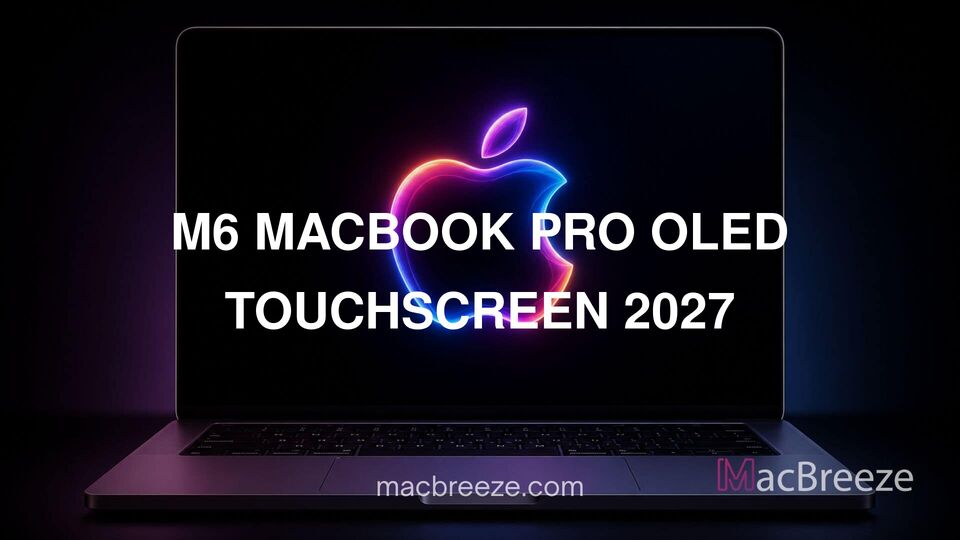
Apple is preparing a massive update cycle across its entire Mac family, aiming to reshape both its internal silicon performance and its traditional hardware design language. Reports indicate that the tech giant will launch its first M6-powered entry-level 14-inch MacBook Pro in late 2026, followed by a groundbreaking OLED touchscreen MacBook Pro in early 2027.
M6 MacBook Pro OLED touchscreen 2027
According to supply chain disclosures and industry insider reports, Apple’s upcoming hardware roadmap introduces a phased transition for the MacBook Pro family. The standard 14-inch MacBook Pro will receive the new M6 processor in late 2026, boosting memory bandwidth and overall efficiency while maintaining its existing chassis. Shortly after, an OLED touchscreen flagship MacBook Pro is expected to debut between late 2026 and early 2027, featuring an ultra-thin design, M5 Pro and M5 Max chip options, and tactile display interaction.
What’s Happening Now
M6 MacBook Pro slated for late 2026
The immediate leg of Apple's notebook rollout focuses on introducing its next generation of Apple Silicon. The base 14-inch MacBook Pro is scheduled to receive the standard M6 chip toward the tail end of 2026. This update is largely aimed at performance optimization, delivering improved central processing unit (CPU) speeds, upgraded graphics processing unit (GPU) capabilities, and expanded memory throughput without drastically altering the physical body of the laptop.
Apple is simultaneously preparing M6-infused refreshes for the desktop line, including the 24-inch iMac. The M6 architecture is expected to leverage a refined node fabrication process, allowing higher transistor density and better energy retention for demanding creative and developer applications.
OLED touchscreen MacBook Pro expected in early 2027
The most dramatic shift in Apple’s laptop strategy revolves around a flagship redesign slated for late 2026 or early 2027. Internal testing indicates that high-end 14-inch and 16-inch MacBook Pro models will adopt organic light-emitting diode (OLED) panels alongside full touchscreen capability. These high-tier machines are expected to launch equipped with M5 Pro and M5 Max silicon, bridging performance needs until M7 chip derivatives arrive further down the line.
This hardware release marks a dramatic pivot for Apple, which historically avoided touch-based displays on its primary computer line. Beyond touch controls and rich OLED contrast levels, the new flagship chassis is expected to feature a noticeably slimmer form factor and replace the top screen notch with an integrated camera cutout reminiscent of the Dynamic Island seen on modern iPhones.
Why It Matters
Implications for consumers and professionals
For creative professionals, software engineers, and power users, the introduction of an OLED touchscreen MacBook Pro fundamental alters portable workflows. OLED display tech provides perfect pitch blacks, higher peak HDR brightness, and exceptional color fidelity compared to traditional mini-LED backlighting. This upgrade serves video editors, colorists, and digital artists who require precise visual accuracy.
Adding touch interaction allows developers to test mobile software applications directly on macOS hardware without relying entirely on screen emulators or secondary mobile devices. Digital illustrators and photo editors also stand to gain direct on-screen manipulation options, reducing the friction between desktop power and iPad-style input.
Significance for Apple’s design and AI strategy
Releasing a touch-enabled laptop indicates a unified approach to Apple’s software ecosystems. For over a decade, company executives maintained that touch interfaces belonged exclusively to iOS and iPadOS while macOS remained optimized for a trackpad and keyboard. Introducing touch interaction alongside subtle macOS interface updates bridges the gap between touch-first mobile apps and traditional desktop workflows.
The move also aligns with Apple’s aggressive push into local artificial intelligence processing. Next-generation silicon like the M6 chip is built to handle heavy, agent-based AI workloads locally on the device. Integrating rich OLED visuals, touch capabilities, and faster neural engines allows Apple to position its MacBook Pro family as a comprehensive platform for multi-modal generative AI tools.
Looking Ahead
Timeline of expected releases
Apple’s hardware roadmap stretches across multiple product waves over the next two years:
- Fall 2026: Launch of the refreshed entry-level 14-inch MacBook Pro featuring the baseline M6 processor, along with new M6-powered 24-inch iMac models.
- Late 2026 to Early 2027: Debut of the redesigned 14-inch and 16-inch high-end MacBook Pro models with OLED displays, touchscreen hardware, and M5 Pro or M5 Max processors.
- Early 2027: System updates to the 13-inch and 15-inch MacBook Air lines featuring M6 silicon.
- Late 2027 to 2028: Successor high-end MacBook Pro updates featuring M7 Pro and M7 Max processors, alongside the eventual migration of OLED displays to the MacBook Air lineup.
What users and developers should prepare for
Software creators and general users should begin anticipating structural shifts in software interaction. Developers building universal apps across iOS and macOS will need to adjust user interface layouts to ensure touch targets feel intuitive on a laptop screen while remaining precise under trackpad control.
From a consumer perspective, buyers considering a laptop upgrade over the coming months must decide whether to invest in current M-series hardware or delay purchases until the M6 chip and touchscreen OLED redesigns arrive. While standard productivity users may find present MacBook configurations more than sufficient, buyers seeking touch integration and display advancements will find the 2026 and 2027 releases well worth waiting for.
Overall, Apple’s upcoming hardware release cycle marks one of the most ambitious eras for the Mac since the initial Apple Silicon transition. By combining M6 silicon efficiency with a touch-capable OLED screen, Apple is setting a new benchmark for professional laptops.