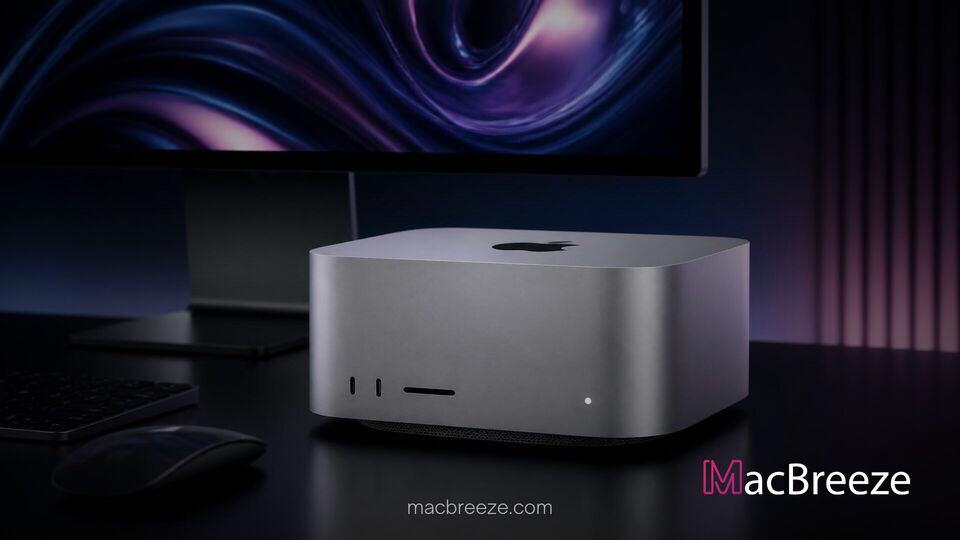
Apple has officially expanded its desktop computer lineup by introducing a upgraded Mac Studio workstation powered by the new M5 Max and M5 Ultra system-on-chips. The refreshed compact machine brings substantial performance improvements to demanding creative workflows, offering expanded unified memory options and improved energy efficiency for professional users.
Designed to serve video editors, 3D animators, software developers, and machine learning researchers, the new hardware maintains the signature extruded aluminum enclosure while delivering unprecedented local compute capabilities. Early unit shipments are scheduled to arrive at customer doorsteps and retail locations worldwide beginning next week.
Apple launches Mac Studio M5 Max M5 Ultra to Redefine Professional Desktop Performance
The headline announcement centers around Apple's introduction of high-end Apple Silicon configurations built on an enhanced three-nanometer manufacturing node. Apple launches Mac Studio M5 Max M5 Ultra systems to replace previous M4 generation models, targeting power users who require desktop-class thermal dissipation alongside maximum memory throughput. The new lineup ensures sustained computational performance without fan noise spikes, continuing the design philosophy established by the original Mac Studio chassis.
By bringing the M5 family architecture to its pro desktop workstation line, Apple is addressing growing computational demands in artificial intelligence, spatial computing rendering, and complex audio engineering. The M5 Max configuration targets heavy creative application suites, while the M5 Ultra doubles down on core count and memory bandwidth for extreme enterprise and creative tasks.
M5 Max and M5 Ultra Bring Massive Compute Gains
At the hardware level, the M5 Max features a 16-core CPU comprised of 12 performance cores and 4 efficiency cores, paired with up to a 40-core GPU. This architecture delivers a reported 25 percent boost in CPU multithreaded performance compared to its predecessor. For high-end creative workflows, the integrated GPU incorporates updated architectural enhancements that accelerate hardware-accelerated ray tracing and mesh shading, providing significant speedups in real-time preview engines like Blender and DaVinci Resolve.
The M5 Ultra pushes compute bounds further by utilizing Apple's proprietary UltraFusion interconnect technology. By combining two M5 Max dies through a high-density silicon interposer, the M5 Ultra scales up to a 32-core CPU and up to an 80-core GPU. The UltraFusion interface maintains ultra-low latency between both halves of the chip, allowing macOS to treat the unified processor array as a single cohesive system on a chip.
Computational testing data provided during the presentation demonstrates that the M5 Ultra can execute complex visual effect renders up to twice as fast as the M5 Max, while consuming a fraction of the power required by conventional x86 desktop workstations with discrete graphics cards.
GPU Neural Accelerators and 512GB Memory Capacity
Alongside central processor scaling, Apple has emphasized local machine learning performance across both processor tiers. The upgraded 16-core Neural Engine embedded within the M5 Max, combined with a 32-core variant on the M5 Ultra, works in tandem with specialized matrix math accelerators built directly into the GPU cores. This combined compute matrix enables developer tools and local large language models to run with minimal latency.
Memory limits have also been significantly expanded. The M5 Max configuration now supports up to 192GB of unified memory with a memory bandwidth of 400GB per second. Meanwhile, the top-tier M5 Ultra system expands unified memory ceilings to an unprecedented 512GB with 800GB per second of bandwidth. This massive memory pool allows visual effects artists to load uncompressed 8K video footage straight into RAM or enable AI researchers to run multi-billion-parameter LLMs locally without encountering system bottlenecks.
These architectural shifts align with broader platform movements discovered across system software, as detailed in recent coverage of how macOS Tahoe 26.7 Beta Leaks References to Unreleased Mac Models ahead of official hardware reveals.
Pro Connectivity and Wi-Fi 7 Debut on Mac Studio
While the exterior footprint of the Mac Studio remains identical to previous models, internal connectivity controllers have received major upgrades. The back panel of the M5 Ultra model houses six Thunderbolt 5 ports, delivering bidirectional transfer speeds of up to 120Gbps for high-bandwidth storage arrays and multi-monitor setups. The M5 Max version features four Thunderbolt 5 ports on the rear and two USB-C ports on the front panel.
Both models feature an upgraded HDMI 2.1 port capable of supporting 8K resolution monitors at 240Hz refresh rates, alongside an enterprise-grade 10Gb Ethernet port, an SDXC card slot on the front, and a high-impedance 3.5mm headphone jack. Wireless networking has also received an upgrade with support for full Wi-Fi 7 features and Bluetooth 5.4.
The inclusion of advanced wireless protocols places the new desktop alongside hardware outlined in Apple's official tech specifications. Users interested in network compatibility details can review how Apple Publishes Official Device List Supporting Full Wi-Fi 7 Features across its professional desktop and mobile lines.
System administrators preparing enterprise rollouts should also note ongoing operating system management shifts, such as how Apple Deprecates hdiutil Disk Tool Command in macOS Golden Gate, requiring updated deployment scripts for modern macOS builds.
Pricing, Configuration Options, and Availability
The upgraded Mac Studio is available for pre-order starting today through Apple's online store and authorized resellers, with retail availability beginning next Friday. Pricing for the base Mac Studio equipped with the M5 Max chip starts at $1,999, which includes 36GB of unified memory and a 512GB solid-state drive.
The flagship Mac Studio featuring the M5 Ultra chip starts at $3,999, coming standard with 64GB of unified memory and a 1TB SSD. Fully customized configurations, offering the maximum 80-core GPU, 512GB of unified RAM, and up to 8TB of internal storage, will top out near $8,799. Educational pricing is available for qualifying institutional customers and students.
Apple also highlighted environmental sustainability initiatives tied to the hardware manufacture. The chassis utilizes 100 percent recycled aluminum in its enclosure, alongside recycled rare earth elements across internal magnets and 100 percent recycled gold in the plating of multiple circuit boards. The packaging is entirely fiber-based, bringing Apple closer to its target of eliminating plastic from all product packaging.
Industry analysts expect the M5-powered Mac Studio to solidify Apple's hold on professional creative markets while setting high benchmarks for compact workstations. As the new hardware rolls out to studio environments, the combination of extreme unified memory capacities, upgraded thermal efficiency, and next-generation connectivity cements the Mac Studio as a premiere desktop platform for demanding workflows.