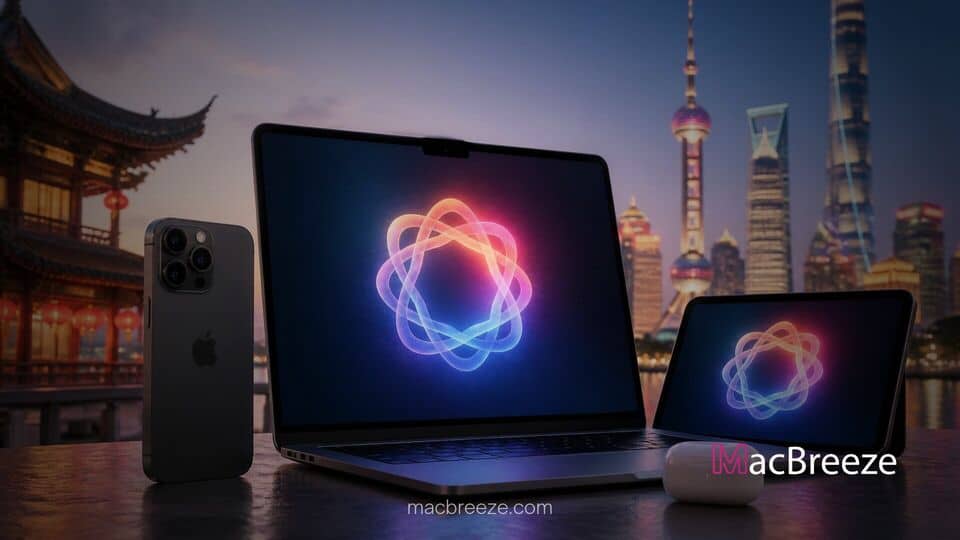
Apple Executive Chairman Tim Cook has officially confirmed that Apple Intelligence will launch in mainland China this December. The announcement marks a major milestone after extensive regulatory reviews, bringing Apple's suite of generative tools to one of its largest global markets.
The feature set will officially arrive for general consumers as part of the upcoming iOS 27.3 update. While public testing begins with a limited beta later this month, full system integration will roll out near the end of the year alongside iPadOS and macOS updates.
Apple Intelligence Expansion to Mainland China
During a high-profile visit to Shanghai, Tim Cook revealed that regulatory authorities have granted clearance for Apple's artificial intelligence features. The launch ends a two-year period during which Chinese iPhone buyers lacked native generative AI capabilities while competing domestic manufacturers embedded local models into their devices.
Regulatory approval required custom engineering to ensure compliance with local internet guidelines. To achieve this, Apple partnered with domestic tech giant Alibaba to train local models and integrate Alibaba's Qwen large language model directly into the operating system. Baidu will also assist with select search and assistant features.
The strategic deployment comes at a critical time for hardware sales. Recent market research shows Apple captured a strong global presence during third-quarter sales, yet closing feature gaps in China remains essential to sustaining growth against local smartphone rivals. You can read more about Apple's market positioning in our coverage on Counterpoint's Q3 2026 market share report.
Regulatory Approvals and Local System Integration
Securing clearance from China's Cyberspace Administration involved tailored security mechanisms. Under the approved setup, core processing logic operates on-device or through localized cloud server architecture that meets strict data sovereignty standards.
By connecting to Alibaba's Qwen infrastructure, Apple devices running in China will process text generation, content summarization, and contextual requests locally without sending user data across international borders. Cook noted during interviews with Chinese media outlets that Apple is delighted to begin rolling out core features gradually after thorough testing.
Features Included in Initial Regional Release
The initial release in December will focus on foundational writing and photo management tools. Chinese users will gain access to several core features, including:
- Writing Tools: System-wide text rewriting, proofreading, and summarization across native and third-party applications.
- Photos Clean Up: Object removal capabilities in the Photos app to quickly eliminate background distractions.
- Live Translation: Real-time translation tools integrated across communication apps.
- Notification Summaries: Condensed notification lists organized by priority.
- Genmoji: Personalized emoji generation based on text prompts.
However, certain advanced features will be absent at launch. The fully rebuilt voice assistant with deep on-screen awareness and cross-app action execution is excluded from the initial China release. standalone image generation tools like Image Playground and visual intelligence camera features will also remain unavailable at launch due to content moderation restrictions.
Timeline for Beta Testing and iOS 27.3 Rollout
Prior to the wide public launch in December, Apple is initiating a structured beta testing period. Developers and registered beta testers in mainland China will gain access to an early build toward the end of October. This preliminary phase allows engineers to refine Chinese language understanding and verify Alibaba integration stability.
The official public release will arrive with iOS 27.3, scheduled to ship in December. Apple frequently aligns major international feature expansions with mid-cycle software point releases to maintain system stability. For instance, similar software schedules were used when Apple adjusted its iOS update mechanism for older firmware.
This software release timeline coincides with hardware deployments across Asia, where Apple has been aggressively expanding its lineup. Recent industry reports highlight significant momentum behind hardware updates, such as the second October Apple launch wave featuring new iPad models and specialized form factors. The arrival of localized AI capabilities is expected to provide an additional incentive for existing users in China to upgrade their devices ahead of the holiday season.
While the initial rollout excludes complex assistant capabilities, bringing native intelligence tools to mainland China removes a significant operational hurdle for Apple. As iOS 27.3 approaches its December release, developers and users alike will be watching closely to see how effectively Alibaba's underlying models integrate into the Apple software ecosystem.