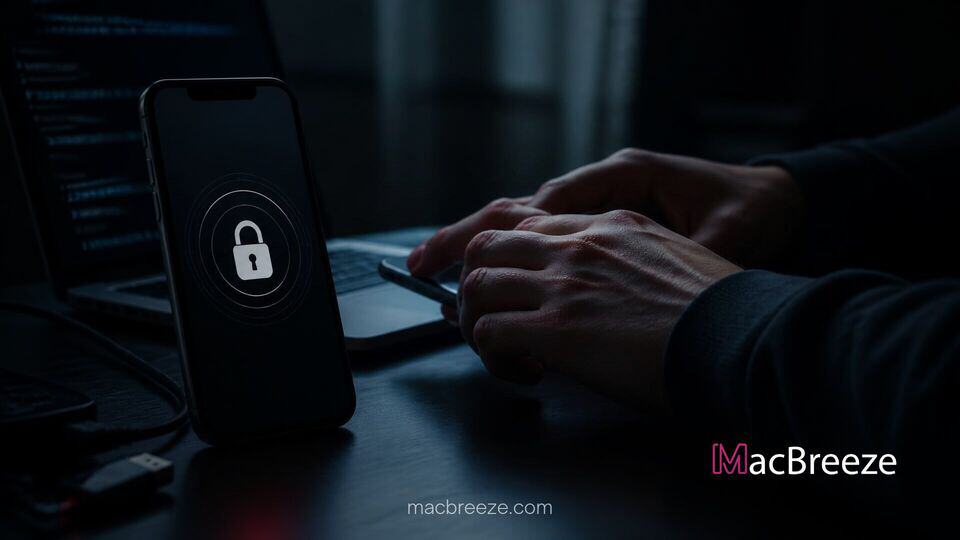
Security research firm Calif has demonstrated the first persistent jailbreak on an iPhone operating under Apple's high-security Lockdown Mode. The demonstration, published via a video proof-of-concept, showed an iPhone 18 Pro being compromised using a weaponized PDF payload transmitted via AirDrop, with root privilege access persisting even after upgrading the operating system to iOS 27.2.
Security Team Demonstrates Exploit Against Lockdown Mode
Apple introduced Lockdown Mode as an extreme, optional protective setting designed to defend high-risk individuals such as journalists, human rights activists, and government officials from sophisticated mercenary spyware. The feature aggressively restricts on-device background processing, blocks most message attachment types, and limits web browser technologies to reduce the attack surface. However, the recent demonstration by Calif confirms that carefully structured exploits can still breach the operating system under specific conditions.
During the demonstration, researchers sent a malicious PDF file over AirDrop to an iPhone 18 Pro that had Lockdown Mode enabled. Upon the user accepting the file transfer prompt, the embedded exploit sequence executed automatically through background document rendering engines. The underlying vulnerabilities allowed the research team to gain elevated system privileges without requiring further user interaction inside the document.
The breakthrough comes amid heightened attention around mobile device integrity. Security analysts routinely track sophisticated threat vectors, including complex exploit kits like flaws exposing system keys, which demonstrate how deeply malicious code can target kernel-level functions once initial access is achieved.
How the Malicious AirDrop PDF Attack Bypasses OS Protections
The attack chain relies on low-level parsing vulnerabilities within the operating system's native handling of PDF graphics rendering. While Lockdown Mode disables PDF previews and attachments in messaging applications like iMessage, local file sharing protocols like AirDrop still permit document receipt if explicitly accepted by the user. This design choice left an avenue open for memory corruption bugs inside document parsers.
What makes the research particularly notable is system persistence. In the demonstration, after the initial compromise was established, the target device downloaded and installed an official operating system update. Once the installation process finished and the device rebooted into the updated version, the jailbreak state remained intact. Maintaining root control across software updates indicates that the exploit achieves persistent modification within protected system partitions or early boot sequences.
Implications for iPhone High-Security Protection Features
For standard users, the immediate security risk remains minimal. The attack requires physical proximity to send an AirDrop transfer, and the receiver must manually hit accept on the incoming prompt. Furthermore, Calif confirmed that technical specifics are being shared privately with Apple rather than being released publicly as a usable jailbreaking tool.
Nevertheless, the proof-of-concept fundamentally alters the security posture expected from Lockdown Mode. Previously, Apple stated it was unaware of any successful real-world mercenary spyware intrusions breaching an active Lockdown Mode session. By proving that a user-accepted file transfer can subvert the hardened sandbox, researchers have exposed critical edge cases in how system services isolate file parsers.
This incident reflects ongoing challenges in mobile operating system security, where rapid hardware developments and software releases require constant defensive hardening. In recent maintenance releases, such as when Apple patched critical security flaws, the company has focused on closing zero-click vectors and unauthorized subsystem access. Similar architectural updates are expected across related platforms, similar to recent updates seen when Apple patched macOS system flaws.
Apple Security Disclosures and Expected Software Fixes
Following established responsible disclosure protocols, Calif stated it will report the underlying security vulnerabilities directly to Apple's security engineering teams. Apple regularly incentivizes researchers through its Bug Bounty program, which awards significant payouts for zero-click and Lockdown Mode bypasses.
Software patches addressing the specific parsing engine vulnerabilities used in the AirDrop proof-of-concept are expected in upcoming system updates. Security experts recommend that users keep their operating systems up to date and remain cautious when accepting incoming AirDrop requests or unrecognized file transfers from unknown sources nearby.
While Lockdown Mode remains one of the most robust defensive features available on commercial mobile hardware, this research demonstrates that zero-day vulnerabilities in common document parsers continue to present complex security challenges even for hardened software environments.