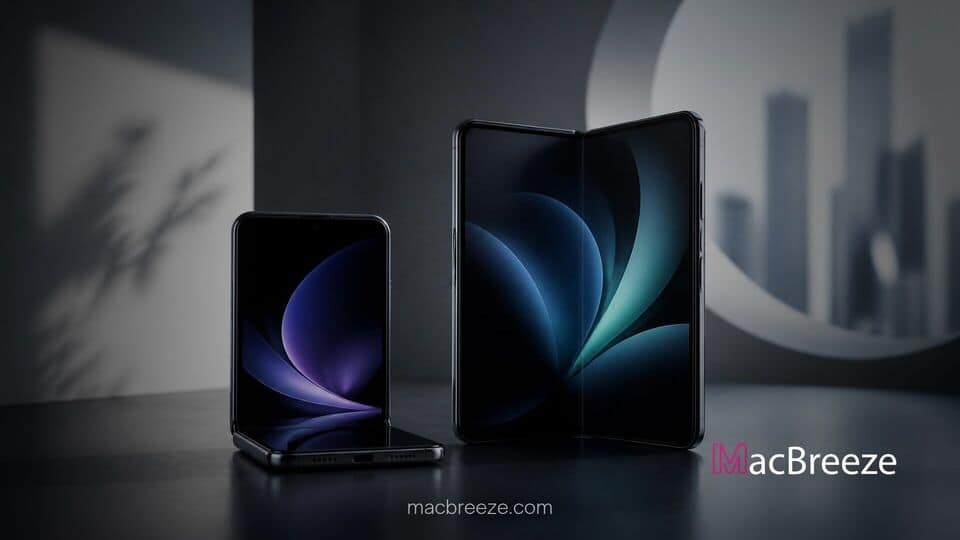
Market research firm TrendForce projects that Apple will capture 29.8 percent of global foldable smartphone shipments by 2027, driven by strong initial demand for its newly launched iPhone Duo. The forecast positions Apple directly behind long-time market leader Samsung as the debut device transforms the competitive dynamics of the flexible display segment.
Following years of development rumors and industry speculation, Apple entered the foldable ecosystem with the official debut of the iPhone Duo. Early retail demand has proven intense, with online shipment dates quickly slipping into early 2027 as consumers flock to the dual-screen form factor. However, this rapid commercial momentum unfolds alongside significant technical hurdles, including developer adaptation challenges and consumer scrutiny surrounding hardware durability.
TrendForce Market Forecast for Foldable Smartphones
According to the latest industry report from TrendForce, the overall foldable smartphone ecosystem is experiencing a major structural shift. Global shipments for flexible displays are expected to grow modestly by 0.5 percent in 2026, reaching approximately 20.2 million units. This sluggish near-term expansion reflects contracting shipments among Android manufacturers, whose combined foldable sales are expected to drop over 20 percent year over year.
However, industry analysts expect the overall trajectory to rebound significantly by 2027, expanding to 23.5 million units for a 16.3 percent annual increase. Analysts attribute this anticipated acceleration directly to Apple's entrance, which is expected to stimulate renewed consumer interest, lower display component costs, and push rival suppliers to innovate more rapidly.
Projected 2027 Market Share for Apple and Competitors
The revised projections from TrendForce indicate a dramatic realignment among top smartphone vendors by 2027:
- Samsung: Forecasted to maintain the lead with 31.9% market share, down from 35.1% in 2026.
- Apple: Projected to take second place with 29.8% market share.
- Huawei: Expected to secure third place with 21.3% market share, down from 24.8% in 2026.
- Other Brands: Remaining vendors including Honor, Motorola, and Xiaomi will compete for the final 17% of total volume.
Initial 2026 Shipment Estimates for iPhone Duo
For its first full year on the market, TrendForce predicts Apple will ship approximately 5 million iPhone Duo units. That volume would instantly earn the company a 24.8 percent market share in 2026. The strong figure comes despite Apple confirming extraordinary iPhone Duo demand as shipping slips to 2027 due to initial supply bottleneck constraints.
Impact of iPhone Duo Demand on Samsung Market Dominance
For nearly a decade, Samsung dominated the foldable smartphone narrative through its Galaxy Z Fold and Galaxy Z Flip series. While the South Korean technology giant continues to hold the highest single vendor volume, Apple's rapid ascent represents the first true challenge to Samsung's supremacy in premium flexible hardware.
Unlike previous Android competitors that primarily impacted regional markets like China, Apple's global retail presence threatens Samsung in critical Western territories. Industry observers note that Apple is capturing a sizeable portion of first-time foldable buyers who previously avoided Android-based alternatives. Furthermore, aggressive enterprise adoption of the dual-screen layout is accelerating cross-platform switching.
Key Hardware and Software Drivers Behind iPhone Duo Growth
TrendForce highlights Apple's tight integration across silicon, operating systems, and developer frameworks as its primary advantage over established Android rivals. The iPhone Duo leverages a proprietary teardrop hinge and multi-layered OLED structure engineered to minimize screen creasing. By managing stress across cover glass, optical adhesives, and encapsulation layers, the display achieves superior visual uniformity when fully opened.
On the software side, Apple has introduced custom dual-screen features across its native operating system. While software flexibility remains an asset, third-party support is still catching up. Users have noted that early iPhone Duo users face pillarboxing in unoptimized apps as developers modify legacy user interfaces for the wider canvas.
To accelerate app optimization, Apple recently issued developer updates. For instance, Apple updated its iWork suite with Creator Studio AI assistant and Duo support to showcase side-by-side productivity workflows. Subsequent system updates are expanding usability even further, as seen when iOS 27.2 brings Apple Pencil support to iPhone Duo displays.
What Lies Ahead for Apple in the Foldable Segment
Despite bright shipment projections, Apple faces immediate operational hurdles regarding hardware reliability. Early adopters have expressed concerns over mechanical durability, particularly following reports where early iPhone Duo owners report display cracks along hinge mechanism points. Additionally, high out-of-warranty replacement costs have heightened consumer caution.
TrendForce emphasizes that Apple's ability to hit its 29.8 percent target in 2027 will depend largely on refining manufacturing tolerances, reducing hinge stress, and persuading top developers to support dual-screen multitasking seamlessly. If hardware yields stabilize and software optimization matures, the iPhone Duo stands poised to solidify Apple as a permanent pillar of the foldable device ecosystem.
In summary, while initial production bottlenecks and hardware growing pains present short-term tests, TrendForce's findings confirm that Apple's arrival has permanently reshaped the foldable market. By commanding nearly 30 percent of global shipments within two years, Apple is poised to transform flexible screens from a niche enthusiast category into a primary driver of smartphone innovation.